
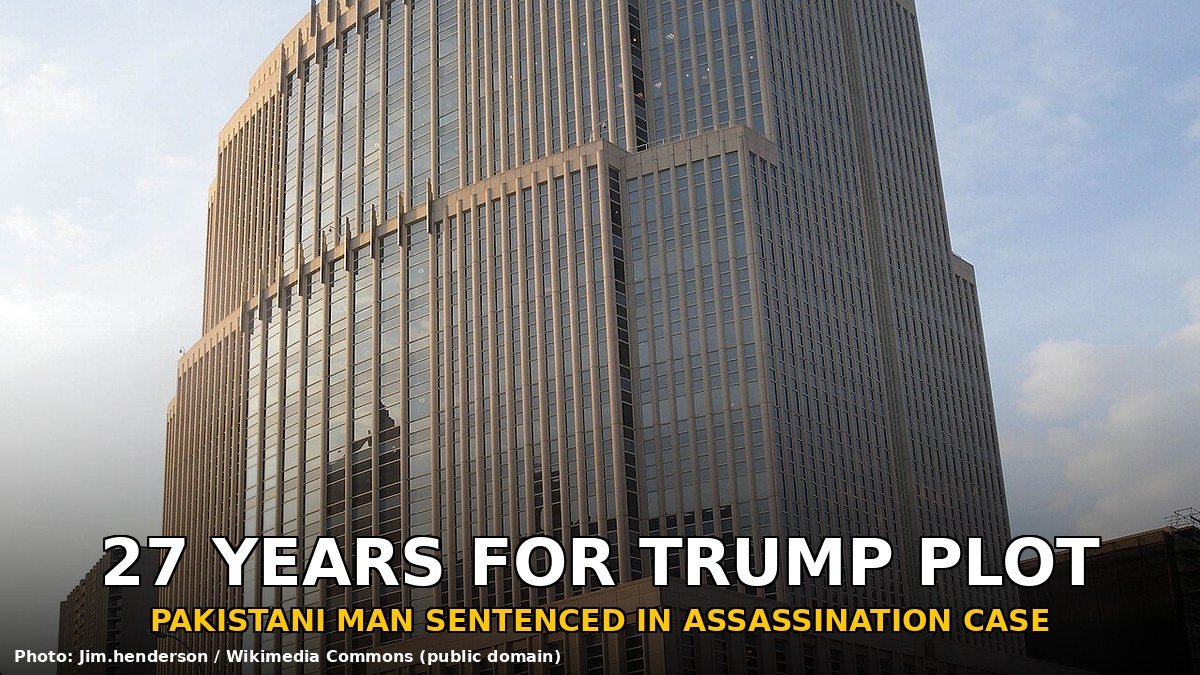

A federal judge in Brooklyn has brought one of the most serious political assassination cases in recent American history to a decisive close. The Asif Merchant sentenced Trump assassination plot case ended on Tuesday, November 18, 2026, when Merchant, a 48-year-old man from Pakistan, was sentenced to 330 months in federal prison — more than 27 years behind bars — for a scheme prosecutors said was organised at Iran’s behest and aimed at killing President Donald Trump and other leading American politicians.
The sentence, handed down by US District Judge Eric R. Komitee, draws a line under a plot that was uncovered in 2024, tried in a Brooklyn courtroom in early 2026, and sentenced against the backdrop of a war between the United States, Israel and Iran that has reshaped the region this year. It also leaves open difficult questions about how far foreign governments will go to settle scores on American soil — and how the American justice system should respond when they do.
Asif Merchant Sentenced Trump Assassination Plot: What the Judge Decided
Judge Komitee sentenced Merchant for attempting to commit an act of terrorism transcending national boundaries and for murder for hire. The 330-month term is a severe punishment, but it is not the punishment prosecutors had asked for. The government had urged the court to impose a life sentence, arguing that the gravity of the plan — the targeted killing of a president and other public figures — demanded the maximum available penalty. The judge rejected that request.
The difference matters. A life sentence would have meant Merchant would almost certainly die in prison. A term of more than 27 years is still, in practical terms, most of the rest of his adult life, but it stops short of the absolute condemnation prosecutors sought. The decision suggests the judge weighed the seriousness of the offence against the particular circumstances of Merchant’s involvement, including his own account of how he came to join the plot and the fact that the plan was stopped before anyone was harmed.
For the Justice Department, the sentence is nevertheless a significant win. A conviction and a decades-long term send a clear message to anyone recruited to carry out political killings in the United States: the consequences will be measured in decades, even when the attack never happens.
The 2024 Plot: How Prosecutors Say It Unfolded
According to prosecutors, Merchant travelled to the United States in 2024 to arrange political assassinations on American soil. The plot, they said, was organised in retaliation for the killing of Iranian commander Qassem Soleimani in a US strike in 2020, during President Trump’s first term in office. Soleimani’s death has remained a central grievance for Tehran ever since, and American officials have long warned that Iran would seek revenge against the officials it held responsible.
Trump was the principal target named in the case, but he was not the only one. Prosecutors said the intended victims also included then-President Joe Biden and Nikki Haley, who had run against Trump for the 2024 Republican presidential nomination. The breadth of that list underscored, in the government’s telling, that the scheme was not about a single grudge but about striking at the leadership of American politics itself.
The plan never came close to being carried out. In April 2024, a person Merchant contacted to help with the plot reported him to law enforcement and became a confidential informant. That decision was decisive. With the informant’s cooperation, investigators were able to monitor Merchant, gather evidence and move in before any attack could take place. Merchant was arrested in 2024 and pleaded not guilty.
A Trial in Brooklyn, Weeks Before War With Iran
A federal jury convicted Merchant in March 2026, after a trial in Brooklyn that began in late February. The timing was extraordinary. The trial opened only days before Trump ordered the US assault on Iran, carried out with Israel, that has since defined the year. Jurors were therefore asked to weigh a case about an alleged Iranian assassination plot at the very moment the United States and Iran were sliding into open conflict.
The prosecution’s case rested on the account of Merchant’s movements, his contacts and the evidence gathered after the informant came forward. The jury accepted that he had travelled to the United States to arrange killings, and that the plot was real and dangerous, even though no weapon was ever fired and no target was ever approached.
That distinction — between a plot that was planned and a plot that was executed — has run through the case from the start. For the defence, the fact that nothing happened was central. For the prosecution, it was beside the point: the crime was the attempt, the travel and the arrangement, and the danger lay in how close the scheme might have come to succeeding had the informant not spoken up.
Merchant’s Testimony: Coercion, Family and the IRGC
Merchant took the stand in his own defence, and his testimony offered a very different version of events from the one prosecutors presented. He said he had joined the plot with Iran’s Islamic Revolutionary Guard Corps unwillingly, and that he had done so to protect his family in Tehran. In his account, he was not a willing assassin but a man caught between a powerful security organisation and the safety of the people closest to him.
He also told the court that he was never ordered to kill a specific person. His Iranian handler, he said, named three people in conversations in Tehran, but no direct order to kill any one of them was given. That claim, if accepted, would soften the picture of Merchant as a committed killer and recast him as a reluctant participant in a scheme he did not fully control.
The jury did not accept that account as a defence to the charges, and the guilty verdict in March made that clear. But the testimony may have played a part in the sentence. A judge deciding between life in prison and a fixed term of years will often look closely at motive, pressure and the defendant’s own role — and Merchant’s account, whatever the jury made of it as a matter of guilt, gave the court a basis for drawing a line short of life.
Asif Merchant Sentenced Trump Assassination Plot: Why the Judge Rejected Life
The refusal of a life sentence is one of the most closely watched aspects of Tuesday’s hearing. Prosecutors had argued that only a life term would reflect the scale of the threat: a foreign-backed plot to murder a president and other senior politicians, organised in revenge for a military strike, and carried out on American soil.
Judge Komitee evidently took a different view. A 330-month sentence is still among the longest terms handed down in a case of this kind, and it reflects the court’s acceptance that the plot was grave, deliberate and deserving of severe punishment. But by declining to impose life, the judge signalled that the case, in his assessment, did not meet the threshold for the ultimate penalty available to him.
Sentencing in federal terrorism and murder-for-hire cases is rarely straightforward. Judges must balance deterrence — the need to discourage others from taking up similar work — against proportionality, the defendant’s background and the actual harm caused. Here, the harm was potential rather than actual: the plot was thwarted, no one was injured, and the intended victims were never in immediate danger. That does not diminish the offence, but it is the kind of factor that can move a sentence from life to a term of years, however long.
Tehran Denies the Plot as Tensions Escalate
Tehran has denied targeting or plotting to attack Trump or other US officials, and that denial has been repeated throughout the case. Iranian officials have consistently rejected American accusations of assassination plotting, portraying them as fabrications designed to justify pressure on Iran.
The denial has done little to ease tensions. The wider context in which Merchant was sentenced is a conflict that has grown far beyond the courtroom in Brooklyn. US-Israeli attacks on Iran since February 28 have killed thousands of people and displaced millions, and many of Iran’s top leaders have been killed, including then-Supreme Leader Ayatollah Ali Khamenei. The war has turned the grievances at the heart of the Merchant case — revenge for Soleimani, confrontation between Washington and Tehran — into a live and ongoing conflict rather than a historical dispute.
That backdrop also helps explain why American officials have treated the case as more than a single criminal prosecution. For the latest reporting on how Iranian threats against US officials are being assessed in Washington, see our earlier story on the Iran dirty bomb plot warning and US intelligence on threats to senior Trump officials. The Merchant case and that intelligence reporting point in the same direction: US officials believe the threat from Iran to American leaders is persistent, and that it has not ended with one conviction or one sentence.
What the Sentence Means — and What Happens Next
For Merchant, the sentence means more than 27 years in a federal prison, with little realistic prospect of release until he is well into his seventies. The Asif Merchant sentenced Trump assassination plot case will be cited by prosecutors in future cases as proof that even a thwarted plot, stopped by an informant before anyone was harmed, can draw a sentence of more than a quarter of a century. For the Justice Department, it is a demonstration that plots hatched abroad and carried out, or attempted, in the United States will be pursued to conviction and punished severely — even when they are stopped early.
For the public, the case is a reminder of how the politics of the Middle East can reach directly into American life. A dispute that began with a US strike in Iraq in 2020, and a death that Tehran has never forgiven, became, four years later, a plan to kill a president on American soil. And a trial that began in Brooklyn in February 2026 ended in a sentencing that took place while the United States and Iran were at war.
The sentence will not end the argument about Iran, or about how the United States should respond to threats against its leaders. But it does close the legal chapter on Asif Merchant. The plot was discovered, the defendant was tried, the jury convicted, and the judge has now spoken. The full background to the sentencing is set out in the Reuters report on Merchant’s sentencing.
What happens next will depend on the war, on diplomacy, and on whether the cycle of retaliation that produced this plot can be broken. On the evidence of 2026 so far, that remains a distant prospect.