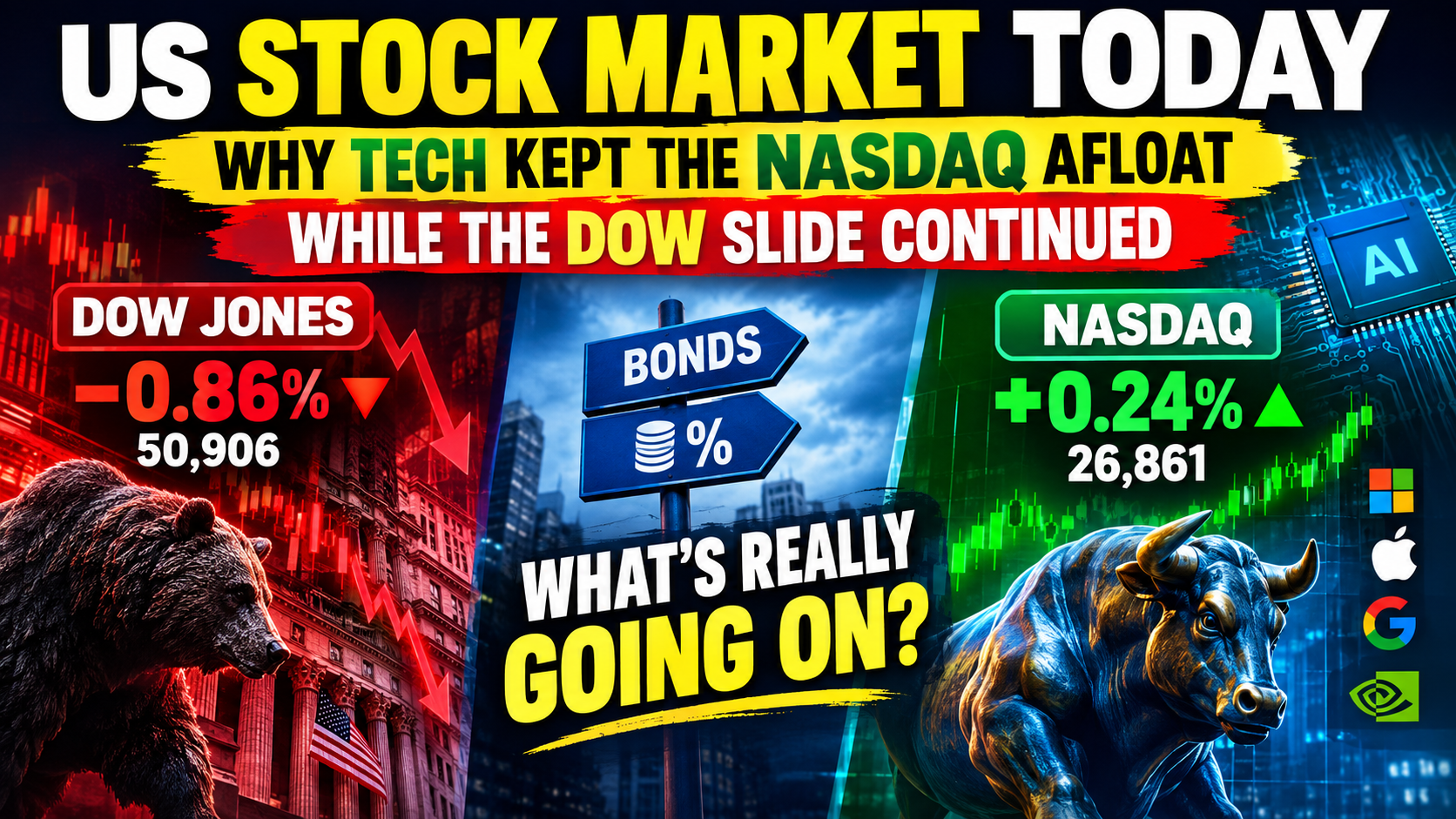
US Stock Market Today: Why Tech Kept the Nasdaq Afloat While the Dow Slide Continued
If you want to understand the US stock market today, just look at the latest closing numbers. We are basically watching two entirely different stock markets operating in the exact same building.
On one side of the trading floor, investors dumping traditional, blue-chip stocks pushed the Dow Jones Industrial Average down 0.86% to 50,906. The broader S&P 500 felt the drag too, dipping a quarter of a percent to settle at 7,651.
Also read:
Super El Niño Explained: Extreme Weather & Global Impacts
But then there is the tech crowd. Completely ignoring the gloomy mood elsewhere, the Nasdaq managed to pull off a 0.24% gain, finishing near 26,861.
So, what is actually going on here? Why are industrial companies taking a beating while semiconductor stocks continue to cruise? When analyzing the US stock market today, it all comes down to the bond market, cash reserves, and Wall Street’s ongoing obsession with artificial intelligence.
The Dow’s Big Problem: Bonds Are Finally Paying Out
The Dow Jones is packed with legacy businesses—think massive manufacturers, banks, and household consumer brands. For years, these companies attracted investors because they paid reliable dividends. But right now, they have a massive headache on their hands: Treasury yields.
Long-term Treasury yields have been creeping up to multi-year highs. If you are an investor looking at the US stock market today, you suddenly have a choice to make. You can risk your money holding a traditional blue-chip company for a 3% dividend, or you can buy a government-backed bond that pays you a higher, completely risk-free return.
Unsurprisingly, a lot of conservative money is leaving the stock market and rushing into bonds. On top of that, these older, heavy-industry companies rely on borrowing money to build factories and expand. With interest rates sitting where they are, taking out loans is painfully expensive. That eats straight into their profit margins, and investors know it.
The S&P 500 is Caught in the Middle
The S&P 500 spent most of the day bouncing between red and green before finally giving up and closing down slightly. It is essentially caught in an awkward tug-of-war between good economic news and bad interest rate reality.
Recently, we found out the US economy actually grew at a solid 2.2% pace in the second quarter. Normally, Wall Street would throw a party over that. But right now, good economic news is actually bad news for stocks. Because people are still spending money and the economy is holding up, the Federal Reserve has absolutely zero pressure to lower interest rates anytime soon.
We also saw the latest inflation numbers (the Core PCE index) come in at 3.0%. That is better than expected, but still a ways off from the Fed’s 2% goal. The takeaway for the average trader? High interest rates are sticking around for a while.
Why Tech and the Nasdaq Just Don’t Care
While the rest of the market stressed over borrowing costs, the tech sector carried the US stock market today by quietly gaining ground.
Big tech companies live in a different reality. Companies like Microsoft, Apple, and Alphabet are sitting on mountains of cash. When you have billions in the bank, you don’t really care if the local bank is charging 7% for a business loan. You fund your own growth.
Furthermore, the artificial intelligence gold rush is still in full swing. Tech giants are buying up massive amounts of server space, advanced microchips, and cloud infrastructure. When a semiconductor company already has its order books filled out for the next two years by desperate tech giants, Wall Street is going to buy that stock, regardless of what the broader economy is doing. That guaranteed tech spending put a hard floor under the Nasdaq today.
What Individual Investors Should Do Right Now
When you see the market splitting in opposite directions like this, it is easy to second-guess your portfolio. If you are investing for the long haul, here is how you should handle this kind of environment:
1. Keep an Eye on the Cash Cash is king right now. Businesses sitting on thick cash reserves and very little debt are going to weather these high interest rates effortlessly. On the flip side, if a company relies on constant borrowing to keep the lights on, they are going to have a rough time. Look for companies that actually turn a real profit.
2. Don’t Ignore the Bond Market For the first time in a decade, fixed-income investments like bonds and CDs are actually offering real competition to the stock market. Paying attention to bond yields tells you exactly where the big institutional money is flowing.
3. Spread It Around If your retirement account was packed with nothing but blue-chip industrial stocks today, you felt the pain. If you were heavy on tech, you had a decent afternoon. Diversification sounds boring, but days like today prove exactly why you need money spread across different sectors.
Frequently Asked Questions (FAQs)
Why did the Dow fall while the Nasdaq went up in the US stock market today? It is all about the types of companies in those indexes. The Dow is heavy on older, traditional businesses that rely on borrowing money and paying dividends—both of which get hurt when interest rates are high. The Nasdaq is full of cash-rich tech companies that are currently riding the massive wave of artificial intelligence spending, making them virtually immune to today’s interest rate fears.
What is the Core PCE, and why do traders care? Core PCE stands for Personal Consumption Expenditures. It is basically a specialized inflation tracker that strips out the crazy price swings of food and gas. The Federal Reserve looks at this specific number to decide if they should raise or lower interest rates. Since the number is still sitting around 3.0%, traders are assuming interest rates aren’t dropping anytime soon.
Is it normal for the market to be this rough in late September? Actually, yes. If you look back at decades of market history, September is notoriously the worst month of the year for stocks. Big investment funds usually use this time to clean up their portfolios before the fourth quarter begins, which creates a lot of choppy trading and random sell-offs.
Should I sell my stocks and buy bonds? That depends entirely on your age and goals, but you don’t necessarily have to choose just one. Because government bonds are finally paying decent returns, a lot of people are using them to generate safe, predictable income while keeping the rest of their money in the stock market to grow over time.
The Bottom Line
At the end of the day, we’re looking at a market pulling in two very different directions. The drops in the Dow and the S&P 500 show us that regular companies are seriously feeling the weight of high interest rates. Meanwhile, the Nasdaq’s resilience proves that the tech industry is strong enough to carry its own weight. As we head into the final months of the year, expect the market to keep reacting aggressively to every new piece of inflation data that hits the wire.
Trusted Sources & Reference Links
Kiplinger — Stock Market Today: S&P 500 and Nasdaq Market Updates
XTB Market Research — Economic Data Revisions & Inflation Analysis