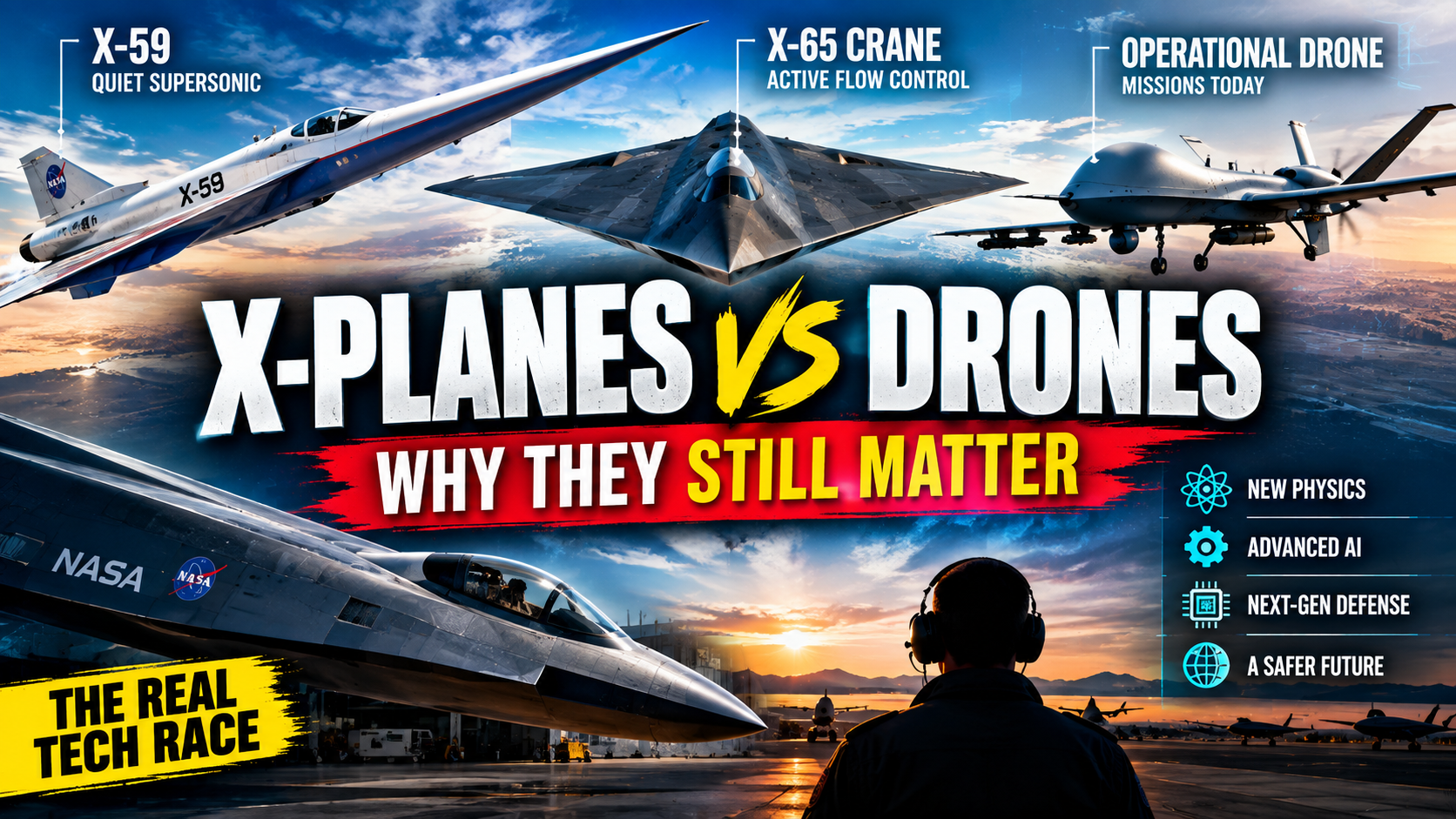
X Planes in the Era of Drones: Why Experimental Aircraft Still Matter
The global aerospace landscape is undergoing its most radical transformation since the dawn of the jet age. Uncrewed aerial vehicles (UAVs), Collaborative Combat Aircraft (CCAs), and autonomous drone swarms dominate military spending and defense headlines. In an era where cheap, mass-produced, and expendable drones perform reconnaissance, strike, and electronic warfare missions, a fundamental question arises: Are dedicated experimental “X-planes” still necessary?
The short answer is yes—more than ever. While operational drones represent the tactical present, X-planes embody the technological future. Far from being rendered obsolete by the drone revolution, X-planes have evolved alongside it, transforming from dangerous manned testbeds into high-tech, often uncrewed laboratory platforms that test physics-defying concepts before they reach frontline drone fleets.
Also Read:
Xi Caps Trump State Visit with Symbolic Stop at National Archives
1. The Shifting Role of the X-Plane: From Chuck Yeager to Autonomous AI
Historically, the American X-plane program—managed by entities like NASA, DARPA, and the U.S. Air Force—was defined by human pilots taking extreme physical risks. Iconic aircraft like the Bell X-1, which broke the sound barrier in 1947, and the rocket-powered X-15, which reached Mach 6.7, pushed the boundaries of speed, altitude, and structural limits.
Today, the core definition of an X-plane has fundamentally changed:
Pure Research vs. Production: Unlike prototype aircraft designed to compete for manufacturing contracts (such as YF-22 vs. YF-23), X-planes are strictly experimental tools built to answer specific scientific or aerodynamic questions.
Risk Tolerance: By transitioning many experimental platforms to uncrewed architectures, engineers can push flight envelopes to destruction without risking a test pilot’s life.
Digital and Physical Convergence: Modern X-planes validate high-fidelity computer simulations, computational fluid dynamics (CFD), and artificial intelligence models in real-world atmospheric turbulence.
Rather than being replaced by drones, modern X-planes are frequently built as drones—serving as the proving ground for the very technologies that make modern uncrewed systems effective.
2. Operational Drones vs. X-Planes: Understanding the Difference
It is easy to confuse high-end military drones with experimental X-planes, as both are often uncrewed and feature exotic stealth geometries. However, their mission profiles, design life cycles, and engineering objectives are vastly different.
| Feature / Metric | Operational Military Drones (e.g., MQ-9, CCA) | Experimental X-Planes (e.g., X-59, X-65) |
| Primary Objective | Tactical mission execution (ISR, strike, escort) | Scientific discovery and flight-data validation |
| Production Scale | Mass-produced in dozens, hundreds, or thousands | Custom-built single aircraft or small test fleets |
| Technology Focus | Mature, proven sensors, weapons, and software | Radical, unproven airframe designs and physics |
| Payload Capacity | Optimized for weapons, radar, and cameras | Packed with flight telemetry and diagnostic sensors |
| Lifespan | Multi-year operational deployment | Temporary lifecycle; retired after flight test goals met |
3. Cutting-Edge X-Planes Redefining Aviation Science
To understand why traditional drone development cannot replace X-plane research, one must look at the groundbreaking technologies currently being flight-tested by NASA and DARPA.
                      [ Fundamental Aerospace Research ]
                                      |
         +----------------------------+----------------------------+
         |                                                         |
         v                                                         v
[ Revolutionary Physics & Control ]                   [ Uncrewed Testbed Validation ]
* Active Flow Control (X-65 CRANE)                   * Hybrid Electric Drones (XRQ-73)
* Quiet Supersonic Flight (X-59)                     * Infrastructure-less VTOL (ANCILLARY)
         |                                                         |
         +----------------------------+----------------------------+
                                      |
                                      v
            [ Scaled Integration into Next-Gen Operational Fleets ]
DARPA X-65 CRANE: Active Flow Control
The Aurora Flight Sciences / DARPA X-65 is testing a century-old aviation holy grail: maneuvering an aircraft without traditional moving control surfaces (like flaps, rudders, or ailerons). Instead, the X-65 uses jets of compressed air—Active Flow Control (AFC)—to alter airflow over its unique joined wings. If successful, AFC will eliminate heavy mechanical actuators, reduce radar cross-sections for ultimate stealth, and significantly cut maintenance costs for future operational drones and jets.
NASA X-59 QueSST: Silent Supersonic Flight
NASA’s X-59 QueSST is engineered to reshape the physics of sonic booms. By utilizing a radically elongated airframe and precise shaping, the X-59 turns the window-shattering sonic boom into a gentle “thump” on the ground. This research is vital for lifting the federal ban on commercial overland supersonic flight—a milestone no standard drone program could achieve.
DARPA XRQ-73 & ANCILLARY: Next-Gen Autonomous Concept Vehicles
DARPA’s XRQ-73 hybrid-electric ISR drone and the ANCILLARY program demonstrate how X-plane designations are directly applied to uncrewed platforms. These vehicles test extreme endurance, hybrid-electric powertrains, and shipboard infrastructure-less vertical takeoff and landing (VTOL) capabilities designed to multiply small-ship operational power.
4. Why Simulation and Drones Cannot Do It Alone
A common misconception is that advanced supercomputers and digital twins eliminate the need for physical X-planes. While Computational Fluid Dynamics (CFD) has accelerated aerospace design, the “wind tunnel in the sky” remains irreplaceable.
Boundary-Layer Turbulence: Real-world atmospheric conditions, thermal gradients, and boundary-layer airflow transitions cannot be 100% accurately modeled in software.
Failing Fast and Safely: Building a modular X-plane allows research teams to deliberately push a radical design past its aerodynamic breaking point to locate true structural limits.
Regulatory Proof Points: Civil aviation authorities (such as the FAA) require real-world flight test telemetry before approving novel propulsion systems or supersonic overflight rules.
5. The Verdict: The Future Belongs to X-Plane Research
In the new era of autonomous combat and commercial drone fleets, X-planes are not competing with drones—they are powering their evolution. As operational drones become commoditized assets focused on low unit cost and volume production, X-planes remain the essential high-risk risk-reduction engines of aerospace engineering.
By testing active flow control, quiet supersonic shockwaves, hybrid-electric power systems, and extreme autonomous flight controls, modern X-planes ensure that both crewed and uncrewed aviation will continue pushing the boundaries of flight for decades to come.
Frequently Asked Questions (FAQs)
What is the primary difference between an X-plane and an operational military drone?
An X-plane is an experimental aircraft built specifically for research and testing unproven technologies, whereas an operational military drone is built for tactical missions like intelligence, surveillance, reconnaissance, or combat strike roles.
Are modern X-planes manned or unmanned?
While historical X-planes were piloted by human test pilots, many modern X-planes (such as the DARPA X-65 CRANE and XRQ-73) are completely uncrewed to minimize safety risks while pushing experimental boundaries.
Why can’t engineers test new technologies on standard drones instead of building X-planes?
Standard drones use mature, proven airframes optimized for mission capability, not radical aerodynamic testing. Modifying production drones can be costly, limited by existing structural layouts, and unsafe for testing extreme, unproven physics.
What is DARPA’s X-65 CRANE program testing?
The DARPA X-65 CRANE program is testing Active Flow Control (AFC)—using compressed air jets rather than traditional moving mechanical surfaces (flaps, rudders) to steer and maneuver the aircraft.
Disclaimer
This article is an educational and analytical review based on public aerospace research data, official NASA press releases, and DARPA public briefings. It is intended for news and educational purposes only and does not reflect official military strategy or proprietary defense contractor positioning.