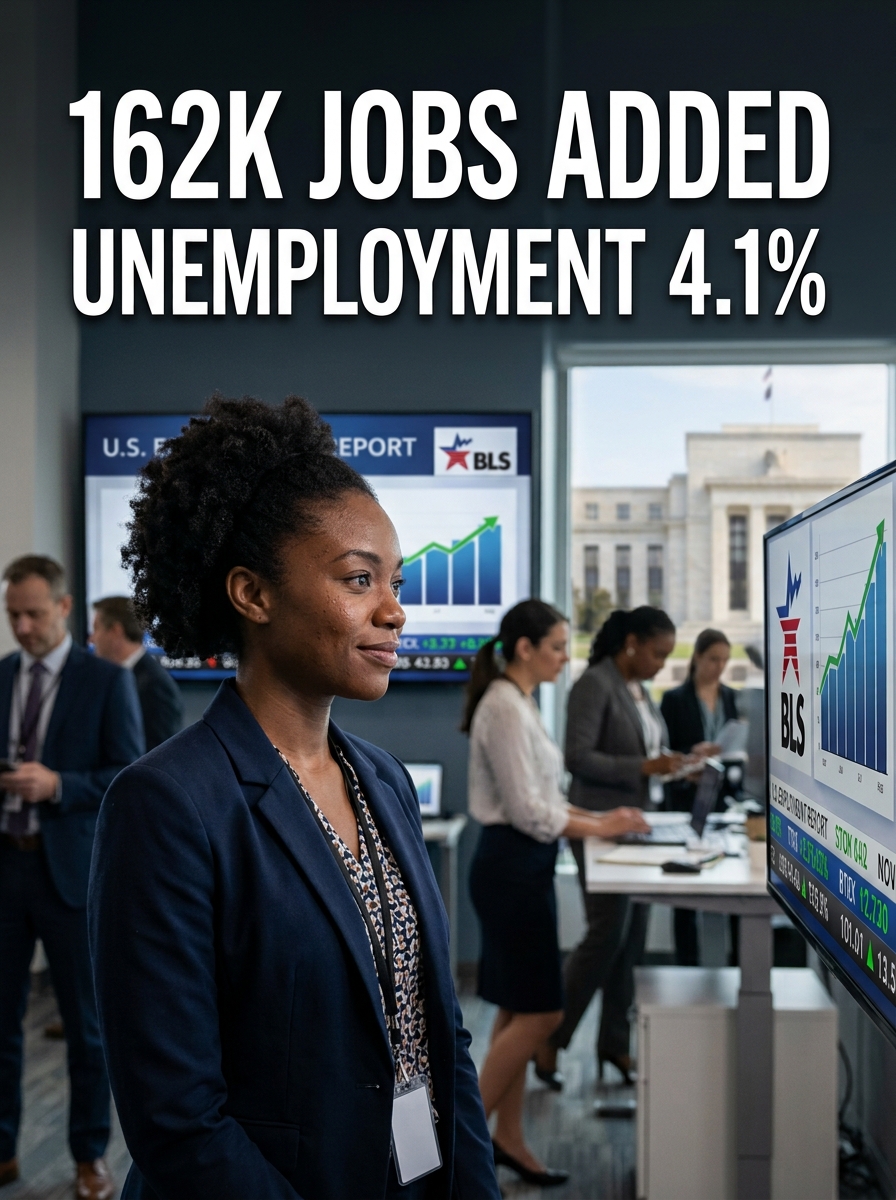
August Jobs Report 2026: U.S. Adds 162,000 Jobs as Unemployment Holds at 4.1%
Introduction: A Surprising Display of Economic Resilience
The U.S. labor market continues to defy pessimistic forecasts, demonstrating remarkable staying power amid shifting macroeconomic currents. According to the latest data released by the U.S. Bureau of Labor Statistics (BLS), the economy added 162,000 jobs in August, comfortably surpassing consensus economist expectations. When paired with meaningful upward revisions to the June and July employment figures, this latest update paints a picture of a steadier, more resilient employment baseline than many analysts had previously estimated.
For policymakers at the Federal Reserve, business leaders, investors, and everyday workers, the August data offers critical insights into the current health of the American economy. While concerns regarding inflation, interest rates, and global economic friction persist, the labor market remains an anchor of stability. This article provides a comprehensive deep dive into the August jobs report, breaking down sector-specific gains, unemployment metrics, job openings, wage growth trajectories, and what these trends mean for the broader economic outlook.
Also read:
Washington Weighs High-Stakes Decisions as Iran Conveys Terms to Revive Stalled Talks
The August Jobs Report: Headline Numbers at a Glance
At first glance, a gain of 162,000 jobs signifies a healthy, moderating pace of expansion rather than a overheated or contracting market. To understand the full context, it is essential to examine the primary metrics released by the BLS:
- Nonfarm Payroll Employment: Increased by 162,000 jobs in August.
- Unemployment Rate: Held steady at 4.1%, maintaining a historically low baseline.
- Upward Revisions: Combined revisions for June and July added tens of thousands of previously uncounted jobs to the ledger, smoothing out earlier volatility.
- Wage Growth: Average hourly earnings rose by 3.1% year-over-year, indicating a continued, healthy moderation in inflationary wage pressures.
- Job Openings: Nationwide openings ticked upward to 7.3 million, signaling sustained employer demand.
These figures suggest that the U.S. economy has successfully navigated away from the extreme labor shortages and hyper-inflationary wage spirals of previous years, settling instead into a sustainable equilibrium.
Sector-Specific Performance: Where Are the Jobs?
Job growth during August was not evenly distributed across all industries, reflecting ongoing structural shifts in consumer behavior and corporate spending. The primary drivers of employment gains included:
1. Leisure and Hospitality
Continuing its multi-year post-pandemic recovery and adjustment phase, the leisure and hospitality sector led job creation in August. Hotels, restaurants, arts, and entertainment venues reported steady hiring to meet resilient consumer demand for travel, dining out, and experiential spending.
2. Government Employment
Federal, state, and local government entities continued to add payrolls, reflecting ongoing investments in public infrastructure, education, and municipal services. While private sector growth often captures the lion’s share of headlines, steady public sector hiring provides an essential economic floor.
3. Health and Social Assistance
Demographic trends—specifically an aging population—continue to drive relentless demand within health and social assistance. Hospitals, ambulatory healthcare services, outpatient care centers, and social service organizations reported robust hiring numbers, a trend that economists expect to persist for decades.
4. Professional and Business Services
Though corporate hiring has become more selective in recent quarters, professional and business services—including legal, accounting, scientific research, and technical consulting—showed healthy resilience, supported by nationwide job openings and skilled labor demand.
Unemployment Rate Stability and the Labor Force
The national unemployment rate holding steady at 4.1% is perhaps one of the most reassuring takeaways from the August report. For months, economists have debated whether cooling economic growth would trigger a sharp spike in layoffs. Thus far, that scenario has failed to materialize.
A 4.1% unemployment rate remains very close to what economists consider full employment. Crucially, this stability has been achieved without triggering runaway wage inflation. Labor force participation rates have also remained relatively stable, indicating that workers who want jobs are continuing to find them, and individuals who stepped out of the workforce during prior economic transitions are finding viable reentry pathways.
Job Openings and Wage Growth: Finding the Balance
Total nationwide job openings ticked up to 7.3 million in August. While this figure is lower than the historic peaks of over 12 million recorded during the post-pandemic labor crunch, it remains elevated compared to historical pre-pandemic standards. The gap between available workers and open positions has narrowed significantly, reducing the frantic bidding wars for talent that characterized 2021 and 2022.
Meanwhile, average hourly earnings rose by 3.1% year-over-year. This moderation in wage growth is a welcome development for the Federal Reserve. Rapid wage growth, while beneficial for workers in the short term, can fuel persistent service-sector inflation if it outpaces productivity gains. A 3.1% annual wage increase generally outpaces current baseline inflation metrics, meaning workers are seeing modest real wage gains while the overall macroeconomic environment stabilizes.
Implications for Monetary Policy and the Federal Reserve
With the August jobs report reflecting a stable unemployment rate, moderate wage growth, and solid job creation, the Federal Reserve faces a nuanced policy landscape.
For months, financial markets have scrutinized every employment release to gauge the timing and magnitude of potential interest rate adjustments. A labor market that is “too hot” might force the Fed to keep rates elevated to suppress inflation. Conversely, a rapidly cooling labor market might prompt aggressive rate cuts to stave off a recession.
The August report strikes a delicate balance: it is neither too hot to trigger fears of runaway inflation nor too cold to signal an imminent recession. This “Goldilocks” scenario provides the central bank with the flexibility to calibrate monetary policy gradually, supporting sustained economic expansion without destabilizing price stability.
Frequently Asked Questions (FAQs)
1. What was the total number of jobs added in the August report?
The U.S. economy added 162,000 nonfarm payroll jobs in August, exceeding consensus economist expectations and benefiting from upward revisions to June and July data.
2. What is the current national unemployment rate?
The national unemployment rate held steady at 4.1% in August, maintaining a historically stable and low baseline near full employment.
3. Which sectors drove the majority of job gains in August?
Job gains were led primarily by the leisure and hospitality sector, government employment, and health and social assistance.
4. How much did wages grow year-over-year?
Average hourly earnings rose by 3.1% year-over-year, pointing to a healthy, continued moderation in wage growth that helps ease inflationary pressures.
5. What do the latest job openings numbers indicate?
Total nationwide job openings ticked up to 7.3 million, showing that employer demand remains healthy, particularly in healthcare, social assistance, and professional business services.
Conclusion
The August jobs report delivers an encouraging message about the underlying strength and adaptability of the U.S. economy. By adding 162,000 jobs, maintaining a 4.1% unemployment rate, and seeing wage growth moderate to a sustainable 3.1%, the labor market has demonstrated that steady, measured expansion is entirely possible in the current economic climate. While challenges remain on the horizon—including global trade dynamics, geopolitical uncertainties, and shifting monetary policies—American workers and businesses continue to showcase remarkable resilience.
Official Resources and Trust Links
For further reading and official data verification, consult the following primary sources: