
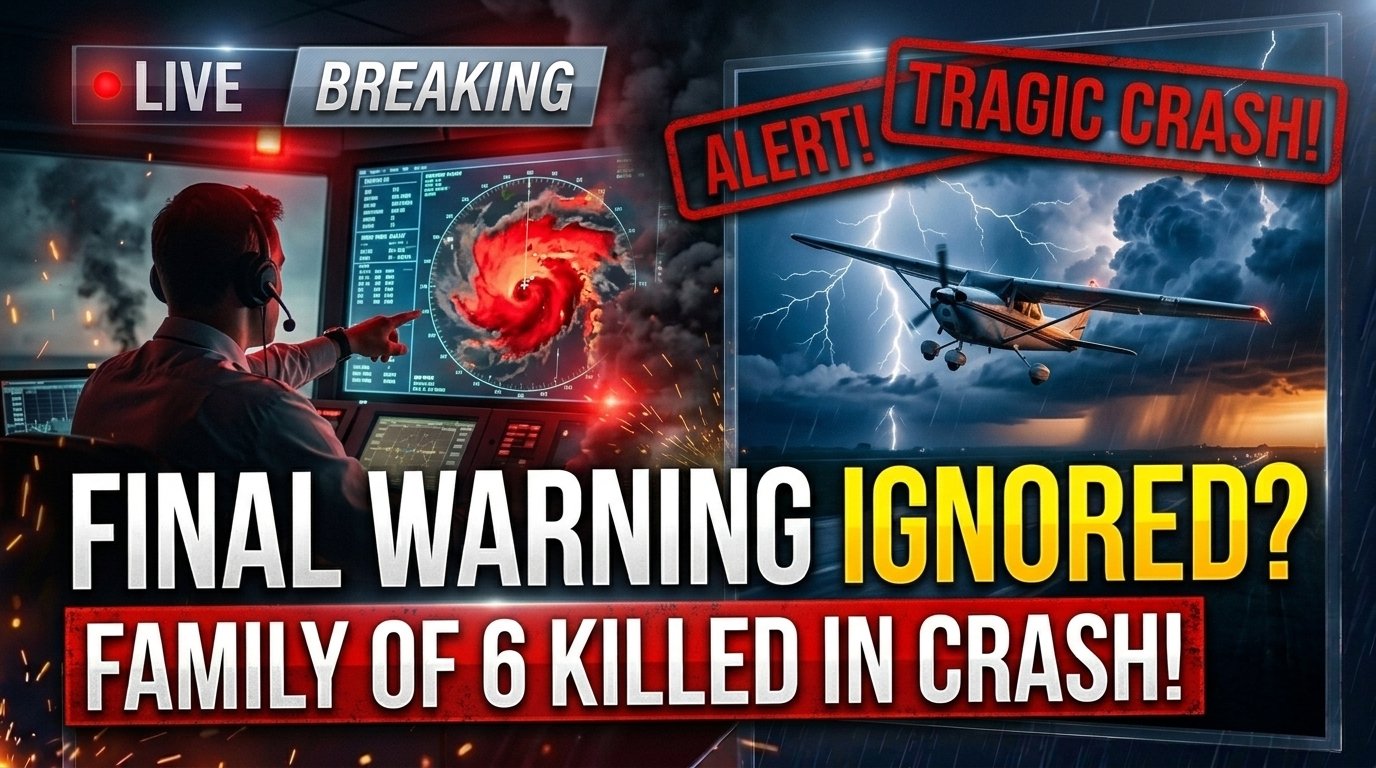
Air Traffic Controller Warned Pilot Dad of Bad Weather Before Plane Crash Killed Family of Six
Newly released air traffic control (ATC) communications have revealed the chilling final exchanges before a small private aircraft went down in severe storm conditions, claiming the lives of an entire family. According to federal aviation records and audio logs, an air traffic controller warned pilot dad of bad weather before plane crash killed family of six, alerting the cockpit to rapidly deteriorating visibility and heavy convective activity along the flight path minutes before radar contact was lost.
The tragedy has sent shockwaves through both the general aviation community and the family’s hometown, prompting federal investigators to examine why the flight continued into hazardous weather conditions despite explicit warnings from ground control.
Also Read:
Ukraine Says Russia Hits Two Grain Ships Near Odesa Ports in Black Sea Strike
Chilling Final Audio Between Cockpit and Air Traffic Control
Audio recordings archived from regional air traffic control frequencies capture the tense sequence of events as the single-engine aircraft cruised toward its destination. As storm cells built rapidly across the region, the controller on duty contacted the pilot to relay updated meteorological radar readings showing severe precipitation, low cloud ceilings, and turbulent wind shear directly ahead.
During the transmission, the air traffic controller advised the pilot of an area of heavy-to-extreme precipitation blocking the route and offered vectoring assistance to divert around the storm front or land at a nearby alternate airport. The pilot acknowledged the weather advisory and indicated an intention to deviate slightly to find a clear corridor, a routine maneuver in general aviation that can quickly turn perilous when storm cells merge faster than onboard instruments or visual cues indicate.
Less than ten minutes after that final weather warning, the aircraft experienced a rapid loss of altitude and vanished from air traffic control radar screens. Repeated attempts by the controller to re-establish radio contact with the aircraft went unanswered.
A Family Tragedy That Devastated a Community
Aboard the aircraft were the father—an experienced private pilot—his spouse, and their four young children, who were returning home from a family trip. Search and rescue teams, supported by local law enforcement, state emergency management agencies, and Civil Air Patrol volunteers, launched an immediate overnight ground and aerial search across rugged, wooded terrain near the aircraft’s last known radar coordinates.
First responders located the wreckage in a densely forested area early the following morning, confirming that there were no survivors among the six family members on board.
Friends, neighbors, and community leaders remembered the parents as devoted community volunteers and described the four children as vibrant, close-knit siblings active in local youth sports and school programs. Vigils and memorial funds were quickly organized to support surviving extended relatives coping with the sudden, unimaginable loss.
Federal Aviation Investigation Underway
Investigators from the National Transportation Safety Board (NTSB) and the Federal Aviation Administration (FAA) arrived at the crash site to document the debris field, recover avionics components, and analyze engine and flight-control integrity.
Under standard NTSB investigation protocols, federal authorities are examining three primary factors:
Meteorological Conditions: Reviewing high-resolution weather radar, satellite imagery, and pilot weather briefings obtained prior to takeoff to determine whether severe icing, downdrafts, or embedded thunderstorms overwhelmed the aircraft.
Pilot Qualifications and Flight Plan: Verifying whether the pilot held an instrument rating (IFR) and whether the aircraft was certified and equipped to fly safely inside clouds and zero-visibility conditions, or if the flight was operating under Visual Flight Rules (VFR).
Mechanical Performance: Transporting the recovered wreckage to a secure facility to inspect the engine, propeller, and flight instruments for any pre-impact mechanical anomalies.
A preliminary NTSB factual report is typically released within several weeks of an accident, while a comprehensive final report determining the probable cause generally takes 12 to 24 months to complete.
The Dangers of “Get-There-Itis” and Adverse Weather in General Aviation
Aviation safety experts note that adverse weather remains one of the leading causes of fatal accidents in non-commercial general aviation. Unlike commercial airliners—which feature dual-pilot crews, high-altitude pressurization, anti-icing boots, and sophisticated onboard weather radar—light single-engine piston aircraft are far more vulnerable to sudden downdrafts, structural icing, and spatial disorientation.
Safety instructors frequently highlight several critical hazards when private pilots encounter deteriorating weather:
Spatial Disorientation: Entering clouds or heavy rain without clear visual horizon references can cause a pilot’s inner ear to send false balance signals, leading to an unrecognized bank or spiral dive within seconds.
Outdated Cockpit Weather: In-flight satellite weather displays (such as ADS-B or SiriusXM) often carry a latency delay of several minutes, meaning a storm cell may be significantly closer and stronger than it appears on the cockpit screen.
Pressures to Reach Home: Known in aviation safety circles as “get-there-itis,” the strong desire to bring family members home on schedule can subtly influence decision-making when diverting or delaying a flight would be the safer option.
Aviation educators emphasize that listening closely to real-time air traffic control weather advisories—and making early decisions to divert to an alternate airfield before entering instrument meteorological conditions—remains the single most effective safeguard for pilots flying with loved ones aboard.
Frequently Asked Questions (FAQs)
What did the air traffic controller tell the pilot before the crash?
According to released ATC audio, the air traffic controller warned the pilot of severe weather, heavy precipitation, and storm cells along the aircraft’s planned route and offered vectoring assistance to navigate around the hazardous weather.
How many people were killed in the plane crash?
All six people aboard the private aircraft—a father who was piloting the plane, his wife, and their four children—were killed in the crash.
Which agency is investigating the fatal plane crash?
The National Transportation Safety Board (NTSB), alongside the Federal Aviation Administration (FAA), is leading the official investigation into the weather conditions, pilot communications, and aircraft wreckage to determine the probable cause.
Why is bad weather so dangerous for small private planes?
Small single-engine aircraft lack the altitude capability, de-icing systems, and structural resilience of commercial airliners. Severe turbulence, downdrafts, and loss of visibility can rapidly lead to spatial disorientation and loss of aircraft control.
How long does an NTSB plane crash investigation take?
The NTSB typically publishes a preliminary factual report within two to four weeks of an aviation accident, while the final report establishing the official probable cause usually takes between 12 and 24 months.
Disclaimer: This article is provided for informational and news reporting purposes based on publicly released air traffic control communications and aviation safety principles. Official determinations regarding the probable cause of aviation accidents rest solely with the National Transportation Safety Board (NTSB) upon completion of its formal investigation.