
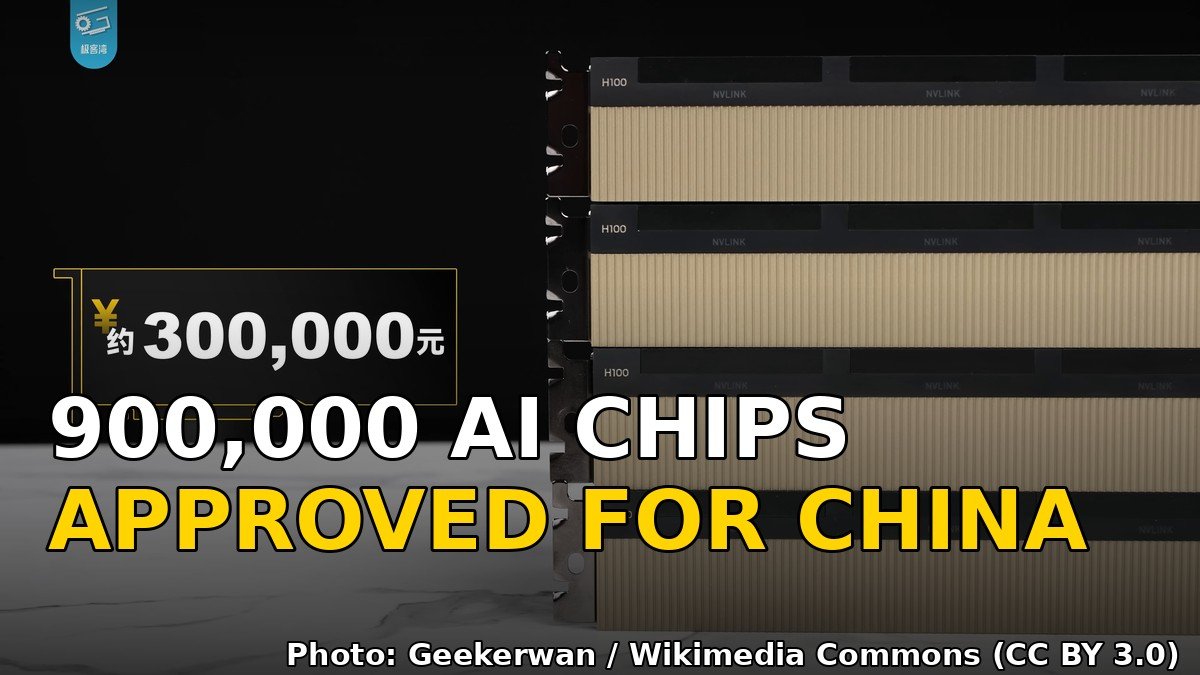
The US approved AI chips for China in far larger numbers than previously known — nearly 900,000 advanced Nvidia and AMD processors cleared for export between December 2025 and May 2026, according to licensing records released by the House Foreign Affairs Committee. The figures, published on 19 November, show that almost a third of the approved chips were destined for Chinese technology giants that the Pentagon lists as military-linked companies — and that none of the chips had actually shipped by 11 May.
What the US approved AI chips for China data actually shows
The Commerce Department approved 21 licence applications covering Nvidia’s H200 and AMD’s MI325X chips, the committee’s records show. In total, 879,868 processors were cleared for Chinese buyers over the six-month period. Companies had asked for far more — permission to export over 3.4 million chips — so Washington did not simply wave everything through. But the scale of what was approved is striking, and it is now public in unusual detail. Committee chairman Brian Mast, a Republican from Florida, described the disclosure as the most detailed public release of its kind under the Export Control Reform Act. One distinction matters throughout this story: an export licence is not a shipment. The records show approvals, not deliveries, and they do not establish how many of the approved processors ultimately reached China.
Nearly a third was earmarked for Pentagon-listed companies
About 272,000 of the approved chips — roughly 31 per cent of the total — were earmarked for Tencent and its subsidiaries, Alibaba, Baidu and BYD. All four appear on the Pentagon’s 2026 registry of Chinese military-linked companies operating in the United States. That is what makes the approvals so sensitive. These are not obscure buyers. They are among China’s largest technology companies, and Washington’s own defence establishment has formally flagged them as military-linked. The question the data raises is a direct one: how did end users with that designation clear a national security review in such numbers?
The December 2025 reversal that opened the door
The approvals followed President Donald Trump’s decision in December 2025 to reverse Biden-era restrictions, allowing Nvidia to pursue H200 sales to China under tighter licensing conditions. The Commerce Department says its approach requires additional national security checks before applications receive case-by-case consideration. Nvidia said the approvals came with strict conditions and limited volumes, and confirmed it has stopped shipping H200 chips to China. AMD said it complies with the applicable US export control requirements and maintains procedures to enforce those rules. The policy, in other words, was not an open door — but it was a door that thousands of the world’s most powerful AI chips walked through on paper.
“Astonishing” — former officials question the review
Former US official Chris McGuire did not hide his disbelief. “The fact that over 30% of the AI chips sent to China were shipped to companies that the Department of War has designated as Chinese military companies is astonishing, and calls into question whether Commerce conducted any serious national security review before approving these licenses,” he told Reuters. His wording says “sent”, but the records themselves show approvals rather than confirmed shipments — a gap that cuts both ways. Either the chips went nowhere, in which case the licensing system approved vast quantities of sensitive hardware for no commercial purpose, or some did ship, in which case the end-use question is even sharper. Neither answer is comfortable for the Commerce Department.
Washington tightens the rules even as the scale emerges
The disclosure arrives as the Commerce Department introduces further restrictions aimed at the alternative routes Chinese companies have used to access advanced processors. New rules require US export licences for certain advanced chips manufactured overseas for Chinese companies, including production arrangements involving foreign semiconductor manufacturers. They also address Chinese companies’ access to advanced AI processors installed in overseas data centres. The licensing records show how much demand already extended beyond China: Nvidia sought permission to send about 1.12 million chips to sites in Malaysia, Indonesia and Thailand across five applications — all of which Commerce returned without action. For data centre operators and chip suppliers, the message is that a licensing decision can now depend on where a remote customer’s ultimate parent company is headquartered, and how much computing power that customer can access across linked data centres.
Why this matters for the AI race
For US technology companies, the situation creates competing pressures. China remains an important market for semiconductor businesses, but continued access to American AI processors could strengthen Chinese companies developing competing AI systems. There is also an enforcement challenge: approving restricted hardware under licensing conditions requires Washington to verify recipients, monitor end use and prevent unauthorised transfers, and weaknesses in those safeguards could undermine the whole purpose of export controls. The disclosure lands in a year already full of Nvidia chip-smuggling scandals — the US blacklisted Megaspeed in a Nvidia chip-smuggling scandal only weeks ago. For enterprise AI buyers, the dispute reinforces the uncertainty around access to advanced computing hardware, with export rules, supplier restrictions and geopolitical tension all capable of disrupting supply. What to watch next is simple: whether any of the approved chips actually ship, what further disclosures the committee releases, and whether Commerce can show its end-use checks work in practice.
The central question is no longer simply whether Washington permits advanced AI chips into China. It is whether the government can ensure those approvals do not undermine the national security objectives behind its own restrictions. On the evidence of these 900,000 chips, that question is still open.
Source: eWeek