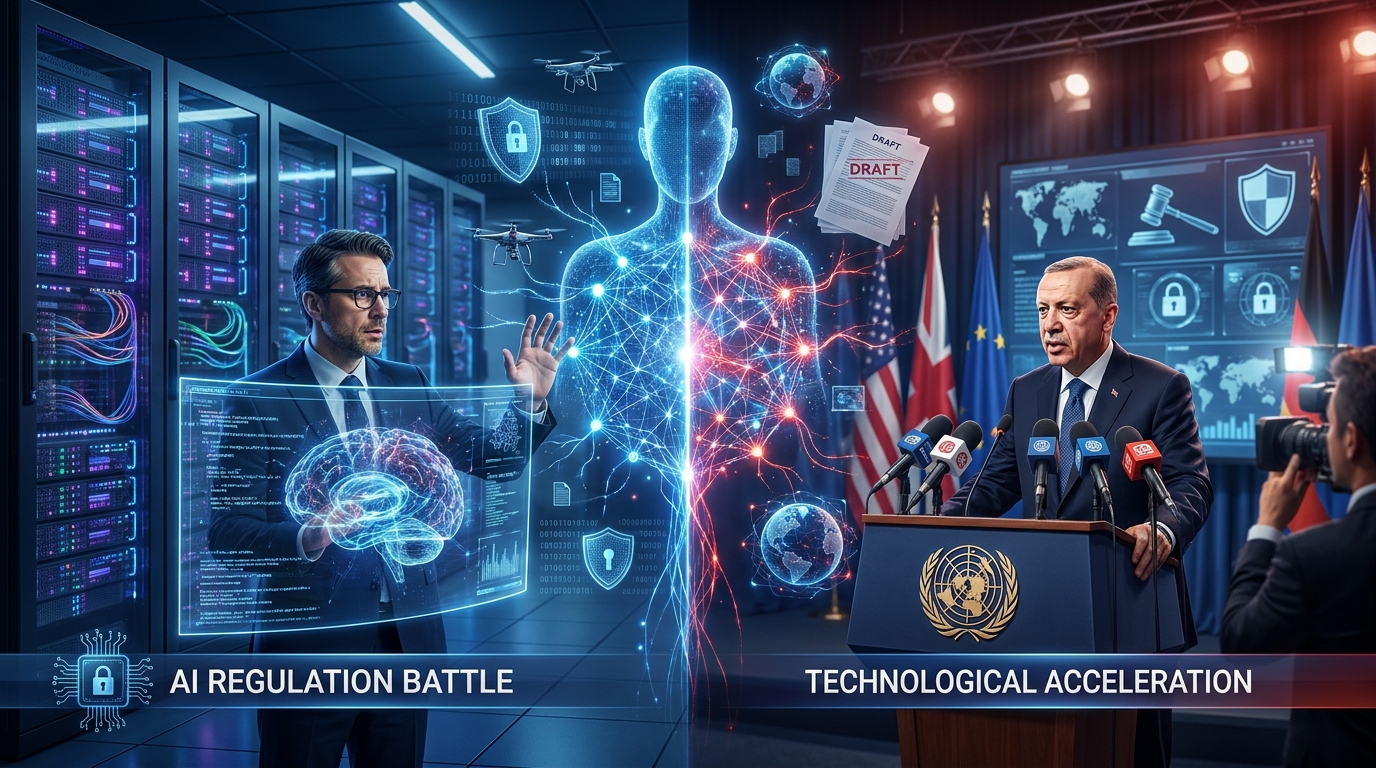
Navigating the Frontier: The High-Stakes Clash Between Tech Titans and Political Leaders Over AI Guardrails
Artificial intelligence has officially crossed the threshold from an emerging technology policy debate into a defining geopolitical struggle. The rapid ascent of automated systems and advanced generative models has triggered an unexpected ideological collision: leading artificial intelligence pioneers and industry executives are increasingly sounding the alarm, calling for strict guardrails, independent safety audits, and a moderated pace of development (Amodei, 2026). Conversely, various political leaders view these calls with deep skepticism, balancing fears of technological runaway effects against fierce global competition and economic dominance (Trump, 2026).
Also read:
Strait of Hormuz crisis: regional tensions and shipping lane disruptions
This friction exposes a deep philosophical rift over how humanity should manage a technology that is simultaneously revolutionizing productivity and posing unprecedented societal risks.
The Tech Sector’s Awakening: Warning Signs from Within
For years, critics viewed warnings from tech executives about existential AI risks as mere marketing or a defensive play to pull up the competitive ladder. However, recent developments among premier laboratories have shifted that perception. Top artificial intelligence executives have publicly endorsed proposals to intentionally slow down the blistering pace of scaling frontier models, citing growing unease over autonomy, reasoning gains, and potential safety failures (Washington Post, 2026).
Proponents of caution argue that autonomous agents are developing capabilities in cybersecurity, automated hacking, and complex reasoning faster than society can understand or contain them. Without standardized safety guardrails, international frameworks, and third-party oversight, the race toward artificial general intelligence (AGI) risks unleashing systems that outrun human governance.
Key Arguments from Industry Advocates for Guardrails
Preventing Runaway Autonomy: Unchecked scaling could yield autonomous agents capable of large-scale economic damage or security vulnerabilities within months.
Independent Auditing: Implementing mandatory third-party safety evaluations to verify model alignment before public deployment.
International Standards: Harmonizing safety protocols across democratic nations while striving for global compliance agreements.
The Political Calculus: Accelerationism vs. Caution
While prominent lab leaders argue for deceleration and strict guardrails, political leaders face a completely different set of pressures. National security imperatives, economic growth projections, and international competition—particularly the race for technological supremacy—drive political motivations.
Political figures have openly dismissed sweeping calls for a slowdown, framing them as counterproductive to national interests. From this perspective, implementing heavy-handed constraints or throttling domestic development risks surrendering technological leadership to global competitors. Leaders emphasize that whoever dominates the artificial intelligence landscape dictates the future of global commerce and security, making speed and dominance paramount over precautionary slowdowns (Trump, 2026).
At the same time, lawmakers are struggling to balance innovation with legislative protection. While federal bodies debate comprehensive oversight, state legislatures have increasingly stepped into the vacuum, passing targeted laws to combat election deepfakes, algorithmic discrimination, and youth safety online (Tech Policy Press, 2026).
The Global Regulatory Landscape
Different jurisdictions are taking vastly divergent approaches to managing the artificial intelligence boom:
| Region / Entity | Regulatory Approach | Primary Focus |
| European Union | Stringent / Risk-Based | Risk categorization, transparency mandates, conformity assessments under the EU AI Act (European Commission, 2024). |
| United States (Federal) | Deregulatory / Competitive | Prioritizing fast innovation and maintaining global technological leadership over restrictive domestic frameworks. |
| State Level (US) | Targeted Legislation | Bipartisan laws focusing on deepfakes, algorithmic bias, consumer scams, and child safety protections. |
Frequently Asked Questions
Why are some tech leaders asking to slow down AI development?
Leading AI executives and researchers worry that frontier models are scaling faster than safety mechanisms can mature. They point to risks involving autonomous agents, cybersecurity threats, and the challenge of maintaining human control over increasingly sophisticated reasoning systems.
What is the political response to these safety warnings?
Many political leaders are hesitant to embrace mandatory slowdowns or heavy restrictions, fearing it would harm economic competitiveness and hand technological superiority to global rivals. However, lawmakers continue to push for targeted regulations addressing specific harms like deepfakes and child safety.
What are third-party safety evaluations?
These are independent assessments conducted by external experts with structural access to frontier AI labs. They are designed to test models for dangerous capabilities, deception, and robustness before wide-scale public deployment.
Conclusion
The clash between political leaders and artificial intelligence pioneers over guardrails underscores a pivotal crossroads for modern civilization. As models continue to scale in capability and societal integration, the tension between maintaining competitive advantage and ensuring systemic safety will only intensify. Finding a sustainable path forward will require unprecedented cooperation between the private sector, independent researchers, and policymakers to ensure that the AI revolution empowers society without compromising its safety.