
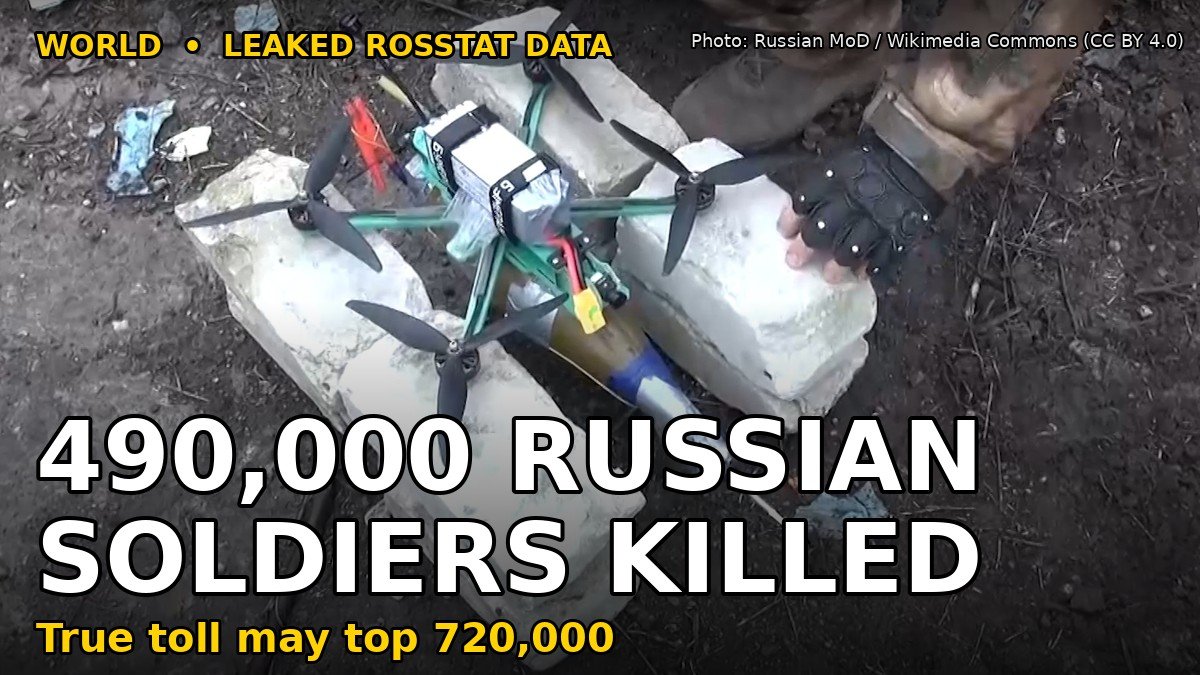
At least 490,000 Russian soldiers killed in Ukraine have now been counted in leaked data from Russia’s own statistics agency, according to an investigation by independent Russian outlets Mediazona and Meduza — a figure far higher than anything the Kremlin has ever acknowledged, and one the researchers say is still only part of the story.
The data, drawn from the hacked database of Rosstat, Russia’s federal statistics service, records military deaths registered through 29 September 2026. When soldiers listed as missing and delays in registering deaths are taken into account, the true toll is likely to be more than 720,000 — roughly one Russian soldier killed every four minutes since the full-scale invasion began in February 2022.
Russian soldiers killed in Ukraine: what the leaked data shows
The investigation, published on 23 November, is based on two sets of records obtained after Rosstat’s systems were breached by the Belarusian hacking group Cyber Partisans and the Ukrainian group Silent Crow, who announced the hack on 1 November. After removing duplicates, the journalists worked with about 11.66 million individual death records covering January 2021 to 29 September 2026.
From those records they identified men aged 18 to 64 whose files showed an explicit military cause of death or indicated they had died in a combat zone. The count came to more than 490,300 — a figure other independent analyses have broadly confirmed. Novaya Gazeta Europe put the number at 490,000, the Vazhnye Istorii (Important Stories) outlet counted more than 499,000 records, and Bloomberg, working separately from the same leak, identified about 470,000 deaths.
Crucially, the researchers tested whether the leaked data could be trusted. They cross-checked it against the registry of inheritance cases, court rulings, other leaks from civil registry offices and previously published official statistics. The leaked records contained 95.1% of the people on Mediazona and BBC Russian Service’s own itemised list of confirmed Russian military dead — a match the journalists say makes large-scale tampering unlikely.
How the death toll was counted — and why it is probably far higher
The 490,000 figure counts only deaths that had already been registered and entered into the database by late September. The hacked database has significant gaps in its 2025 records, and most military deaths from 2026 had not yet been entered at all. The researchers therefore used statistical modelling to estimate how many deaths would appear if the database were fully up to date, including soldiers still listed as missing.
That model puts the toll at about 530,000 by the end of 2025, rising to around 720,000 or more by the autumn of 2026. A study cited by The New York Times reached a similar conclusion, estimating that the number of Russian troops killed likely exceeds 700,000.
The BBC Russian Service’s own named list — built since the invasion from official reports, social media posts, new memorials and graves — stood at about 290,000 confirmed dead in early November. Military experts estimate that list captures only 45 to 55% of the real total, which would put the true figure between roughly 527,000 and 644,000 even before the latest modelling. Mediazona notes its 490,000 figure itself misses about 3,000 war deaths from 2022 and early 2023, many of them Wagner fighters killed near Bakhmut whose records sit in registry offices in the occupied Donetsk and Luhansk regions.
The heaviest losses have come in Donetsk Oblast. According to separate reporting by Agentstvo and Proekt, Russia lost more troops in its attempts to seize Donetsk than in any single offensive during the Second World War, with 270,547 deaths registered in occupied parts of the region under codes linked to combat operations.
The Kremlin’s response
The Kremlin has refused to discuss the findings. Asked about the reports, spokesman Dmitry Peskov said only Russia’s Defence Ministry could release casualty figures and suggested ignoring all other data. Rosstat confirmed it had been targeted by a cyberattack between 29 October and 1 November but denied that any protected data had been leaked, and said it found no sign its databases had been compromised.
That position is at odds with the journalists’ authentication work and with the scale of the material involved. The leaked records also show how the war has reshaped mortality across Russia more broadly, with deaths among young men rising sharply in regions that supplied the most soldiers.
What the numbers mean for the war
The figures land as the war approaches its fifth year, with no end in sight. Combined military casualties on both sides are now estimated to exceed two million, and the fighting in eastern Ukraine continues at a grinding pace that produces steady losses on both sides.
For Moscow, the numbers present a political problem as much as a military one. The Kremlin has kept official casualty figures secret throughout the war, and the gap between its silence and the scale now documented in its own statistics is becoming harder to sustain. For Ukraine and its allies, the data offers the clearest picture yet of the price Russia is paying for a war President Vladimir Putin once assumed would last a few days.
The leaked records do not contain names, but they do record age, place of residence, place of death and the circumstances of each death — a level of detail that makes the toll difficult to dismiss as an estimate built on guesswork. As more of the missing are registered in the months ahead, the researchers expect the confirmed count to keep climbing towards their modelled figure of more than 720,000.