
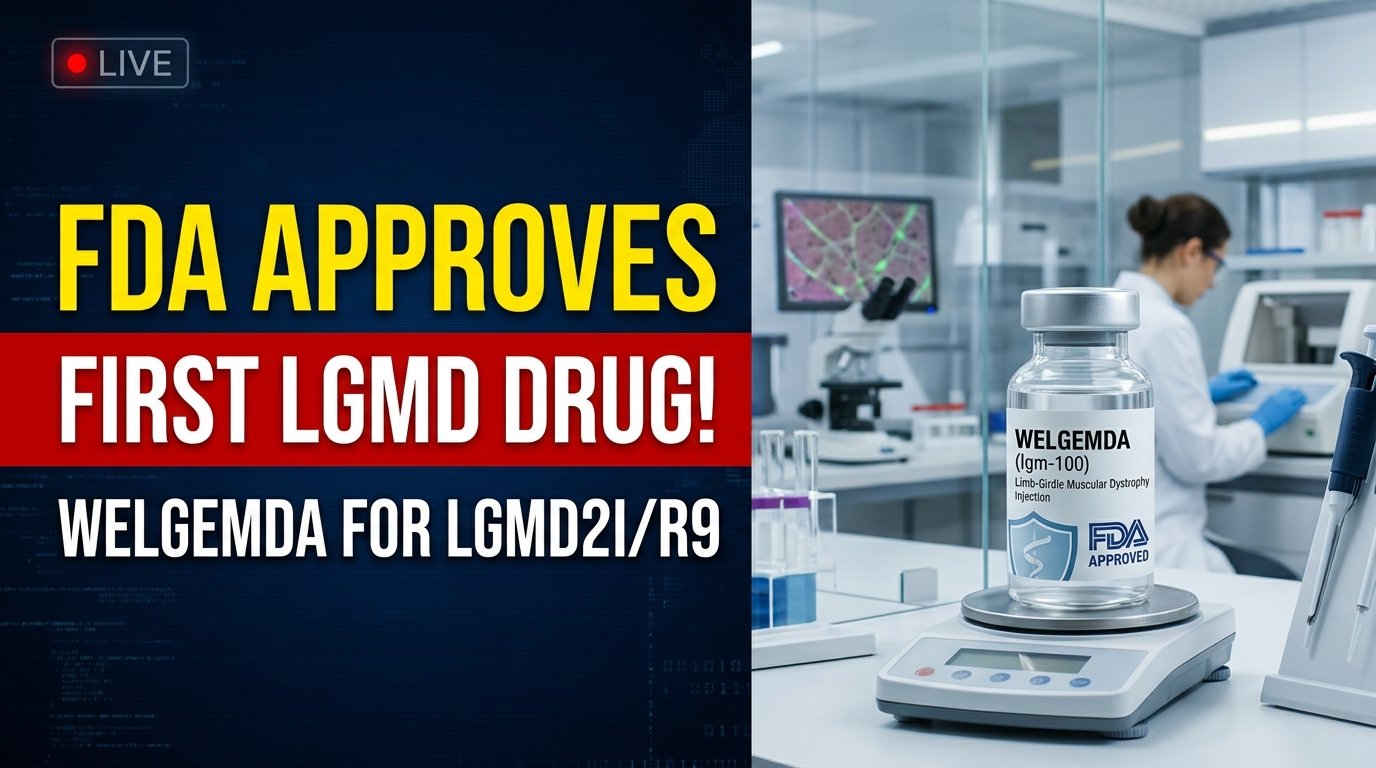
FDA Approves First Ever Treatment for Limb-Girdle Muscular Dystrophy
In a landmark therapeutic milestone for rare neuromuscular medicine, the FDA approves first ever treatment for limb-girdle muscular dystrophy on November 23, 2026, granting approval to Welgemda (ribitol, formerly studied as BBP-418). The oral medication is authorized for adults and pediatric patients weighing at least 30 kilograms (about 66 pounds) who have limb-girdle muscular dystrophy type 2I/R9 (LGMD2I/R9), making it the first approved therapy for any form of limb-girdle muscular dystrophy.
Manufactured by ML Bio Solutions Inc. and distributed by BridgeBio Pharma, Inc., Welgemda is administered twice daily dissolved in water. For patients and families who have navigated progressive muscle weakness without an approved pharmacological option, the decision represents a major scientific breakthrough backed by clinical evidence of improved walking speed, respiratory function, and muscle protein glycosylation.
Also Read:
Vance and Rubio Meet Qatar PM as Efforts to Revive Stalled Iran Talks Continue
                 [ WELGEMDA (RIBITOL) FDA APPROVAL MATRIX ]
                                         │
             ┌───────────────────────────┴───────────────────────────┐
             ▼                                                       ▼
  [ REGULATORY & INDICATION SCOPE ]                       [ CLINICAL & MECHANISTIC PROFILE ]
   • Approved Nov 23, 2026 (1st for Any LGMD)              • Oral Ribitol Mixed in Water (Twice Daily)
   • Indication: LGMD Type 2I/R9 (≥30 kg / ~66 lbs)        • Enhances FKRP Pathway & αDG Glycosylation
   • Manufacturer: ML Bio Solutions / BridgeBio            • Gains in 100m Walk Speed & Forced Vital Capacity
             │                                                       │
             └───────────────────────────┬───────────────────────────┘
                                         ▼
                     [ FIRST-EVER THERAPEUTIC MILESTONE FOR LGMD2I/R9 ]
1. Clinical Evidence and Mechanism of Action in LGMD2I/R9
Limb-girdle muscular dystrophy type 2I/R9 is a rare inherited muscle disorder caused by mutations in the FKRP gene. Impaired FKRP function disrupts the glycosylation of alpha-dystroglycan, a protein vital for anchoring muscle fibers to surrounding tissue and maintaining muscle cell stability, leading over time to progressive weakness around the hips and shoulders as well as potential respiratory challenges.
  FKRP Gene Mutation & Deficit    Ribitol Target Engagement       12-Month Clinical Outcomes
+-----------------------------+  +------------------------------+  +------------------------------+
| Reduced FKRP Activity       |->| Oral Ribitol Delivers        |->| Faster 100m Timed Walk Speed |
| Impairs Alpha-Dystroglycan  |  | Substrate to Support         |  | & Improved Forced Vital      |
| Glycosylation & Muscle Link |  | Glycosylation & Matriglycan  |  | Capacity vs. Placebo         |
+-----------------------------+  +------------------------------+  +------------------------------+
|                 **Status: FDA Approved for LGMD2I/R9 (Patients ≥30 kg)**                     |
+----------------------------------------------------------------------------------------------+
Key Clinical and Regulatory Highlights
Phase 3 FORTIFY Trial Performance: Approval was supported by data from a randomized, double-blind, placebo-controlled trial (NCT05775848) in patients with genetically confirmed LGMD2I/R9. At a planned 12-month interim analysis, patients treated with Welgemda demonstrated statistically significant improvements compared with placebo in walking speed—evaluated via the 100-meter timed test—and lung function, measured by forced vital capacity.
Biomarker and Target Engagement: Treated patients also showed significant increases in glycosylated alpha-dystroglycan, confirming target engagement at the recommended dose. Regulators noted that ribitol’s mechanism may involve supporting glycosylation pathways and increasing matriglycan production to help anchor alpha-dystroglycan in muscle tissue.
Safety and Expedited Designations: Welgemda previously received FDA Orphan Drug, Fast Track, and rare pediatric disease designations. In clinical testing, common adverse reactions included gastrointestinal symptoms—such as diarrhea and stomach pain—alongside joint pain.
2. Quantitative & Clinical Summary of the Approval
The table below summarizes core clinical and regulatory parameters associated with Welgemda’s approval for LGMD2I/R9:
| Approval / Trial Dimension | Key Details & Reported Findings | Clinical & Regulatory Context |
| Drug Name & Active Ingredient | Welgemda (ribitol / BBP-418) | First-ever FDA-approved therapy for any form of LGMD |
| Approved Population | Adults and pediatric patients weighing ≥30 kg (~66 lbs) with genetically confirmed LGMD2I/R9 | Oral formulation dissolved in water, taken twice daily |
| Key Efficacy Endpoints (12-Mo) | Statistically significant gains in 100-meter walk speed and forced vital capacity vs. placebo | Supported by increases in glycosylated alpha-dystroglycan |
| Common Adverse Reactions | Gastrointestinal effects (diarrhea, stomach pain) and joint pain | Prior to approval, held Orphan Drug, Fast Track & rare pediatric disease status |
3. Broader Impact on Neuromuscular Care and Future Research
Neurologists and muscular dystrophy advocates have framed the approval as an important initial step rather than a complete cure:
                              [ NEUROMUSCULAR CARE & R&D OUTLOOK ]
                                                 │
             ┌───────────────────────────────────┴───────────────────────────────────┐
             ▼                                                                       ▼
  [ SUBTYPE SPECIFICITY ]                                              [ ONGOING SCIENTIFIC PIPELINE ]
   • Targets FKRP-Related LGMD2I/R9                                      • Years of Basic & Preclinical Work
   • Does Not Cover All LGMD Subtypes                                  • Longer-Term Follow-Up Continues
   • Requires Genetic Confirmation                                     • Fuels Broader LGMD Drug Discovery
             │                                                                       │
             └───────────────────────────────────┬───────────────────────────────────┘
                                                 ▼
                         [ BUILDING MOMENTUM FOR RARE MUSCLE DISORDERS ]
Strategic Takeaways
Focused on a Specific Genetic Subtype: Limb-girdle muscular dystrophy encompasses multiple genetic forms depending on which gene is affected. Welgemda is specifically indicated for FKRP-related LGMD2I/R9 in eligible patients weighing at least 30 kg, meaning individuals with other LGMD subtypes still await targeted therapies.
A Foundation for Continued Innovation: Neuromuscular specialists emphasize that while Welgemda is not a cure and will not benefit every patient equally, demonstrating measurable functional gains in a controlled trial helps establish clinical pathways and momentum for additional treatments across muscle disorders.
Value of Sustained Translational Research: The approval reflects decades of foundational research into dystroglycan glycosylation and muscle cell stability that translated into a targeted oral therapy.
Technical Conclusion
The regulatory milestone in which the FDA approves first ever treatment for limb-girdle muscular dystrophy brings a long-sought first therapy to individuals living with LGMD2I/R9. Backed by 12-month clinical trial data showing improvements in walking speed, forced vital capacity, and alpha-dystroglycan glycosylation, Welgemda opens a new chapter for LGMD2I/R9 care while underscoring the need for ongoing research across all forms of the disease.
Frequently Asked Questions (FAQs)
What is the first FDA-approved treatment for limb-girdle muscular dystrophy?
The FDA approved Welgemda (ribitol) on November 23, 2026, for adults and pediatric patients weighing at least 30 kilograms with limb-girdle muscular dystrophy type 2I/R9 (LGMD2I/R9), marking the first approved treatment for any form of limb-girdle muscular dystrophy.
How did Welgemda perform in clinical trials?
In a randomized, double-blind, placebo-controlled trial of patients with genetically confirmed LGMD2I/R9, patients receiving Welgemda showed statistically significant improvements in walking speed (100-meter timed test) and lung function (forced vital capacity) at a 12-month interim analysis compared with placebo, along with increased glycosylated alpha-dystroglycan.
Does Welgemda treat all types of limb-girdle muscular dystrophy?
No. Welgemda is approved specifically for limb-girdle muscular dystrophy type 2I/R9 (linked to FKRP gene mutations) in patients weighing at least 30 kilograms.
What are common side effects reported with Welgemda?
The most common adverse reactions reported in clinical evaluations include gastrointestinal symptoms—such as diarrhea and stomach pain—as well as joint pain.
Disclaimer
This article is provided strictly for educational, informational, and medical news reporting purposes and does not constitute medical advice, diagnosis, or treatment recommendations. Always consult a qualified healthcare professional or neuromuscular specialist regarding any medical condition or treatment decision.