Apple Intelligence iOS Integration, Enterprise AI & Quantum Horizons
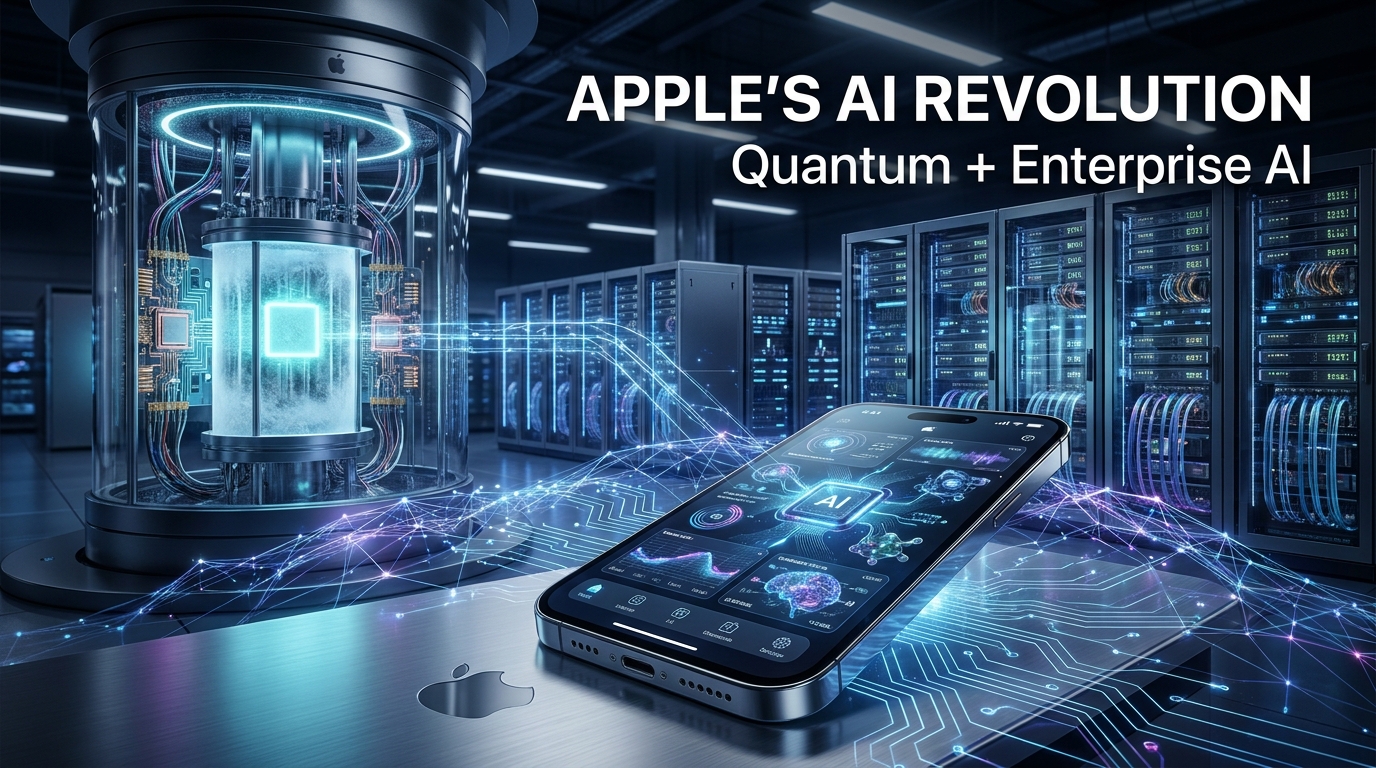
Apple Intelligence iOS integration is redefining how we interact with technology, shifting artificial intelligence from standalone cloud applications into the core, ambient fabric of our daily operating systems. Beyond consumer hardware, this wave coincides with massive leaps in enterprise AI infrastructure and quantum computing. Together, these domains are solving long-standing computational bottlenecks, changing how data privacy is maintained, and pushing the boundaries of automated intelligence from the edge to the cloud.
Also read:
El Niño Atlantic hurricane season Sets Historic Lows: Causes & Impacts
The OS-Level Paradigm Shift: Apple Intelligence and iOS Rollouts
For years, the generative AI boom was defined by separate chat applications, browser windows, and isolated prompt boxes. Apple changed this playbook by embedding intelligence directly into the operating system. Rather than forcing users to context-switch, modern iOS iterations weave intelligence frameworks across Siri, Spotlight, Safari, and native developer tools.
On-Device Processing Meets Private Cloud Compute
The core engineering achievement behind the Apple Intelligence iOS integration rollout relies on a hybrid architecture:
Local Neural Engine Inference: Everyday tasks—such as live translation, document summaries, inline typing suggestions, and photo enhancements—run entirely on-device using custom Apple Foundation Models. This eliminates round-trip cloud latency and ensures lightning-fast execution.
Private Cloud Compute (PCC): When requests require heavy data processing beyond mobile chip limitations, Apple routes tasks to dedicated silicon servers protected by end-to-end verifiable privacy. Data is never stored or logged, ensuring strict enterprise-grade compliance.
App Intents and Developer APIs: Developers can expose their app functionalities directly to the system’s AI layer via App Intents, enabling cross-app orchestration where Siri can execute multi-step user requests seamlessly.
Scaling Enterprise AI Infrastructure
While consumer devices handle ambient personal contexts, enterprise environments face a radically different challenge: managing massive data pipelines, minimizing hallucination risks, and orchestrating agentic workflows across legacy databases.
Enterprise AI infrastructure is transitioning from experimental cluster setups to hardened, highly optimized operational frameworks. Modern enterprise deployments require:
Hybrid Retrieval-Augmented Generation (RAG): Ensuring internal document repositories remain secure while allowing localized LLMs to query corporate wikis, customer relationship management (CRM) systems, and enterprise resource planning (ERP) software in real time.
Agentic Workflows: Moving past static text generation into multi-agent systems capable of autonomous execution—such as auditing software dependencies, handling automated supply chain adjustments, and cross-checking compliance protocols.
Hardware Heterogeneity: Integrating traditional GPUs with specialized neural processing units (NPUs) and emerging accelerators to lower the total cost of ownership (TCO) for continuous model inference.
The Quantum Horizon: What Next-Gen Computing Means for AI
As classical silicon approaches physical scaling limits, quantum computing is stepping out of theoretical physics laboratories and into practical enterprise roadmaps. The intersection of quantum mechanics and machine learning—often called quantum machine learning (QML)—promises exponential speedups for complex optimization problems.
Standard neural networks struggle with massive combinatorial spaces, such as molecular simulation for drug discovery, complex financial risk modeling, and large-scale logistics routing. Quantum processors leverage qubits capable of superposition and entanglement, allowing algorithms to evaluate vast parameter spaces simultaneously.
While fault-tolerant, error-corrected quantum computers are still maturing, hybrid classical-quantum algorithms are already being tested in sandbox environments. As these systems scale, they will drastically reduce the training times of frontier AI models and solve optimization bottlenecks that currently choke modern enterprise infrastructure.
Frequently Asked Questions (FAQs)
What makes Apple Intelligence iOS integration different from standard chatbot apps?
Apple’s approach focuses on ambient, system-wide integration rather than a standalone app. By embedding foundational models directly into the operating system and leveraging local hardware, features operate privately and instantly across native apps without needing manual web prompts.
How does Apple protect user privacy during cloud-based AI tasks?
Apple utilizes Private Cloud Compute (PCC), an architecture that extends device-level security into scalable server clusters. Requests processed in the cloud are cryptographically secured, never persisted on external storage databases, and subject to independent security audits.
Which devices support the latest Apple Intelligence features?
Because these capabilities require substantial on-device neural processing power and high-speed RAM, they are restricted to modern hardware, including iPhones featuring the A17 Pro or A18 chips (and newer), alongside iPads and Macs powered by Apple Silicon (M1 or higher).
How is enterprise AI infrastructure adapting to agentic workflows?
Enterprise architectures are shifting toward secure RAG frameworks and modular APIs that allow AI agents to securely interact with internal software tools, databases, and communication channels without risking data leakage or unauthorized access.
The convergence of consumer-facing operating system intelligence, scalable enterprise architectures, and quantum computing innovations marks a turning point in the tech landscape. Apple has proven that user privacy and deep AI utility can coexist through hybrid on-device and cloud frameworks. Simultaneously, enterprise and quantum advancements are laying the groundwork for a future where autonomous systems solve problems previously thought intractable. As these technologies mature, the boundaries between hardware, software, and intelligence will continue to dissolve entirely.