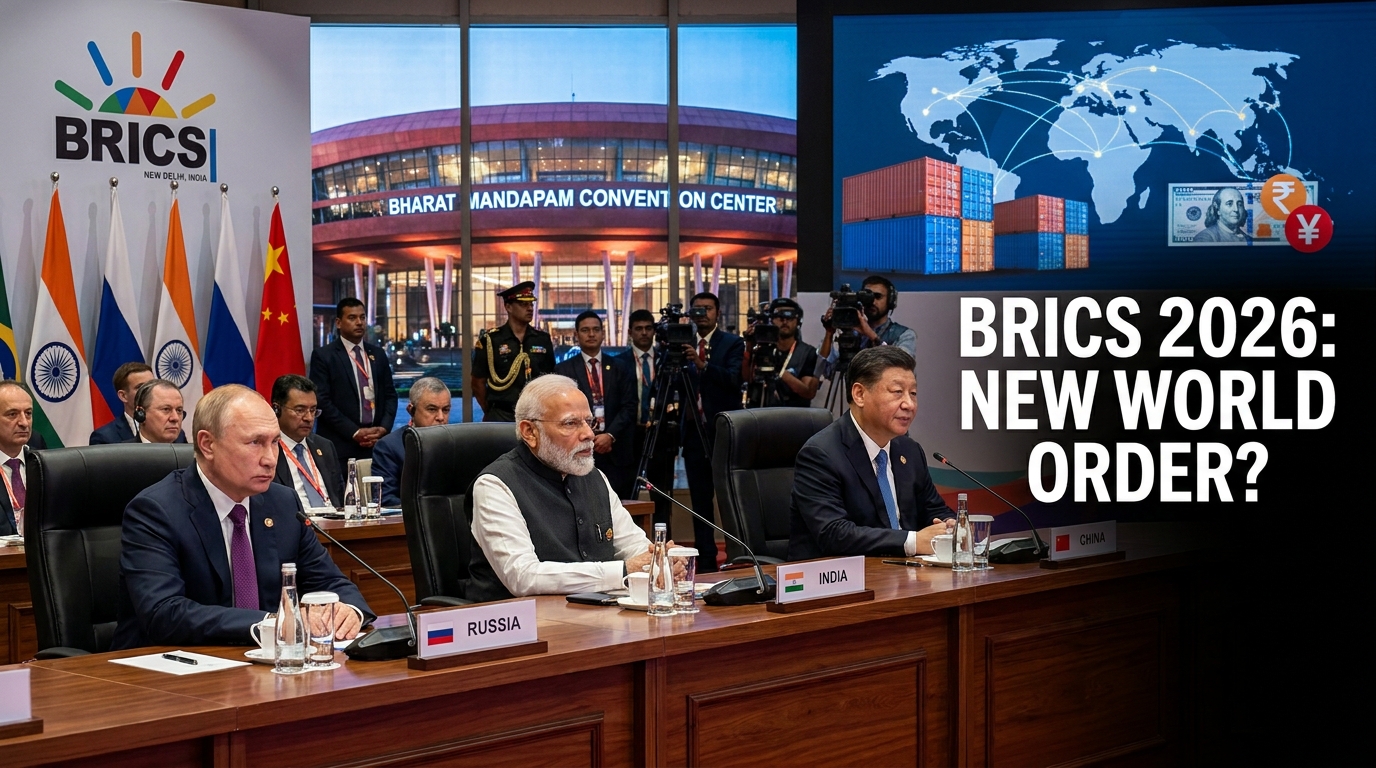
18th BRICS Summit 2026 New Delhi is the primary focus of international diplomacy as world leaders, trade ministers, and international delegates converge at the Bharat Mandapam convention center. Marking two decades since the bloc’s foundational inception, this year’s high-stakes gathering takes place against a turbulent backdrop of shifting geopolitical alignments, supply chain realignments, and intense debates over the future of international trade.
Also read:
US Open 2026 Tennis Finals: Showdowns, Results & Highlights
Under India’s active Chairship guided by the overarching theme, “Building for Resilience, Innovation, Cooperation and Sustainability,” the expanded eleven-member coalition faces a pivotal moment. With heavyweights like Russian President Vladimir Putin, Chinese President Xi Jinping, and leaders from Brazil, South Africa, Iran, the UAE, Egypt, Ethiopia, Indonesia, and Saudi Arabia taking part alongside international figures like UN Secretary-General António Guterres, the summit is shaping up to be one of the most consequential multilateral forums of the decade.
Expanding Horizons: The New Face of BRICS
When the bloc first emerged as “BRIC” in 2006—and later added South Africa in 2010—its primary focus was framing an alternative economic voice for emerging developing economies. Fast forward to the present day, and the coalition has undergone a massive structural evolution. Following historic expansions that brought in powerhouses and resource-rich nations like Egypt, Ethiopia, Iran, Saudi Arabia, the UAE, and Indonesia, BRICS now represents over 40% of the global population and a significant share of global GDP and oil production.
This expansion has naturally diversified the group’s agenda. No longer just a forum for economic dialogue, the bloc has transformed into a comprehensive geopolitical platform addressing food security, energy channels, digital public infrastructure, and climate resilience. India’s stewardship has focused heavily on keeping the bloc grounded in a “Humanity First” approach, ensuring that the interests of the Global South remain central to global governance reforms.
De-Dollarization and Alternative Trade Currencies
At the core of intense closed-door deliberations and financial committee meetings are discussions surrounding alternative currency frameworks and cross-border payment mechanisms. With mounting concerns over the weaponization of traditional financial infrastructure and Western-led sanctions, member states are aggressively exploring alternatives to reduce reliance on the US Dollar.
While a single, uniform “BRICS Currency” remains a long-term and logistically complex objective, member states are fast-tracking pragmatic alternatives. These include:
Expanded Local Currency Settlements: Boosting bilateral trade invoices settled directly in national currencies (such as the Indian Rupee, Chinese Yuan, and UAE Dirham) to lower transaction costs and currency risks.
BRICS Pay and Digital Interoperability: Exploring decentralized financial messaging frameworks and cross-border digital payment linkages to bypass legacy systems like SWIFT.
New Development Bank (NDB) Expansion: Capitalizing the Shanghai-headquartered NDB to issue more local-currency denominated loans for sustainable infrastructure projects across the developing world.
Despite strong political momentum, the path forward requires careful calibration. Nations like India and Saudi Arabia maintain complex, multi-vectored economic relationships with Western economies, meaning that any aggressive structural break from the dollar faces internal balancing acts. The New Delhi Declaration is expected to reflect a measured, consensus-driven approach that prioritizes financial sovereignty without completely alienating global market integration.
Geopolitical Alignments and Regional Security
Beyond trade and finance, the 18th BRICS Summit serves as a critical pressure valve for ongoing global conflicts. The discussions are heavily shaped by persistent supply chain fractures, ongoing disruptions in maritime energy routes, and geopolitical flashpoints in Eastern Europe and the Middle East.
Significantly, the summit has provided a diplomatic stage for high-profile bilateral engagements. Prime Minister Narendra Modi’s meetings with international counterparts—including a closely watched dialogue with Chinese President Xi Jinping aimed at stabilizing ties along the border—demonstrate how BRICS functions not just as an economic bloc, but as an indispensable diplomatic venue where rival or competing powers can engage constructively.
Furthermore, the presence of leaders from energy-heavy Middle Eastern economies highlights the bloc’s growing influence over global oil corridors. Balancing energy security with aggressive climate commitments remains a tightrope walk, but member states are leveraging the platform to push for fairer technology transfers and green financing models from developed nations.
Frequently Asked Questions (FAQs)
Q1: Where and when is the 18th BRICS Summit taking place?
A1: The 18th BRICS Summit is being held on September 12–13, 2026, at the Bharat Mandapam convention center in New Delhi, India.
Q2: What is the official theme of India’s BRICS Chairship?
A2: India’s chairship is anchored under the theme: “Building for Resilience, Innovation, Cooperation and Sustainability.”
Q3: Which countries are currently full members of BRICS?
A3: Following recent expansions, BRICS comprises eleven full member states: Brazil, Russia, India, China, South Africa, Egypt, Ethiopia, Iran, Saudi Arabia, the United Arab Emirates, and Indonesia.
Q4: Is a new BRICS currency being launched at the New Delhi summit?
A4: While a formal single currency is not being launched immediately due to technical and economic complexities, member states are actively expanding local currency trade settlements and developing resilient cross-border digital payment rails.
Q5: What is the primary objective of the New Delhi Declaration?
A5: The New Delhi Declaration is the consensus-based concluding document that outlines joint commitments on multilateral governance reform, sustainable development, trade diversification, anti-terrorism cooperation, and technological collaboration.
Conclusion
The 18th BRICS Summit marks a defining juncture for contemporary international relations. As the bloc celebrates twenty years of cooperation, its ability to navigate internal economic divergences while presenting a unified voice on global governance will set the tone for the multipolar world order. Whether through redefining trade corridors, pioneering digital financial architecture, or fostering strategic dialogue amidst global friction, the decisions finalized under the dome of Bharat Mandapam will resonate far beyond the capital, shaping the economic and political realities of the Global South for decades to come.