
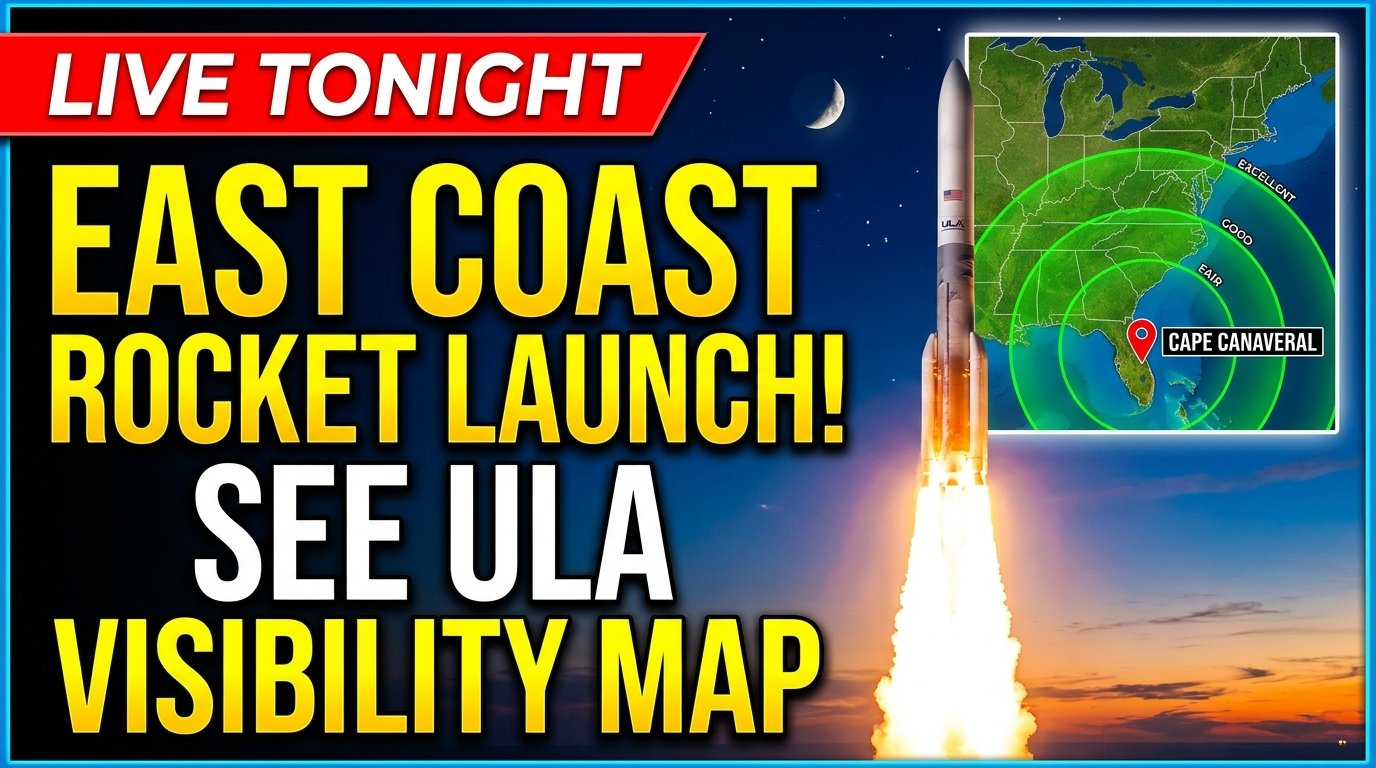
Florida Rocket Launch May Be Seen Along East Coast. See ULA Visibility Map
Skywatchers from Florida to the Mid-Atlantic have an exciting opportunity to witness a rare spaceflight spectacle, as a Florida rocket launch may be seen along East Coast skies. United Launch Alliance (ULA) is set to send its heavy-lift Vulcan rocket roaring off Space Launch Complex 41 at Cape Canaveral Space Force Station, carrying the Amazon Leo (LV-01) mission—a landmark deployment of 45 broadband communication satellites.
Because the rocket will fly on a steep northeasterly trajectory paralleling the Atlantic seaboard, millions of residents outside the Sunshine State could catch sight of the glowing exhaust plume streaking across the horizon—provided local cloud cover cooperates.
Also Read:
SpaceX Catches Starship for the First Time: Ship 42 Snatched From the Sky by Tower Arms
Why This Florida Rocket Launch May Be Seen Along East Coast Skies
Most orbital missions departing Cape Canaveral head due east over the open Atlantic Ocean, making them visible primarily to viewers on Florida’s Space Coast. However, when a Florida rocket launch may be seen along East Coast coastlines, it is because the mission requires a high-inclination orbit.
For the Vulcan VC6L launching the Amazon Leo (LV-01) payload, the rocket climbs northeastward up the U.S. East Coast to place its 45 satellites into low Earth orbit. Powered by twin Blue Origin BE-4 main engines and six solid rocket boosters, Vulcan generates a bright, high-altitude plume that can be spotted hundreds of miles downrange.
Understanding the ULA Visibility Map and Viewing Zones
To help skywatchers know exactly when and where to look, United Launch Alliance provides an official ULA visibility map showing concentric time rings radiating outward from Cape Canaveral, Florida. Each ring indicates roughly how many seconds after liftoff the ascending rocket clears the local horizon:
0 to 60 Seconds After Liftoff (Florida Space Coast & Central Florida): Viewers near Cape Canaveral, Titusville, Cocoa Beach, and Orlando see the rocket immediately upon ignition, experiencing both the blinding flame and the deep rumble of sonic shockwaves.
1 to 3 Minutes After Liftoff (Northern Florida, Georgia & South Carolina): As Vulcan gains altitude, coastal residents from Jacksonville to Savannah, Hilton Head, and Charleston can spot a bright, fast-moving star climbing low in the southeastern sky.
3 to 5 Minutes After Liftoff (North Carolina & Virginia): By the time the booster nears the Outer Banks and Chesapeake Bay, the rocket is soaring more than 60 miles above Earth, appearing as a luminous arc along the eastern horizon before main engine cutoff and stage separation.
5+ Minutes After Liftoff (Maryland, Delaware, New Jersey & New York): Under crystal-clear skies and low horizon haze, observers as far north as the Mid-Atlantic may glimpse the upper-stage Centaur V engine burning brightly low over the Atlantic Ocean.
Best Viewing Locations on Florida’s Space Coast
For spectators traveling to Florida to watch the liftoff in person, launch viewing experts highlight several prime vantage points around Cape Canaveral:
Kennedy Space Center Visitor Complex (Saturn V Center): Located roughly 5.4 miles from Pad 41, offering an unobstructed view across the Banana River.
Playalinda Beach (Canaveral National Seashore): Situated approximately 5.8 miles from the pad, providing a sweeping coastal view.
Max Brewer Bridge & Parrish Park (Titusville): About 13.2 miles away, widely regarded as one of the best free public viewing spots along the Indian River.
Port Canaveral / Route 528: Roughly 12.9 miles from Pad 41, offering clear water-level sightlines of the ascending booster.
Practical Tips for Spotting the Launch from Your Backyard
Whether you are standing on a Florida beach or scanning the horizon hundreds of miles north, a few simple preparations can dramatically improve your odds of spotting the rocket:
Find an Unobstructed Eastern Horizon: Because the rocket stays relatively low in the sky for viewers north of Florida, trees, tall buildings, or coastal dunes can block the view. Head to a beach, bridge, rooftop, or open field facing east-southeast.
Use a Compass App Ahead of Liftoff: Point your smartphone toward the east-southeast (or due east for viewers farther north along the coast) before T-minus zero so you aren’t searching the wrong quadrant of the sky.
Follow the Live ULA Webcast: Launch windows can shift due to upper-level winds or range checks. Streaming the live broadcast ensures you know the exact second of liftoff so you can start your personal countdown based on the ULA visibility map.
Watch for Stage Separation: Around the three-to-four-minute mark, look closely for a brief dimming followed by a renewed glow as the spent booster separates and the Centaur V upper stage ignites.
Frequently Asked Questions (FAQs)
Why can this Florida rocket launch be seen along the East Coast? The United Launch Alliance Vulcan rocket is flying on a northeast trajectory paralleling the Atlantic coastline to deliver 45 Amazon Leo satellites into low Earth orbit, bringing the ascending rocket within sight of coastal states north of Florida.
What rocket and payload are launching from Cape Canaveral? United Launch Alliance (ULA) is launching a Vulcan VC6L rocket from Space Launch Complex 41 at Cape Canaveral Space Force Station carrying the Amazon Leo (LV-01) mission with 45 broadband communication satellites.
How far north can the ULA rocket launch be seen? Depending on weather, atmospheric clarity, and horizon visibility, the rocket’s bright plume can potentially be seen from Florida through Georgia, the Carolinas, Virginia, and as far north as Maryland, New Jersey, and New York.
How long after liftoff will the rocket become visible along the East Coast? According to ULA visibility timelines, viewers in Georgia and South Carolina can look 1 to 3 minutes after liftoff, while observers in North Carolina, Virginia, and the Mid-Atlantic should watch the eastern horizon roughly 3 to 6 minutes after launch.
Where are the best places to watch the launch in Florida? Top viewing spots near Cape Canaveral include the Kennedy Space Center Visitor Complex, Playalinda Beach, the Max Brewer Bridge in Titusville, and the Route 528 causeway near Port Canaveral.
Disclaimer
This article is for informational and news reporting purposes only. Rocket launch windows, trajectories, and coastal visibility conditions are subject to weather constraints, range safety, and schedule adjustments by United Launch Alliance (ULA) and the U.S. Space Force.