
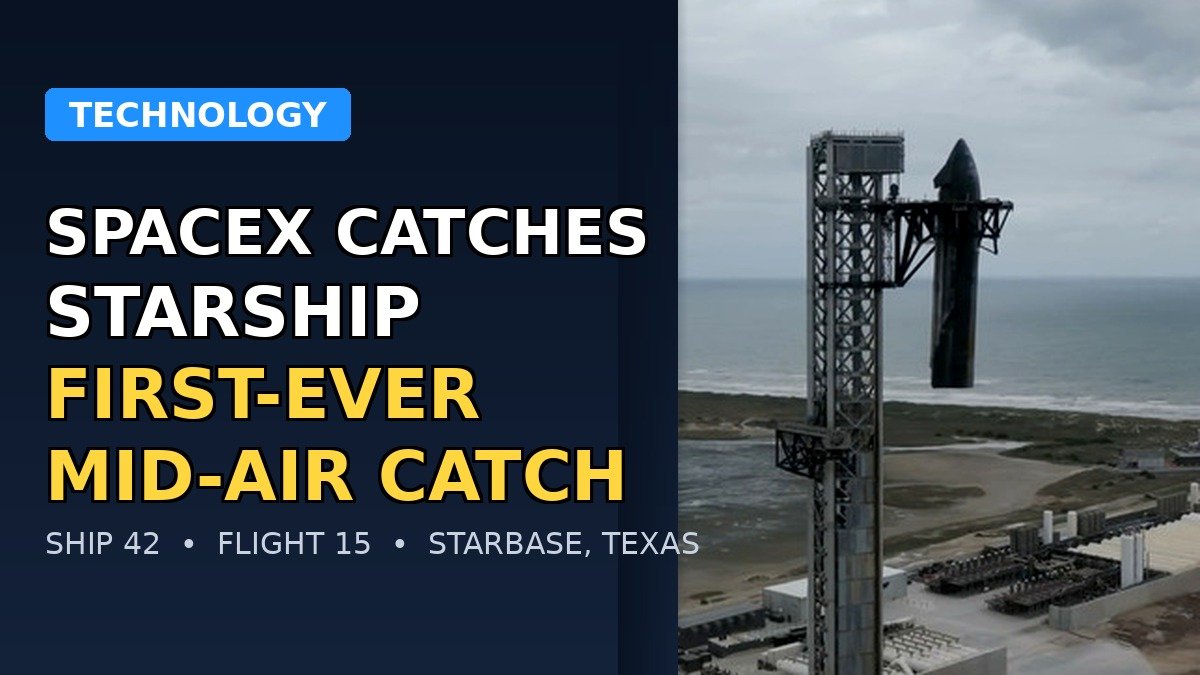
SpaceX catches Starship — and this time it means the whole ship. For the first time ever, SpaceX has caught the upper stage of its giant Starship rocket with the mechanical arms of its launch tower, snatching the 171-foot spacecraft out of the sky as it returned from orbit on Saturday.
Ship 42 dropped out of the clouds over Starbase in Texas, reignited three of its engines to flip itself vertical, and settled gently between the tower’s “chopstick” arms at about 4:20 p.m. ET — roughly 22 and a half hours after it lifted off. It was the first time SpaceX had ever attempted to recover a Starship upper stage, and the first time any spacecraft returning from orbit has been caught in mid-air like this.
“Mechazilla catches Starship!” SpaceX posted on X, as founder Elon Musk congratulated his “incredible team.” The company’s livestream played the 1977 hit “Baby Come Back” as the charred spacecraft descended into the tower’s grasp.
SpaceX Catches Starship: How the First Ship Catch Happened
The catch was the climax of Flight 15, the 15th test flight of the world’s largest and most powerful rocket — and only the second time a Starship has reached orbit.
The mission launched on Friday from Starbase, with SpaceX aiming for its most ambitious goal yet: a double catch, recovering both the Super Heavy booster and the Ship on the same flight. The booster was meant to return to the launch site first, with the Ship following a day later.
That plan fell apart within minutes of liftoff. But the Ship itself flew almost flawlessly. After separating neatly from its booster, it soared into orbit, released 26 advanced Starlink V3 satellites, and then kept flying — circling the Earth 14 times at an altitude of about 265 kilometres (165 miles), far longer than the one or two laps of the previous mission.
Then came the hard part. Unlike the booster, which returns from a relatively low altitude at relatively low speed, the Ship had to survive a fiery re-entry from orbital speed, with its heat shield glowing, before slowing enough for the tower to grab it. SpaceX said everything on the spacecraft, including its vital heat shield, appeared to work well.
As it fell back toward Texas on Saturday afternoon, the 52-metre spacecraft emerged from thick cloud, fired its engines, and eased itself down between the two mechanical arms above Launch Pad 2. The arms closed around it. The crowd watching from the Gulf of Mexico coastline erupted.
A 22-Hour Flight, 14 Orbits and 26 Satellites
The numbers behind Flight 15 show how far Starship has come in a single year. This was only the second orbital flight in the programme’s history — the first came on Flight 14 in September — yet the Ship stayed in space for nearly a full day and completed 14 laps of the planet.
The satellite deployment mattered too. Shortly after reaching orbit on Friday, Ship 42 released 26 Starlink V3 satellites, the larger, more capable generation of SpaceX’s internet constellation. It was a real payload delivered on a real orbital mission, not just a test flight with a dummy mass.
At 124 metres (407 feet) tall, the full Starship stack remains the biggest rocket ever flown. Saturday’s catch proved that the upper half of it — the part that actually goes to space — can come home in one piece.
The Booster That Didn’t Make It Back
The day was not a clean sweep. The Super Heavy booster — the rocket’s bottom half — failed to make its own return to the launch pad about 10 minutes after Friday’s liftoff, ending SpaceX’s hopes of recovering both stages on the same mission.
SpaceX’s Kate Tice said the booster’s engines stopped firing too soon on the way back down. Its guidance system sensed it was not in the right position and automatically initiated a detour over the water, followed by self-destruction. The booster exploded over the Gulf of Mexico before hitting the water.
It was a reminder of how unforgiving this kind of recovery is. SpaceX had already caught the Super Heavy booster three times on earlier flights, so the technique itself is proven. But on Flight 15, something went wrong early in the booster’s return, and the vehicle destroyed itself rather than risk coming down in the wrong place. Engineers are still investigating the cause.
The failure stings because the double catch was the headline goal of the flight. Recovering both stages together would have been the first complete recovery of an orbital launch system. SpaceX will have to try again.
Why the Catch Matters for the Moon — and Mars
Catching the Ship is about much more than a spectacular video. It is the missing piece of SpaceX’s plan to make Starship fully and rapidly reusable — the same rocket flying again and again with little more than refuelling in between, like an aeroplane.
That is what makes the economics work. A rocket that is thrown away after every flight is expensive; a rocket that comes home can fly often and cheaply. SpaceX officials said Saturday’s catch demonstrates Starship’s full reusability, which is crucial for rapid, low-cost recycling of the vehicle.
Nobody is watching that more closely than NASA, which is paying billions of dollars for Starship to land Artemis astronauts on the Moon later this decade. NASA Administrator Jared Isaacman welcomed the achievement on X, calling it “almost magic.”
The catch also matters for Mars, where Musk wants Starship to carry people and cargo. A vehicle that can return from orbit and be caught, inspected and reflown is the foundation of that plan. No Ship has ever been reused so far — but Saturday proved that reuse is now physically possible.
SpaceX also expects to begin launching Starships from Florida’s Kennedy Space Center within the next few months, which would let it fly far more often than the Texas site alone allows.
What Happens Next
The next test will be whether Ship 42 can fly again — and whether SpaceX can finally pull off the double catch, bringing both the booster and the Ship home on the same mission.
That is the bar now. Saturday showed the Ship can be caught. The booster has been caught before. Doing both at once, and then doing it routinely, is what turns a stunt into a system.
For now, SpaceX has something no one else has: a spacecraft that flew to orbit, spent a day circling the Earth, and then came back to be caught by the same tower it launched from. After 15 test flights, the world’s biggest rocket finally came all the way home.
Source: NPR