
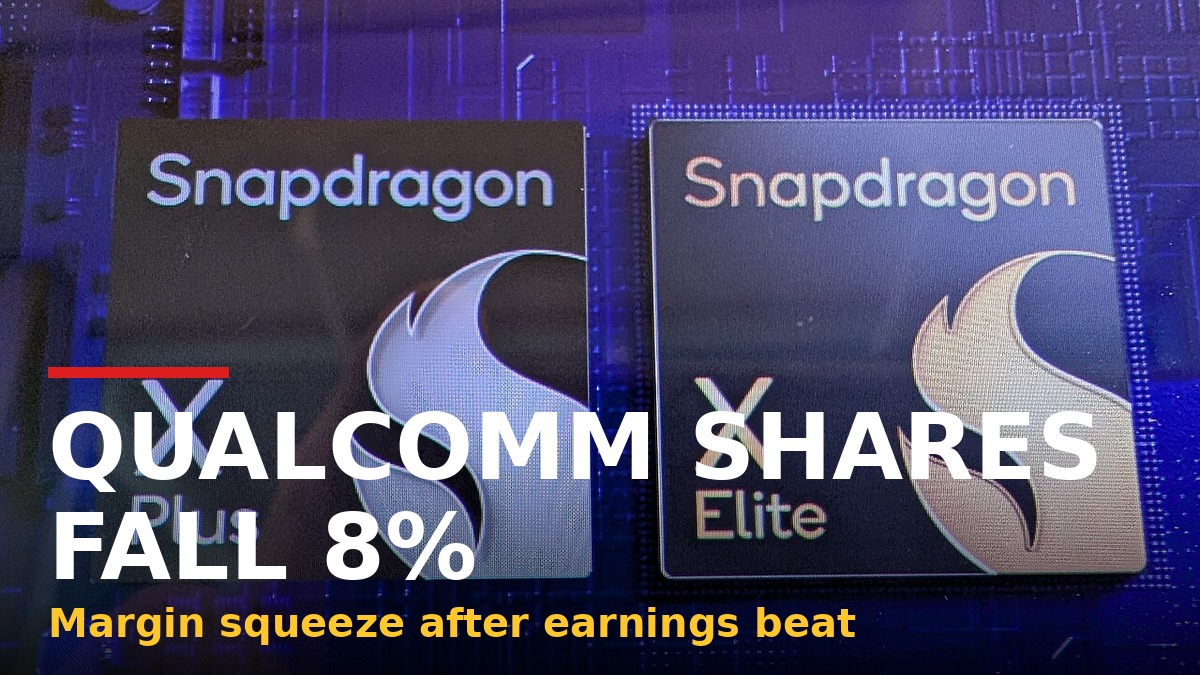

Qualcomm shares fall sharply after the closing bell on Tuesday, sliding 7.8% in after-hours trading and wiping out a 5.3% gain from the regular session. The stock, which had closed at $173.19, was down about 10% in premarket trading on Thursday, November 5, as investors focused less on what Qualcomm earned and more on what it now costs the company to build its chips.
On the surface, the fiscal fourth-quarter numbers looked fine. Qualcomm reported adjusted earnings of $2.17 a share, a touch above the $2.16 analysts had expected, and adjusted revenue of $10.44 billion — down 7% from a year earlier but ahead of the roughly $10.1 billion Wall Street had pencilled in. On a GAAP basis, revenue came in at $10.32 billion and earnings at $1.17 a share. The problem was not the quarter that just ended. It was the margin story underneath it.
Why Qualcomm shares fall after a beat on earnings
Beats do not always lift a stock, and this was one of those nights. Traders sold first and asked questions later, because the detail that mattered most sat in the chip division’s profitability. Revenue in the QCT chip unit fell 8% to $9.02 billion, and its pre-tax margin dropped to 24% from 29% a year earlier. Research and development spending, meanwhile, rose 13%, adding to the squeeze.
The cause, in Qualcomm’s own words, is industry-wide: “The semiconductor industry is experiencing a broad-based increase in input costs across wafer fabrication, assembly, test, advanced packaging, memory and other materials.” In plain terms, almost everything that goes into making a chip has become more expensive at once, and Qualcomm is now passing those costs on through higher product prices. The catch is timing — the company expects the full benefit of those price rises to show up only in the second half of fiscal 2027.
Handset chips take the biggest hit
The sharpest pain was in handsets, still Qualcomm’s largest market. Handset chip revenue fell 26% to $5.14 billion, below the $5.25 billion analysts expected, as Apple continued to shift volume away and demand for Android phones stayed soft. The wider phone market is not helping: global smartphone shipments fell 20% in the September quarter to a 14-year low, according to Counterpoint Research, as surging memory costs — driven by demand from AI data centres — pushed device prices higher and buyers held back.
That combination is a big part of the reason Qualcomm shares fall even when the wider business is holding up: fewer phones being sold, and each chip costing more to make. It is a difficult backdrop for a business that has spent years trying to reduce its reliance on the handset cycle.

The one bright spot: cars
Not everything in the report pointed down. Automotive revenue jumped 89% to about $2 billion, the standout line of the quarter, as carmakers continued to add more silicon to their vehicles. The division is still small next to handsets, but its growth rate is the kind of number that would normally excite investors — on any other night, it might have been the headline.
Guidance leaves investors wanting more
The outlook for the first quarter of fiscal 2027 did little to steady the stock. Qualcomm guided revenue to between $10.4 billion and $11.2 billion, with the midpoint above the roughly $10.5 billion analysts expected, and adjusted earnings of $2.15 to $2.35 a share. The midpoint of $2.25, however, came in below the $2.27 consensus — and the margin guidance was the real disappointment. The chip-design division’s operating margin is expected to fall to 20% to 22%, excluding interest, down from 24% in the fourth quarter.
For a company whose story has long been about premium silicon and fat margins, a margin guide that steps down is a hard sell, even when the revenue line holds up. That is the question behind why Qualcomm shares fall on a night like this: how long the squeeze lasts, and how much of it Qualcomm can pass on before customers push back.
A supply problem, not a demand problem
Qualcomm’s management was keen to frame the issue as one of supply rather than demand. “We don’t have a demand issue; it’s a supply issue,” chief executive Cristiano Amon said. Finance chief Akash Palkhiwala added that the company’s baseline gross margin should return to its historical 48% to 50% range by the second quarter, once the price increases work through.
The company is also spending heavily to secure its future. Capital expenditure for the full year came to about $2.49 billion — more than double the prior year’s $1.19 billion and above the roughly $1.86 billion analysts had estimated. Some of that money is aimed at the data centre, where Qualcomm is targeting $5 billion of revenue in fiscal 2027. Data-centre sales in the current quarter are expected to reach about $650 million, ahead of the roughly $539 million expected.
That ambition puts Qualcomm in the same race as its chipmaking peers. AMD, for example, has just posted a record quarter as its own data-centre business nearly doubled — a reminder that the AI build-out is rewarding chipmakers unevenly, and that execution on costs matters as much as demand.
What comes next for Qualcomm
The next few quarters will be a test of patience, and whether Qualcomm shares fall further will depend on how quickly those price rises feed through. If memory prices stay high and wafer costs keep climbing, margins will stay under pressure until the second half of the fiscal year. If smartphone demand recovers — or if the automotive and data-centre businesses keep growing at their current pace — the earnings power of the business could look very different by then.
For now, though, the market has made its judgment, and Qualcomm shares fall on a simple equation: a beat on earnings was not enough when the cost of making chips is rising faster than the price of selling them. As Barron’s reported, the after-hours slide wiped out the day’s gains and then some — and with the stock down again before Thursday’s open, Qualcomm’s margin squeeze is the story investors will be watching into the new year.