
Table of Contents
US Strikes Iran Qeshm Island: What We Know So Far
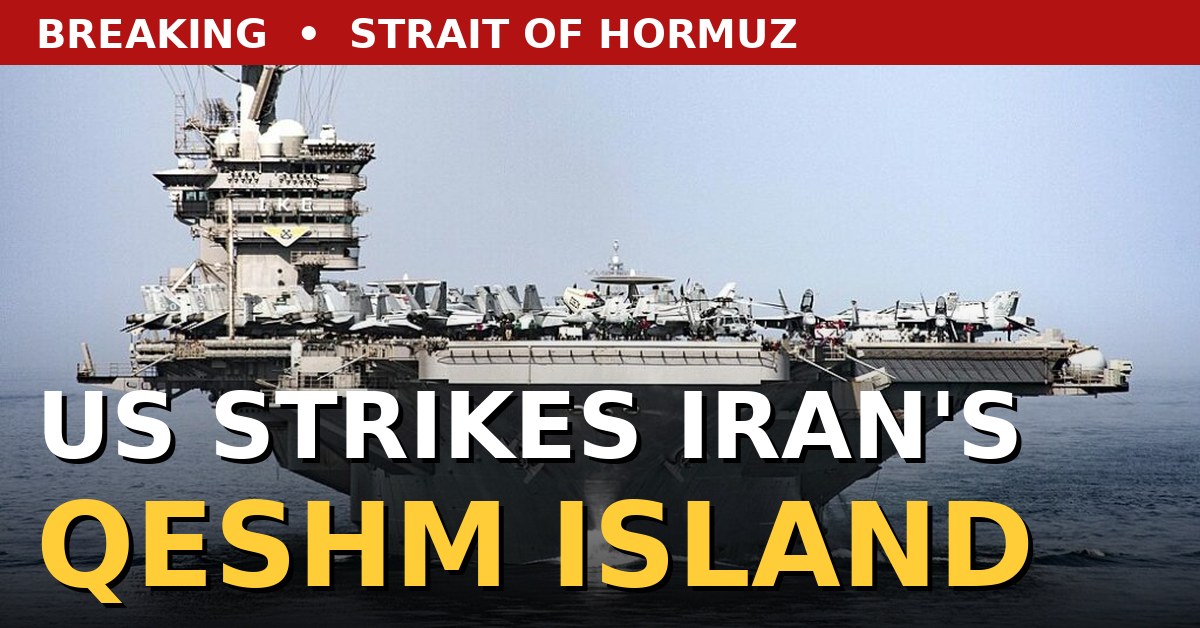
US strikes Iran Qeshm Island in a limited operation on Monday night, The Wall Street Journal reported, citing US officials — the latest in a series of secretive American operations that have quietly continued even as Washington talks up a possible deal with Tehran.
The operation targeted a missile launcher on the island after Iran’s Islamic Revolutionary Guard Corps fired a surface-to-air missile at an American aircraft over the Strait of Hormuz, Axios reported, quoting a US official. A US fighter jet then destroyed the launcher in self-defense.
Three US officials told CNN the US strikes Iran Qeshm Island were defensive in nature and meant to protect American assets in the region. “This was a defensive measure for Iranians using surface-to-air missiles against US assets,” one official said.
The Trigger: Iranian Fire on a US Aircraft
According to American accounts, the immediate provocation was Iranian fire on a US military aircraft. The National reported that an Iranian surface-to-air missile brought down an American drone over waters east of the Strait of Hormuz, and that Iranian media published images purporting to show the interception and destruction of a US MQ-9 Reaper drone.
In a separate incident the same day, US forces reportedly intercepted an IRGC missile launched from Qeshm that was targeting commercial shipping, officials told the Journal — underscoring how close the fighting has crept to the world’s most important oil chokepoint.
Qeshm, the largest island in the Strait of Hormuz, sits about 14 miles from the Iranian port city of Bandar Abbas and is home to a large underground missile site, a naval base, and a major desalination plant. Roughly 20 million barrels of oil passed through the strait every day before the war began — a flow that has been largely blocked since February.
What Iran Is Saying
Iranian state news agency IRNA reported that five explosions were heard in rapid succession on the island on Monday, with some residents saying they saw two aircraft in the skies. Blasts were also reported from the direction of the sea near Bandar Lengeh.
The IRGC had earlier claimed it captured US reconnaissance drones near the strait. US Central Command, which oversees American forces in the Middle East, did not immediately respond to a request for comment, and officials offered no details about casualties or damage.
A Pattern of Secret Strikes
The Journal’s reporting is significant for what it reveals about the war’s hidden rhythm: Washington has been engaged in smaller-scale strikes against Iran for several weeks, deliberately keeping them secret so as not to signal any intent of resuming its major military campaign.
Officials described the US strikes Iran Qeshm Island operation as limited by design — not the kind of major combat operation that has been contemplated in Washington. One official said the strikes were also meant to deny Iran the freedom to attack commercial ships in the strait, keeping the pressure on Tehran without collapsing the fragile diplomatic track.
The US has targeted Qeshm Island previously in the war, and the island’s underground missile complex makes it a recurring focus of American planners. For a deeper look at how the conflict is straining Iran’s infrastructure, see our coverage of Iran’s canceled flights as sanctions bite.
Trump’s Mixed Signals
The strike landed on the same day President Donald Trump raised doubts about whether he would follow through on his threatened resumption of military strikes against Iran — and said a deal with Tehran could still happen. Asked by reporters whether he was considering striking Iran after Tuesday’s midterm elections, Trump replied simply: “no.”
The contrast captures the administration’s dual approach: pursuing indirect negotiations with Tehran — mediated in Doha — while maintaining military resolve in the Gulf. The United States and Iran have been at war since February 28, making this an eight-month-old conflict fought increasingly in the shadows.
What Happens Next
Coming on the eve of Election Day, the operation is a reminder that the Iran situation remains unresolved and that combat is very much still on the table — whatever the diplomatic signaling suggests. With CENTCOM staying silent and casualty details absent, the full scope of the strike may take days to emerge.
Markets and shippers will be watching the Strait of Hormuz closely: every exchange of fire near the chokepoint raises the risk premium on the oil that still moves through the region — and on the ships that carry it. For the original reporting, see Reuters’ coverage of the US strike on Qeshm Island.