
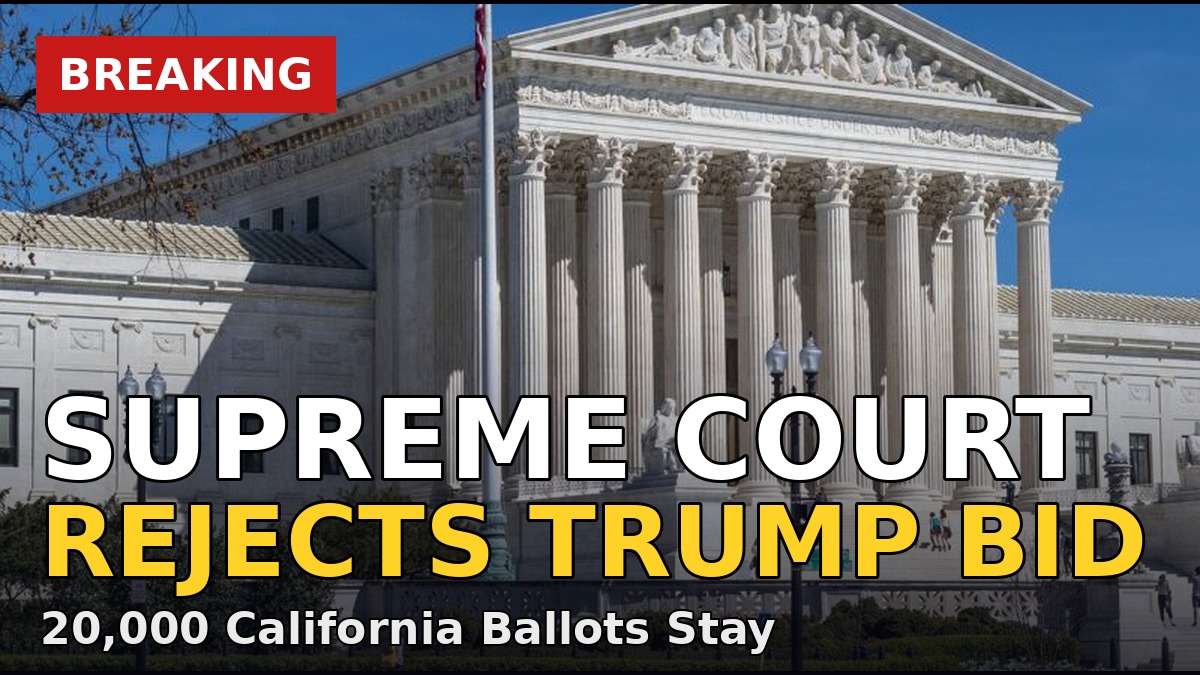
The Supreme Court Says No, Hours Before Election Day
One day before the most consequential midterm election in a generation, the Supreme Court handed President Donald Trump an unmistakable rebuke: it will not force California to set aside the mail-in ballots of more than 20,000 registered voters the administration claims may not be American citizens.
The justices denied the Justice Department’s emergency request on Monday, November 2, just hours after it was filed — an unusually fast turnaround that left California’s existing ballot-counting procedures untouched as millions of voters head to the polls to decide which party will control Congress.
The order was brief and unsigned, a single sentence offering no explanation, as is typical when the court handles emergency matters. No justice publicly dissented. Perhaps most telling: the court did not even ask California for a response, a step it usually takes when it gives serious consideration to an emergency request.
What the Trump Administration Was Asking For
The Justice Department wanted the Supreme Court to order California to segregate any mailed ballots cast by voters on a list compiled by the Department of Homeland Security — and to keep those ballots from being counted until each voter’s citizenship could be verified.
Solicitor General D. John Sauer argued that once California mixes the challenged ballots with lawful ones, “there is no way to get the challenged ballots back” if the voters later turn out to be ineligible. The administration’s position: segregate now, verify later.
The underlying dispute began in October, when the Justice Department sued California, claiming the state was obstructing enforcement of the federal law that makes it a crime for noncitizens to vote in federal elections. At first the government claimed California’s voter rolls contained as many as 190,000 people in the country illegally; it has since revised that figure down to roughly 20,000.
Why Lower Courts Already Said No
The Supreme Court’s denial was the third defeat for the Justice Department in as many rounds — a losing streak that began well before the eve of the election.
On October 28, U.S. District Judge David Carter rejected the department’s request for a temporary restraining order that would have prevented California from counting ballots connected to voters on the federal list. Carter’s language was striking: “Never before in American history has the federal government, on the eve of an election, sought to coerce a state and local government to abandon their own Constitutional election procedures and bend to the will of the Executive Branch.”
Two days later, a divided panel of the 9th U.S. Circuit Court of Appeals refused the administration’s request again, in a 2–1 decision. The majority warned that forcing California to use the federal list could block valid votes from being counted and jeopardize the entire Los Angeles County election. In dissent, Circuit Judge Patrick Bumatay called the government’s proposed fix reasonable, arguing it “would not cancel any vote but would allow time to verify the eligibility of suspected noncitizens.”
The Unreliable List at the Center of the Fight
California’s central objection is that the Homeland Security list is unreliable — and could sweep up thousands of perfectly eligible American citizens.
The state argues that forcing it to segregate ballots based on the list would disenfranchise legitimate voters on the eve of an election that has been underway since early October, with ballots mailed to some 23 million registered voters and hundreds of thousands already processed.
The appeals court also pointed to the National Voter Registration Act, which bars systematic voter-roll purges within 90 days of a federal election — a rule Congress wrote precisely to prevent last-minute changes like this one.
A Bigger Battle Over Who Runs American Elections
This case is not just about 20,000 ballots in California. It is part of President Trump’s broader push to expand the federal government’s role in running elections — a role the Constitution assigns to the states and to Congress, not the executive branch.
Trump has alleged, without evidence, that noncitizens are swinging American elections by voting illegally. Federal law already makes noncitizen voting a criminal offense, and documented cases remain vanishingly rare — but the allegation has become a cornerstone of the administration’s election agenda.
The September ruling is worth remembering here: just weeks ago, the Supreme Court rejected an earlier Trump administration effort to restrict mail-in voting. Monday’s one-sentence denial continues that pattern — the court, for now, is not willing to rewrite election procedures days before an election.
What It Means for Tuesday’s Midterms
With the Supreme Court declining to intervene, the lower-court rulings stand. California will not be required to build a special system to segregate the challenged ballots before Tuesday’s election, and the state’s normal procedures for processing ballots and verifying voter eligibility remain in place.
For voters, the message is simple: nothing changes. Mail-in ballots already received will be counted under the same rules as before, and the 20,000 challenged ballots remain commingled with the rest — exactly where the Justice Department said they should not be, and exactly where California says the law requires them to be.
For the administration, the defeat lands at the worst possible moment politically. Monday’s ruling adds another judicial loss to a record that the court itself declined to explain — and sets the terms for an election where every party is now watching California’s count, and Washington’s next move, with unusual intensity. For the original reporting, see USA Today’s coverage of the Supreme Court’s rejection of the ballot bid.