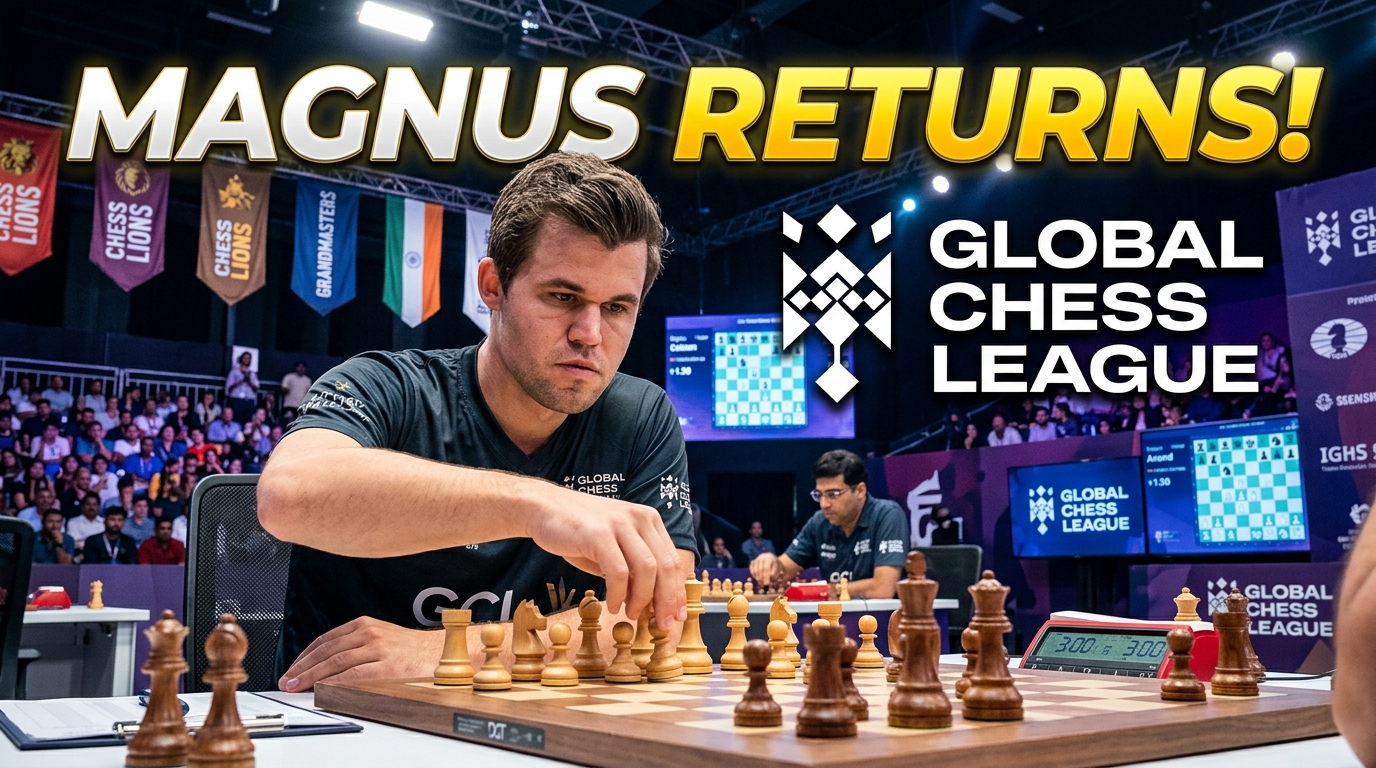
Global Chess League and Franchise Revolution: Magnus Carlsen’s Return, Team Formations, and the Future of Professional Chess
The landscape of competitive chess is undergoing a radical transformation. Long defined by grueling individual classical tournaments, the sport has successfully embraced a high-octane franchise model that mirrors mainstream global leagues. At the forefront of this movement is the Tech Mahindra Global Chess League (GCL), which has captured the imagination of millions worldwide.
With marquee names returning to the fold, high-profile strategic ownership groups stepping in, and innovative format rules designed for maximum viewer engagement, professional chess has firmly entered a new era of entertainment and athletic prestige.
Also read:
Global Markets and Inflation: US Stocks, Tech Earnings, and Investor Sentiment
The Rise of Franchise Chess: A Paradigm Shift
For decades, chess was perceived primarily as an isolated, solitary battle of wits. While classical championships retain their historic prestige, they rarely offered the collaborative dynamics, team strategies, or broadcast-friendly pacing required to capture mass commercial audiences.
The introduction of franchise-based team events changed this narrative entirely. By combining elite grandmasters, rising women superstars, and emerging prodigies into single unified teams, leagues like the GCL created a completely new tactical ecosystem. Every game impacts a collective team score, turning individual brilliance into a shared pursuit.
Strategic investments further validate this shift. For instance, the inclusion of high-profile international sports figures—such as former FC Barcelona star Gerard Piqué joining the FYERS American Gambits as a strategic shareholder alongside Indian cricketer R. Ashwin—highlights how mainstream sports capital is flowing into professional chess.
Magnus Carlsen and the Quest for Team Glory
The most significant storyline dominating current chess headlines is the high-profile return of World No. 1 Magnus Carlsen. After skipping the previous season, the Norwegian GOAT is back on Indian soil, leading the defending champions, the Alpine APL Pipers, at the majestic Bangalore Palace.
Despite an unrivaled individual trophy cabinet, Carlsen has famously had a complicated relationship with team competitions. Aside from a European Club Cup victory, major team gold medals have often eluded him. Speaking candidly at the pre-tournament press conference, Carlsen emphasized his intense focus:
“I am focused on playing the tournament here. I am very excited to be back. Of course, I am a little bit surprised to be back, seeing as we had a couple of really frustrating years for the team… this time, I am just trying to do my best.”
The Alpine APL Pipers feature a formidable lineup designed to break that streak. Alongside Carlsen on the Icon board, the team boasts 2026 Candidates runner-up Anish Giri, Vidit Gujrathi, chess queen Koneru Humpy, and 2025 Women’s World Cup sensation Divya Deshmukh making her high-stakes league debut.
Team Formations, Squads, and Strategic Lineups
The tournament features six powerhouse franchises competing across a double round-robin format, culminating in a high-stakes final. Each team match is fought across six distinct boards: one Icon, two Superstar Men, two Superstar Women, and one Prodigy.
| Franchise Team | Icon Player | Key Superstar Men | Key Superstar Women | Prodigy / Young Talent |
| Alpine APL Pipers | Magnus Carlsen | Anish Giri, Vidit Gujrathi | Koneru Humpy, Divya Deshmukh | Volodar Murzin |
| PBG Alaskan Knights | Viswanathan Anand | Arjun Erigaisi | (Balanced Roster) | Abhimanyu Mishra, Yagiz Kaan Erdogmus |
| Triveni Continental Kings | Alireza Firouzja | Wei Yi, Aravindh Chithambaram | Zhu Jiner, Alexandra Kosteniuk | Pranav V |
| FYERS American Gambits | Javokhir Sindarov | Daniil Dubov, Nihal Sarin | Bibisara Assaubayeva, Sarasadat Khademalsharieh | Marc Andria Maurizzi |
| CheQ Mumba Masters | Maxime Vachier-Lagrave | Shakhriyar Mamedyarov, Vladimir Fedoseev | Carissa Yip, Dronavalli Harika | Daneshvar Bardiya |
| Ganges Grandmasters | Ian Nepomniachtchi | Levon Aronian, Leinier Dominguez | (Balanced Roster) | (Rising Talent) |
Innovation, Time Controls, and Broadcast Tech
To keep fans glued to their screens, the league implements a dynamic rapid time control: 20 minutes per player with a 2-second increment added only from Move 41. This ensures rapid time scrambles, psychological pressure, and decisive results.
Furthermore, the scoring system incentivizes aggressive, risk-taking chess. Winning with the Black pieces awards 4 Game Points, while a win with White grants 3 points, and a draw yields 1 point. This bold rule discourages safe draws and forces players to fight for advantages out of the opening.
On the technological front, organizers are integrating augmented reality (AR), virtual reality (VR), physical AI applications, and live match-winning probability meters into the broadcast. These tools bridge the gap between casual viewers and grandmaster-level complexity, making the matches deeply immersive.
Frequently Asked Questions (FAQs)
What is the Global Chess League (GCL)?
The Global Chess League is a franchise-based professional chess tournament jointly organized by Tech Mahindra and FIDE. It features top international grandmasters competing in mixed-gender teams across a fast-paced rapid format.
Why did Magnus Carlsen skip Season 3?
Magnus Carlsen skipped the third season due to scheduling conflicts and personal workload management, but he has returned for Season 4 as the Icon player for the defending champions, Alpine APL Pipers.
How does the GCL team scoring system work?
Matches are played across six boards simultaneously. Teams earn Match Points (MP) based on overall match wins, while individual games accumulate Game Points (GP). Notably, winning with the Black pieces grants 4 points compared to 3 for White, encouraging dynamic play.
Who are some of the notable debutants in the current season?
The current season features high-profile debuts such as 2025 Women’s World Cup winner Divya Deshmukh, who joins the Alpine APL Pipers.
Conclusion
The evolution of professional chess through global franchise events marks a monumental leap forward for the sport. By marrying elite sports entertainment with cutting-edge technology, rapid time controls, and multi-generational team lineups, leagues like the GCL have successfully expanded chess’s global footprint. As Magnus Carlsen and other titans battle it out over the board, one thing is certain: the future of competitive chess is fast, fierce, and fiercely collaborative.