
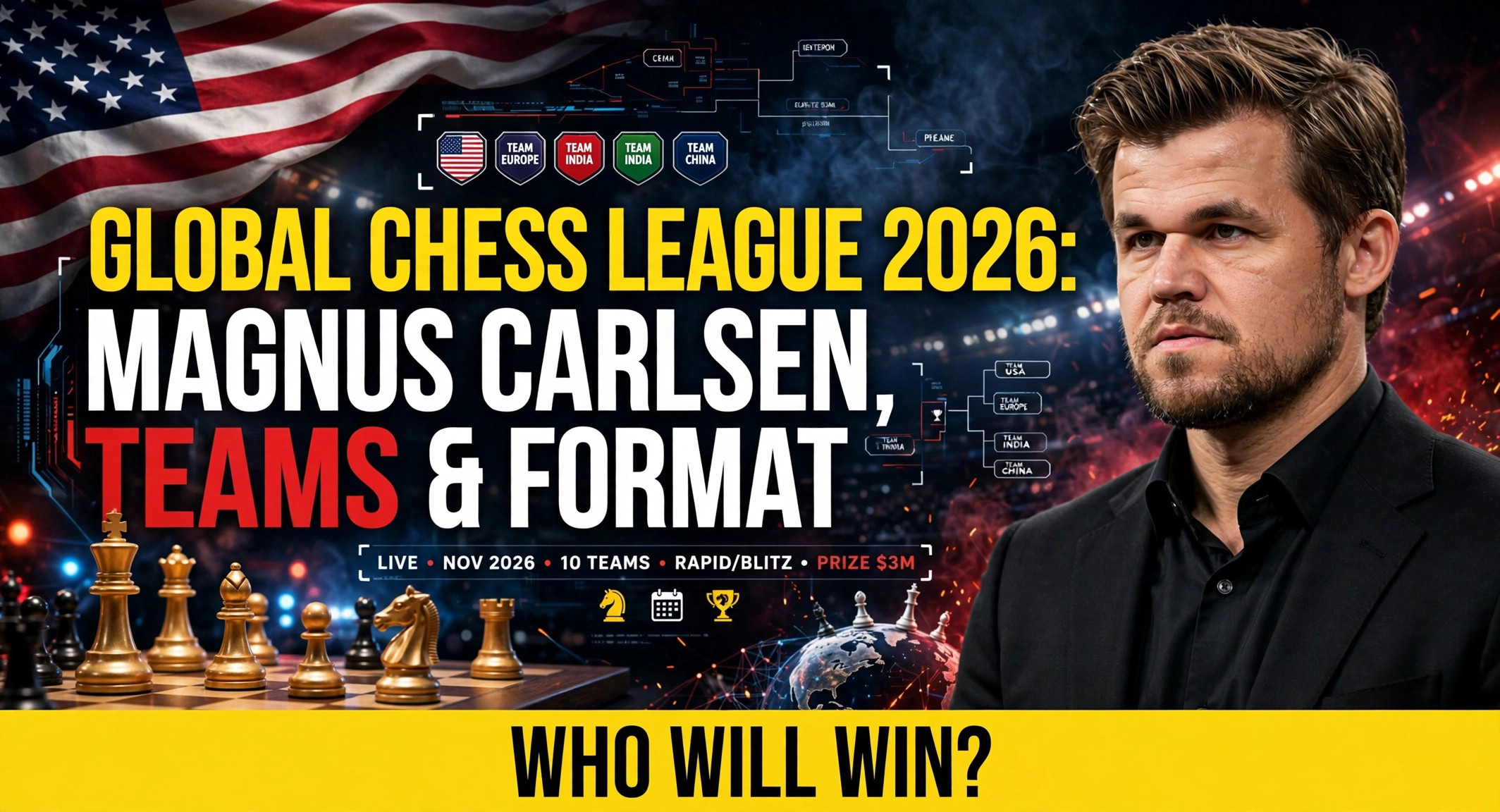
Global Chess League and Franchise Revolution: Magnus Carlsen’s Return, Team Formations, and the Future of Professional Chess
Competitive chess doesn’t look the way it used to. For decades it was the lonely grind of individual classical tournaments — now it’s a high-octane franchise model, built for arenas and broadcasts the way mainstream leagues are. And the Tech Mahindra Global Chess League (GCL) is leading the charge, pulling in millions of viewers worldwide.
Marquee names are coming back. Big-money owners are buying in. The format itself is engineered for drama. Put it together and professional chess has walked into a new era — part sport, part entertainment spectacle.
Also read:
Global Markets and Inflation: US Stocks, Tech Earnings, and Investor Sentiment
The Rise of Franchise Chess: A Paradigm Shift
Chess spent decades being perceived as a solitary battle of wits. Classical championships kept their historic prestige, sure. But they never offered the team dynamics, the tactics, or the broadcast-friendly pace needed to win over mass commercial audiences.
Then came the franchise team events, and the whole narrative flipped. Elite grandmasters, rising women’s superstars, and teenage prodigies now share a single roster. Every result feeds a collective team score. Individual brilliance became a shared pursuit — and the GCL built an entirely new tactical ecosystem out of it.
The money followed fast. When former FC Barcelona star Gerard Piqué joined the FYERS American Gambits as a strategic shareholder — alongside Indian cricketer R. Ashwin — it sent a clear signal: mainstream sports capital now sees professional chess as an asset worth owning.
Magnus Carlsen and the Quest for Team Glory
The biggest storyline in chess right now is the return of World No. 1 Magnus Carlsen. After sitting out last season, the Norwegian GOAT is back on Indian soil — leading the defending champions, the Alpine APL Pipers, at the majestic Bangalore Palace.
Here’s the twist: for all his individual silverware, Carlsen has a complicated history with team events. Aside from a European Club Cup victory, the big team golds have mostly slipped through his fingers. At the pre-tournament press conference, he didn’t hide behind clichés:
“I am focused on playing the tournament here. I am very excited to be back. Of course, I am a little bit surprised to be back, seeing as we had a couple of really frustrating years for the team… this time, I am just trying to do my best.”
The Pipers have loaded up to end that drought. Next to Carlsen on the Icon board sit 2026 Candidates runner-up Anish Giri and Vidit Gujrathi, chess queen Koneru Humpy, and 2025 Women’s World Cup sensation Divya Deshmukh — making her high-stakes league debut. That’s a formidable lineup by any measure.
Team Formations, Squads, and Strategic Lineups
Six powerhouse franchises are going at it in a double round-robin format, all roads leading to one high-stakes final. Each team match is contested across six boards: one Icon, two Superstar Men, two Superstar Women, and one Prodigy.
- Alpine APL Pipers — Icon: Magnus Carlsen; Superstar Men: Anish Giri, Vidit Gujrathi; Superstar Women: Koneru Humpy, Divya Deshmukh; Prodigy: Volodar Murzin.
- PBG Alaskan Knights — Icon: Viswanathan Anand; Superstar Men: Arjun Erigaisi; Superstar Women: (Balanced Roster); Prodigy: Abhimanyu Mishra, Yagiz Kaan Erdogmus.
- Triveni Continental Kings — Icon: Alireza Firouzja; Superstar Men: Wei Yi, Aravindh Chithambaram; Superstar Women: Zhu Jiner, Alexandra Kosteniuk; Prodigy: Pranav V.
- FYERS American Gambits — Icon: Javokhir Sindarov; Superstar Men: Daniil Dubov, Nihal Sarin; Superstar Women: Bibisara Assaubayeva, Sarasadat Khademalsharieh; Prodigy: Marc Andria Maurizzi.
- CheQ Mumba Masters — Icon: Maxime Vachier-Lagrave; Superstar Men: Shakhriyar Mamedyarov, Vladimir Fedoseev; Superstar Women: Carissa Yip, Dronavalli Harika; Prodigy: Daneshvar Bardiya.
- Ganges Grandmasters — Icon: Ian Nepomniachtchi; Superstar Men: Levon Aronian, Leinier Dominguez; Superstar Women: (Balanced Roster); Prodigy: (Rising Talent).
Innovation, Time Controls, and Broadcast Tech
To keep fans glued to their screens, the league runs a rapid time control: 20 minutes per player with a 2-second increment added only from Move 41. That’s a recipe for time scrambles, psychological cracks, and decisive results.
The scoring rewards guts, too. A win with the Black pieces is worth 4 Game Points; White gets 3; a draw yields 1. Safe, boring draws get punished — the rules push players to fight out of the opening.
Then there’s the broadcast itself: augmented reality, virtual reality, physical AI applications, and live match-winning probability meters. These tools shrink the gap between a casual viewer and grandmaster-level complexity. Matches feel immersive instead of impenetrable.
Frequently Asked Questions (FAQs)
What is the Global Chess League (GCL)?
A franchise-based professional chess tournament run jointly by Tech Mahindra and FIDE. It lines up top international grandmasters in mixed-gender teams and plays everything at a fast rapid pace.
Why did Magnus Carlsen skip Season 3?
Scheduling conflicts and workload management — he needed the break. He’s back for Season 4 as the Icon player for the defending champions, the Alpine APL Pipers.
How does the GCL team scoring system work?
Matches run across six boards at once. Teams collect Match Points (MP) for overall match wins, while individual games stack up Game Points (GP). The kicker: winning with Black earns 4 points versus 3 for White — a deliberate nudge toward fighting chess.
Who are some of the notable debutants in the current season?
The headline debut is 2025 Women’s World Cup winner Divya Deshmukh, lining up for the Alpine APL Pipers. Her high-stakes league debut is one of the season’s most-watched storylines.
Conclusion
Franchise chess has given the sport something it never had: a team identity, a broadcast pulse, and owners who think in terms of entertainment. Elite competition, rapid time controls, cutting-edge tech, and lineups spanning three generations — the GCL has genuinely stretched chess’s global footprint. As Carlsen and the rest of the field battle over the board, one thing feels settled: competitive chess is going to be fast, fierce, and fiercely collaborative from here on.
1 thought on “Global Chess League 2026: Magnus Carlsen, Teams & Format”