
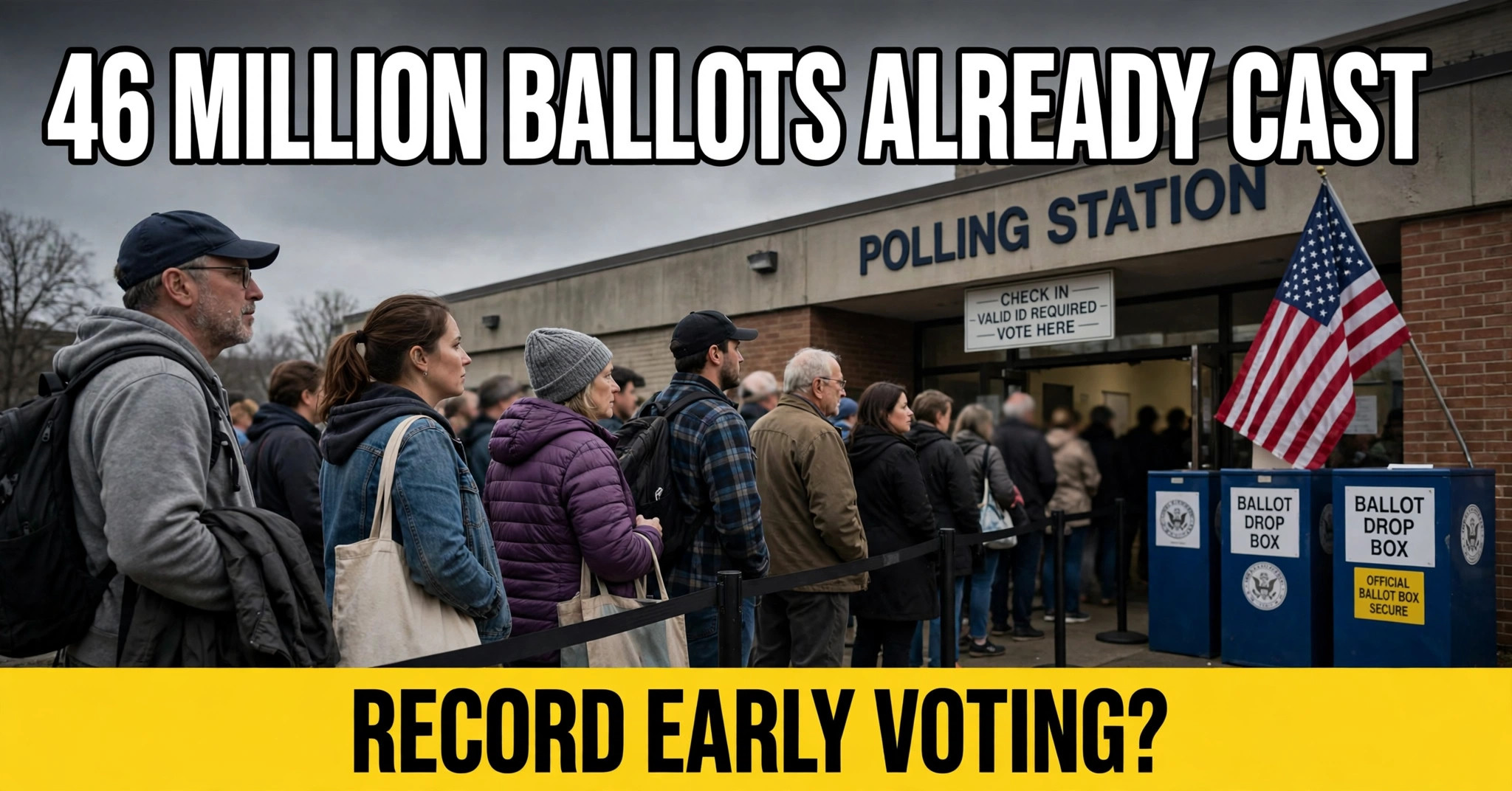
Early voting breaks midterm record as more than 46 million Americans have already cast ballots in the 2026 midterm elections, topping the 45.9 million early votes recorded during the entire 2022 midterm — with four days still to go before Election Day on Tuesday, November 3.
The figures come from the University of Florida Election Lab’s widely followed tracker, which compiles early-vote totals as states report them. When the early voting breaks midterm record fell on October 30, it set a new all-time high for early voting in any midterm, and the count is still climbing.
It is the latest sign that casting a ballot before Election Day has gone from the exception to the norm in American elections. About half of all ballots in the 2022 midterms were cast early; in 2016, that share was roughly 40 percent, according to the Center for Election Innovation & Research.
Early voting breaks midterm record: the numbers
As of October 30, more than 46 million early ballots were in, according to the Election Lab. Totals vary slightly between trackers as states report new data, but every major count agrees the early voting breaks midterm record now belongs to 2026.
The split between voting methods is nearly even. About 24.1 million ballots have been cast in person and 21.7 million returned by mail, per OnPoint Politics. The two parties are voting differently, though: Democrats appear to be moving from mail voting toward early in-person voting, while Republicans may be shifting toward voting in person closer to Election Day, experts told Axios and iHeart.
The biggest states are doing the heavy lifting. Texas had banked more than 6.3 million early votes as of October 28, according to the Associated Press. Florida has about 4.5 million and North Carolina about 2.4 million, per OnPoint Politics.
Older voters dominate the early electorate so far. Among early voters with age data available, about half are 65 or older, while only 4.5 percent are between 18 and 25, University of Florida data reported by Newsweek shows. Election researchers also report unusually strong early participation among unaffiliated voters as well as Black and Hispanic voters, according to Axios.
How 2026 compares with past midterms
The 2022 midterms were already a high-water mark: about 45.9 million people voted early that year. This year’s early voting breaks midterm record push passed that mark on October 30, with several days of early voting still to run in most states.
The gains are striking in key states. Texas is up 50 percent from the same point four years ago — 6.3 million versus 4.2 million — and South Carolina is also running well ahead of its 2022 pace, the AP reports.
University of Florida political scientist Michael McDonald, who runs the Election Lab, says overall turnout could surpass 2022. That would be no small feat: Michigan and Georgia both set midterm turnout records in 2022, and Michigan has only recently expanded statewide early voting, which makes direct comparisons harder, the AP notes.
The longer trend is unmistakable. About 40 percent of ballots were cast before Election Day in 2016. That rose to 50 percent in the 2022 midterm, per the Center for Election Innovation & Research. Early voting has not just grown — it has become the way a huge share of Americans vote.
What is new this year
The early voting breaks midterm record also reflects how much access has expanded. Forty-seven states and Washington, D.C., now offer early in-person voting to all voters, and 37 states plus D.C. offer no-excuse mail voting, according to the Center for Election Innovation & Research. Back in 2000, only 24 states offered early voting at all.
Several states are running new systems for the first time this cycle. Connecticut is holding its first midterm with permanent early in-person voting, which began in 2024; early voting there runs October 19 through November 1, per Ballotpedia. Michigan is holding its first midterm with early in-person voting statewide after voters approved it in November 2022, the AP reports. New York is holding its first midterm with no-excuse mail voting, which the state offered temporarily during COVID-19 before making it permanent starting in 2024.
Three states remain holdouts: Alabama, Mississippi and New Hampshire still do not offer early in-person voting to all voters, according to the National Conference of State Legislatures.
The rules around mail ballots have tightened in some places. Kansas, North Dakota, Ohio and Utah passed laws in 2025 ending grace periods for mail ballots, CBS News reports — ballots there must arrive by Election Day to count. Elsewhere, the Supreme Court kept grace periods intact: in Watson v. RNC, decided 5-4 on June 29, the Court ruled states may count mail ballots postmarked by Election Day that arrive afterward. Fourteen states and D.C. have such windows, ranging from one day in Texas to 21 days in Washington, according to the R Street Institute and Votebeat.
What the early numbers cannot tell you
The early voting breaks midterm record is exciting, but experts urge caution about reading too much into it. Turnout is not support: early totals measure who is voting, not who they are voting for, as ABC7 notes.
Party registration figures get a lot of attention — and a lot of misreading. In states that report it, registered Democrats have cast 43.9 percent of early ballots and Republicans 31.3 percent, according to the Election Lab. That shows who returned a ballot, not how they marked it. Plenty of registered partisans cross party lines, and unaffiliated voters — who are turning out in unusual numbers this year — do not show up in either column.
Timing also differs by party. Experts note Republicans may be shifting toward in-person voting closer to Election Day, while Democrats appear to be moving from mail voting to early in-person voting. A lopsided early count can look very different once Election Day votes are added.
And records do not decide races. Harris County, Texas, had 862,700 early votes as of October 28, compared with 564,500 at the same point in 2022, the AP reports. The county also set early-vote records in 2018 — and Democrats still lost statewide that year, ABC13 notes.
Finally, states are not apples to apples. Different rules, voting windows and reporting practices make comparisons difficult, as ABC7 points out. A state that started early voting weeks ago will always look busier than one that just opened its polls.
Sources and Resources
This story is based on No Labels’ “Early Voting Breaks the Midterm Record: What 46 Million Ballots Tell Us About 2026” (October 30, 2026), which draws on the University of Florida Election Lab’s early-vote tracker and reporting from the Associated Press, Axios, Newsweek, the Center for Election Innovation & Research and Ballotpedia.
Related: Trump Restores Cancelled Iowa and Kansas Rallies Days Before Midterms
Frequently Asked Questions
How many people have voted early in the 2026 midterms?
More than 46 million Americans had voted early as of October 30, 2026, according to the University of Florida Election Lab. The early voting breaks midterm record tops the 45.9 million early votes cast during the entire 2022 midterm.
When is Election Day 2026?
Election Day is Tuesday, November 3, 2026. Early voting is available to all voters in 47 states and Washington, D.C., though dates and hours vary by state.
Which states have the most early votes so far?
Texas leads with more than 6.3 million early votes as of October 28, followed by Florida with about 4.5 million and North Carolina with about 2.4 million.
Does the early vote tell us who is winning?
No. Early totals measure who is voting, not who they are voting for. Party registration of early voters gets attention — Democrats at 43.9 percent, Republicans at 31.3 percent in states that report it — but that shows who returned a ballot, not how they marked it.
Can I still vote early?
In most states, yes — early in-person voting runs through the weekend in many places, though exact end dates vary. Alabama, Mississippi and New Hampshire do not offer early in-person voting to all voters. Check your state’s election office for hours and locations.
Conclusion
In just a few years, voting early has gone from the exception to the norm — and the early voting breaks midterm record set in 2026 has raised the bar higher. More than 46 million ballots are already in, with days of voting still to come.
The early numbers show Americans are engaged. Who they chose will not be known until the votes are counted on November 3.