
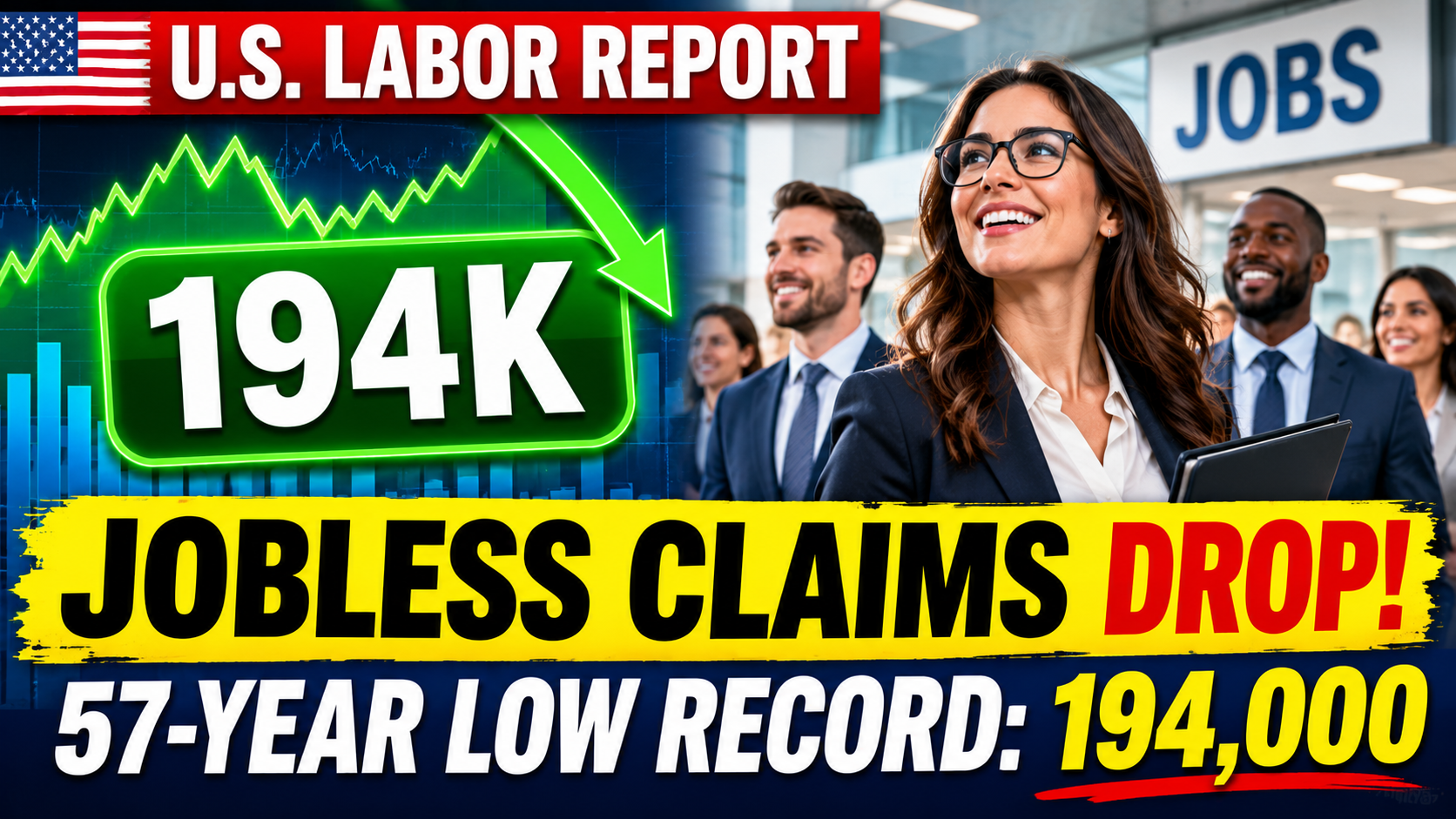
US Weekly Jobless Claims Fall to 194,000, Hovering Near 57-Year Lows
Introduction: Labor Market Resilience Beats Expectations
The United States economy continues to show extraordinary labor resilience in the face of broader macroeconomic uncertainty. According to the latest data released by the U.S. Department of Labor, US weekly jobless claims fall to 194,000, hovering near 57-year lows. The new figures highlight sustained employer reluctance to lay off workers despite elevated interest rates, trade adjustments, and ongoing foreign policy developments.
For the week ending October 24, initial state unemployment benefit claims decreased by 1,000 to a seasonally adjusted 194,000. This latest reading keeps first-time filings within striking distance of the multi-decade record low of 189,000 touched earlier in July, underscoring historically low historical levels of corporate downsizing across key domestic industries.
Also Read:
Pentagon Fires Top Military Planner Lt. Gen. Brett Sylvia Over Alleged Classified Leaks
Detailed Analysis of Initial and Continuing Claims Data
The Department of Labor’s Unemployment Insurance Weekly Claims report outlines stability across primary employment metrics. The upwardly revised figure for the prior week was set at 195,000, demonstrating that claim totals have remained steadily below the crucial 200,000 threshold for several consecutive weeks.
Initial Claims Reduction: Seasonally adjusted first-time applications declined by 1,000 to reach 194,000. Unadjusted claims also showed state-level pullbacks, led by substantial declines in states like Ohio, Tennessee, and California.
Four-Week Moving Average: The four-week moving average—a metric favored by economic analysts to smooth out short-term weekly volatility—fell by 1,250 to 196,750.
Continuing Claims Drop: The number of individuals continuing to receive state unemployment benefits after an initial week of aid dropped by 21,000 to a seasonally adjusted 1.701 million for the week ending October 17.
Insured Unemployment Rate: The seasonally adjusted insured unemployment rate held steady at 1.1%, reflecting a stable underlying workforce participation baseline.
[Weekly Initial Claims Drop to 194,000] ---> [4-Week Average Moves to 196,750] ---> [Continuing Claims Decline to 1.701M] ---> [Labor Market Near 57-Year Lows]
Key Drivers of Ongoing Job Market Strength
Economists point to several structural and corporate factors insulating American workers from mass layoffs:
1. Robust Corporate Profitability and Demand
Despite elevated borrowing costs, solid corporate profit margins and sustained consumer demand have allowed businesses to retain existing staff. Rather than cutting headcounts to reduce operating expenses, major employers have increasingly prioritized retention over fresh recruiting drives.
2. Shifting Labor Supply Dynamics
Demographic adjustments, along with ongoing immigration policy enforcement, have tightened overall labor force growth. With a constrained labor supply pool, employers remain cautious about reducing existing staff, fearing future difficulties in rehiring qualified personnel when economic expansion accelerates.
3. Strategic Hiring and Retention Tactics
While top-line payroll expansion has moderated compared to post-pandemic spikes, the lack of aggressive hiring has been balanced by an equally muted rate of worker termination. This “low-hiring, low-firing” equilibrium keeps overall unemployment claims near historic lows.
| Claims Benchmark Metric | Reported Current Level | Historical & Economic Context |
| Initial Jobless Claims | 194,000 | Decreased by 1,000; hovers near the 57-year low recorded in 1969 |
| 4-Week Moving Average | 196,750 | Down 1,250; signals persistent weekly stability in worker filings |
| Continuing Claims | 1.701 Million | Fell by 21,000; indicates jobless workers are finding replacement positions |
| Insured Unemployment Rate | 1.1% | Unchanged; demonstrates strong workforce stability nationwide |
Economic Outlook and Federal Reserve Policy Expectations
The strength of the employment market comes at a pivotal moment for monetary policy makers at the Federal Reserve. With the labor market continuing to exhibit strength, central bank officials face a nuanced landscape as they weigh future benchmark interest rate decisions.
While recent consumer confidence indexes show growing optimism regarding employment security, market analysts remain watchful regarding long-term business expenditures amid global trade dynamics and geopolitical headlines. However, current data suggests that the baseline foundation of U.S. employment remains firmly intact heading into the final quarter of the year.
Frequently Asked Questions (FAQs)
Q1: Why are US weekly jobless claims falling near 57-year lows?
A: Jobless claims remain near 57-year lows because employers are prioritizing worker retention, driven by steady consumer demand, solid corporate profits, and a tighter labor supply pool.
Q2: What was the exact initial jobless claims figure for the week ending October 24?
A: Initial jobless claims fell by 1,000 from the prior week’s revised total to a seasonally adjusted 194,000.
Q3: How did continuing claims for unemployment benefits perform in the latest report?
A: Continuing claims dropped by 21,000 to a seasonally adjusted 1.701 million for the week ending October 17.
Q4: What is the 4-week moving average for jobless claims?
A: The four-week moving average of initial claims declined by 1,250 to 196,750, providing a smoothed picture of ongoing labor market strength.
Disclaimer
Disclaimer: This article summarizes economic data, statistical reports, and government releases provided by the U.S. Department of Labor as of late October 2026. Macroeconomic trends and official employment figures are subject to future routine revisions by government reporting agencies.