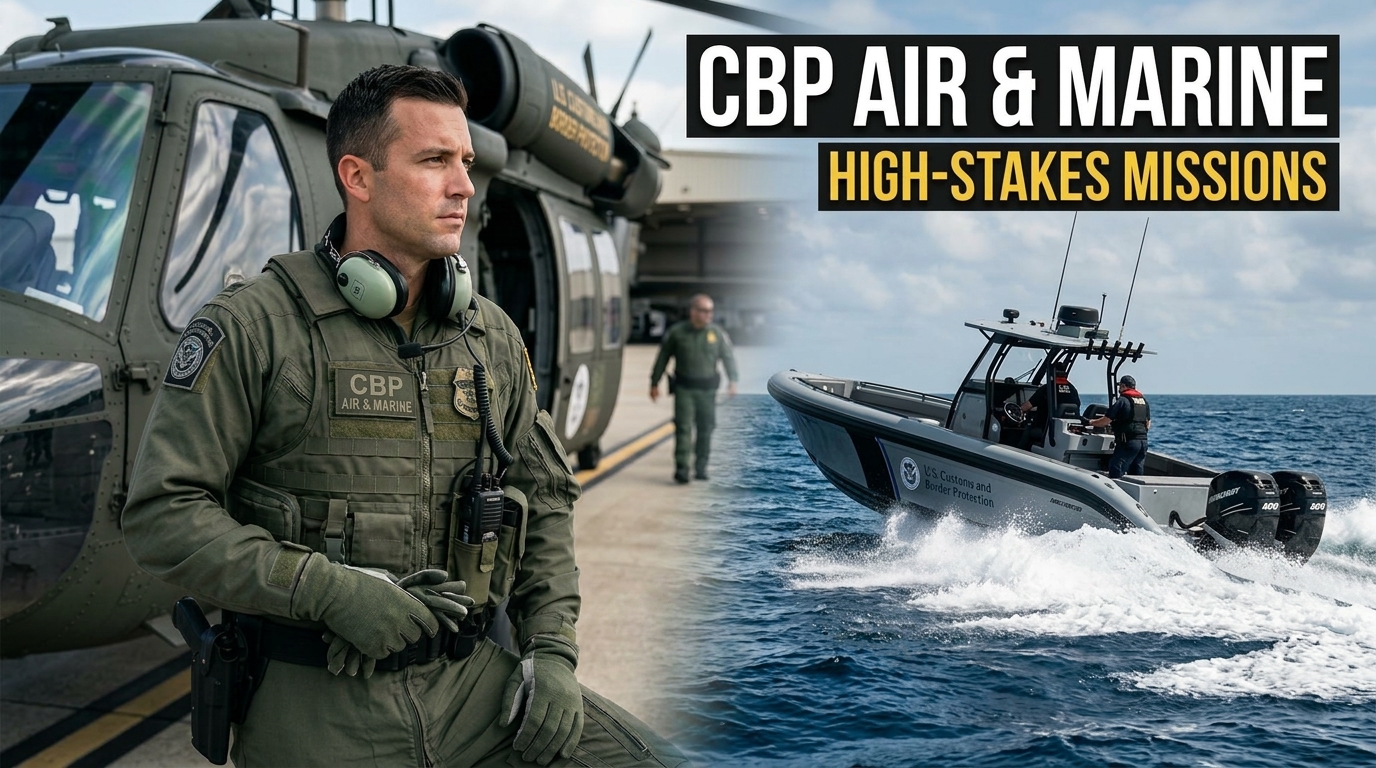
Introduction to CBP Air and Marine Operations (AMO)
The United States Customs and Border Protection (CBP) is the nation’s largest civilian law enforcement organization, tasked with keeping terrorists and their weapons out of the U.S. while facilitating lawful international travel and trade. Within this massive agency, Air and Marine Operations (AMO) serves as the critical aviation and maritime law enforcement component.
Also read:
How to Boost Everyday Productivity Using AI in 2026
Formed under CBP to unify the federal government’s airborne and maritime border security efforts, AMO commands a ready, highly specialized fleet. Operating from 74 locations across the United States and its territories, AMO agents fly over 240 aircraft—including UH-60 Black Hawk helicopters and Predator B unmanned aerial systems (drones)—and navigate more than 300 highly advanced marine vessels.
For professionals seeking an adrenaline-fueled, high-stakes career in federal law enforcement, becoming an AMO Pilot (Air Interdiction Agent) or a Marine Interdiction Agent offers an unparalleled opportunity to protect the homeland. From conducting counter-narcotics missions in the Caribbean to tracking illegal border crossings in the desert and executing high-risk search and rescue operations, AMO agents are always on the front lines.
This comprehensive guide breaks down the duties, stringent requirements, and intensive hiring processes for these elite law enforcement positions.
Air Interdiction Agents (CBP Pilots): Guardians of the Skies
An Air Interdiction Agent (AIA) is far more than a traditional pilot. As a fully sworn federal law enforcement officer, an AIA utilizes advanced aviation assets to track, intercept, and apprehend individuals involved in illegal smuggling, human trafficking, and terrorism.
Daily Responsibilities
AIAs conduct air-to-air, air-to-water, and air-to-ground interdiction missions. Typical responsibilities include:
Patrolling coastlines, borders, and inland waterways to detect and prevent the illegal entry of contraband and undocumented individuals.
Operating highly sophisticated manned and unmanned aircraft systems (UAS) while performing complex law enforcement missions.
Gathering tactical intelligence, monitoring suspect behavior patterns, and sharing critical data with local, state, and international task forces.
Testifying under oath in federal court proceedings regarding interdictions and arrests.
Minimum Hiring Requirements for Pilots
To take the yoke as a CBP Pilot, applicants must meet rigorous aviation standards:
Flight Hours: The minimum standard to enter on duty is 1,500 flight hours. However, waivers of up to 500 hours are available, reducing the requirement to 1,000 hours. Candidates can begin the application process with 750 flight hours, provided they reach the minimum before their final assessment.
Specific Ratings: You must possess a current FAA Commercial or ATP Pilot Certification. CBP hires dual-rated pilots (Airplane and Rotorcraft), airplane-rated pilots, and helicopter-rated pilots. Equivalent military ratings are also accepted.
Detailed Breakdown: The hours must include at least 250 Pilot-in-Command (PIC) hours, 75 instrument hours, and 75 night hours.
Age and Citizenship: Applicants must be U.S. citizens and must be referred for selection before their 40th birthday (exceptions exist for veterans’ preference eligible candidates and those with prior federal civilian law enforcement experience).
The Three-Part Flight Assessment
Candidates who meet the preliminary requirements must pass a strenuous one-day assessment:
Written Evaluation: Tests pilot knowledge based on published FAA Part 91 regulations, IFR EnRoute/Sectional Aeronautical Charts, and flight information publications.
Flight Evaluation: Candidates demonstrate flight proficiency in an AMO aircraft alongside a flight instructor, evaluated against FAA commercial pilot standards.
Structured Interview: Scenario-based questions that test judgment, decision-making, flexibility, and emotional maturity.
Marine Interdiction Agents: Protectors of the Seas
A Marine Interdiction Agent (MIA) commands CBP vessels and acts as the nation’s primary maritime law enforcement shield. Operating on the open ocean, the Great Lakes, and inland rivers, MIAs combat maritime smuggling and terrorism.
Daily Responsibilities
Whether at the helm of a 41-foot interceptor or a coastal patrol vessel, MIAs engage in highly dynamic maritime operations:
Serving as vessel commanders to conduct maritime patrols, surveillance, and pursuit activities.
Executing high-speed vessel pursuits and tactical intercepts of suspect boats attempting to enter U.S. waters illegally.
Searching vessels, cargo, and individuals to seize contraband, weapons, and illicit narcotics.
Collaborating with the U.S. Coast Guard and other agencies on joint investigations and search-and-rescue operations.
Minimum Hiring Requirements for Mariners
Experience & Licensing: Applicants must possess at least one year of specialized law enforcement experience and hold a valid United States Coast Guard (USCG) issued vessel license (such as an OUPV license).
General Prerequisites: Like pilots, MIAs must be U.S. citizens, pass a background investigation, possess a valid driver’s license, and be hired before their 40th birthday (unless veteran/federal waivers apply).
The Three-Part Vessel Assessment and Fitness Test
MIA candidates undergo a grueling evaluation to prove their maritime competence:
Structured Interview: Evaluates the candidate’s core competencies, such as integrity and rapid decision-making in high-stress maritime scenarios.
Vessel Evaluation: Candidates operate a 30-foot twin-engine vessel, demonstrating proficiency in close-quarter maneuvering, docking, open-water handling, and safety equipment usage.
Written Exam: Covers Navigation General, Deck General, and the “Rules of the Road.” Candidates must also demonstrate practical chart plotting.
Because maritime interdiction is physically demanding, MIAs must also pass a strict physical fitness test that includes a 1.5-mile run in under 16:30, 24 push-ups in one minute, a 220-yard sprint, a 100-yard non-stop swim, and a 5-minute water tread.
Additional Core Roles in AMO
While Pilots and Mariners are the tip of the spear, AMO relies on a broader team of professionals:
Detection Enforcement Officers: Conduct aviation and maritime surveillance, tracking threats and coordinating interdictions from advanced radar and control centers.
Aviation Enforcement Agents: Serve as federal agents aboard aircraft, handling tactical communications, airborne counter-terrorism detection, and suspect apprehension upon landing.
The Training Pipeline: FLETC and AMBTA
Successfully passing the assessments is just the beginning. All Air and Marine Agents must undergo an intense background investigation and pass a strict polygraph examination (though TS/SCI cleared veterans and prior federal LEOs may be eligible for waivers). Furthermore, candidates must obtain a Secret or higher-level security clearance.
Once hired, candidates are sent to the Federal Law Enforcement Training Center (FLETC) in Glynco, Georgia. Here, they complete the 15-week Air and Marine Basic Training Academy (AMBTA). This rigorous academy covers federal law, firearms proficiency, defensive tactics, and arrest techniques. Agents also complete Spanish language training, water survival courses, and specialized tactical aviation or maritime training specific to their assigned assets.
Compensation, Benefits, and Hiring Incentives
Careers in CBP AMO are highly rewarding both professionally and financially. AMO agents are typically hired on the General Schedule (GS) pay scale, usually starting between GS-9 and GS-11, with rapid promotion potential.
In addition to standard federal LEO benefits—which include early retirement options (typically after 20 years of service at age 50), comprehensive health insurance, and the Thrift Savings Plan (TSP)—CBP often offers lucrative recruitment incentives. Depending on the critical need of the location and the applicant’s specific qualifications, new AMO agents can receive recruitment bonuses and retention incentives ranging up to $10,000, and sometimes up to $60,000 for highly specialized, hard-to-fill assignments.
Conclusion
A career with U.S. Customs and Border Protection’s Air and Marine Operations is not for the faint of heart. It requires exceptional technical skill, unwavering physical and mental endurance, and a profound commitment to public service. Whether you are navigating a helicopter through treacherous weather to rescue a stranded hiker or commanding an interceptor vessel to halt a midnight smuggling operation, AMO Pilots and Marine Interdiction Agents represent the very best of federal law enforcement. For those who meet the strict requirements, AMO offers an elite, dynamic, and purposeful career protecting the borders of the United States from the sky and the sea.
Frequently Asked Questions (FAQs)
1. Is there an age limit to join CBP Air and Marine Operations?
Yes, under federal law (Public Law 100-238), applicants must be referred for selection before reaching their 40th birthday. However, this age limit can be waived if you are a veteran preference eligible candidate or have prior service in a federal civilian law enforcement position.
2. Do I need military experience to become an AMO Pilot or Mariner?
No, military experience is not mandatory. Many successful applicants come from the civilian commercial aviation and maritime sectors. However, military veterans are highly encouraged to apply, and military flight ratings or vessel handling experience translate very well to AMO requirements.
3. What is the polygraph requirement for CBP?
All law enforcement positions within CBP, including AIAs and MIAs, require a rigorous polygraph examination to ensure the integrity of the workforce. Some applicants with an active Top Secret/SCI clearance (such as certain veterans) or who have recently passed another federal polygraph may be eligible for a waiver or reciprocity.
4. How long does the basic training take?
New hires attend the Federal Law Enforcement Training Center (FLETC) in Georgia for a mandatory 15 weeks to complete the Air and Marine Basic Training Academy (AMBTA), followed by additional specialized flight, vessel, survival, and Spanish language courses.
5. Are AMO agents allowed to carry firearms?
Yes. Air Interdiction Agents and Marine Interdiction Agents are sworn Federal Law Enforcement Officers. They are required to maintain firearms proficiency and are armed while on duty to enforce federal laws and apprehend suspects.