
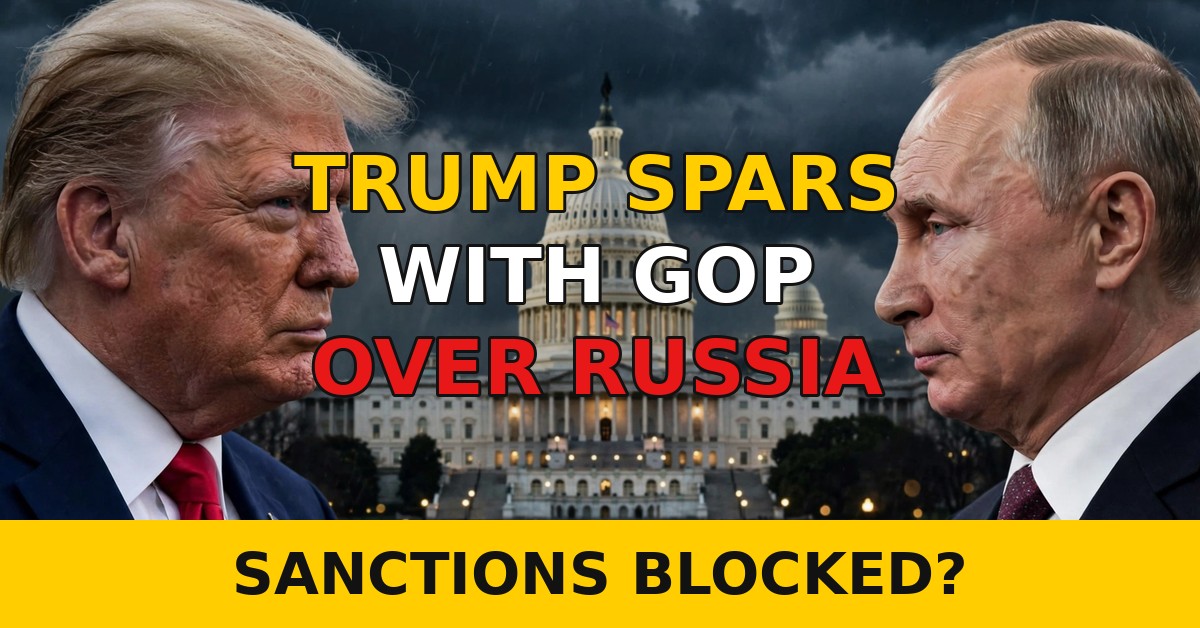
Trump Ukraine Russia business after war: Donald Trump says the United States will be ready to do business with both Russia and Ukraine once their war ends — a remark that lands just days before a ceasefire his wife says is due to begin, and ten days before Americans vote in the midterm elections.
Speaking to reporters in Palm Beach, Florida, after casting his vote alongside First Lady Melania Trump, the president framed a peace deal not just as an end to fighting, but as a return to normal commerce.
“We’d like to get back to life where Russia and Ukraine make a deal, and then we’d be able to do business with both. We’ll do business with Ukraine and with Russia after this war ends, I would think,” Trump said.
It was a short answer, but it carried a large implication. Trade and investment with Russia have been heavily restricted under years of Western sanctions imposed since Moscow’s full-scale invasion of Ukraine. Any move back toward doing business with Moscow would mark a sharp break with that sanctions regime — and Trump offered no timetable, conditions or details for how it would happen.
Trump Ukraine Russia business after war: What Trump actually promised — and what he didn’t
Trump’s comment was conditional, and that condition matters. He did not say the United States would resume business with Russia now, while the war continues. He said it would happen after the war ends, after a deal.
That distinction is the whole story. Washington already does extensive business with Ukraine, including military and economic support, and has kept channels open with Kyiv throughout the war. Russia is the other side of the equation: sanctions, export controls and the political cost of dealing with Moscow have kept American companies largely out.
By putting both countries in the same sentence, Trump was signalling what a post-war order could look like from his perspective — one in which the United States is a commercial partner to both former combatants, rather than a country still policing the peace through sanctions alone.
Whether that vision is realistic is another question. A peace deal would still have to settle territory, security guarantees, sanctions relief and reconstruction, none of which Trump addressed in these remarks.
Melania Trump and the October 27 ceasefire claim
The First Lady used the same appearance to talk up diplomatic efforts behind the scenes, pointing to support from the Vatican and a ceasefire she said is about to begin.
“It is great to have Pope’s support and they (Russia and Ukraine) are starting ceasefire on the October 27th and I hope everything goes as it’s planned. We have talked with both (President Putin and President Zelenskyy); we signed agreements,” Melania Trump said.
Her claim deserves careful handling. A local ceasefire in the Russian-held town of Oleshky has separately been reported as starting around this period, and the White House has credited the First Lady with a back-channel role. But a local or limited ceasefire is not the same as a full, nationwide end to the war, and readers should not take the October 27 date as a confirmed, comprehensive peace.
Trump himself praised her role in glowing terms. “I think she’s doing better than the professionals right now,” he said.
That line will draw attention — and criticism. Supporters will read it as a president crediting unconventional diplomacy. Critics will ask why, if agreements have been signed, the details have not been made public, and what exactly has been agreed with Presidents Vladimir Putin and Volodymyr Zelenskyy.
Why the timing matters
The remarks came as Trump voted in Palm Beach, with the November 3 midterm elections just days away. The midterms will decide control of the House and a third of the Senate, and the president has spent the closing stretch of the campaign tying foreign policy to his domestic message.
That context helps explain the second half of his appearance, in which he turned sharply to domestic politics and attacked Democrats, accusing them of widespread corruption.
“Democrats are very corrupt. To me, corruption is one of the biggest things. If you look at Minnesota, if you look at Los Angeles, if you look at New York, the corruption is rampant and to me, corruption is a very big factor,” Trump said.
He also repeated claims about voting irregularities, saying: “They found a lot of discrepancies — bad ones, big ones. In Los Angeles, as you know, they have 20,000 votes, and it could be as high as a million votes… The U.S. Attorney found, potentially, hundreds of thousands of illicit votes.”
Those are Trump’s claims, and they should be reported as such. No evidence was presented during the appearance to support the figures he cited, and election officials have previously disputed similar broad claims about large-scale illicit voting.
What to watch next
Three things will tell us whether this was campaign rhetoric or the start of a real shift:
First, whether any ceasefire actually holds from October 27, and whether it extends beyond a local area to a broader halt in fighting.
Second, whether the White House publishes any detail of the agreements Melania Trump referred to.
And third, whether Trump or his administration spells out what “doing business” would mean in practice — sanctions relief, energy deals, reconstruction contracts, or something else entirely.
Until then, the headline is what Trump said, not what has been agreed: after the war, in his view, America will do business with both sides. The war itself, for now, is not over.
Trump Ukraine Russia business after war: What it could mean in practice
Trump Ukraine Russia business after war is, for now, a promise, not a programme. Trump gave no timetable in Palm Beach, so the key question is what would have to change first.
Any discussion of Trump Ukraine Russia business after war therefore starts with the conditions already set out above: a deal, an end to fighting, and a decision on sanctions. That is why the sanctions debate matters, as shown in our report on Trump’s Russia sanctions waiver and the backlash in Congress.
Readers can check the current framework in the U.S. Treasury’s Ukraine-/Russia-related sanctions programmes. It also follows earlier ceasefire reporting, including Trump’s Russia-Ukraine energy ceasefire announcement.
That is the test for any Trump Ukraine Russia business after war plan. None of this changes what Trump said in Palm Beach. It simply sets out what would need to follow before business could resume on the terms he described