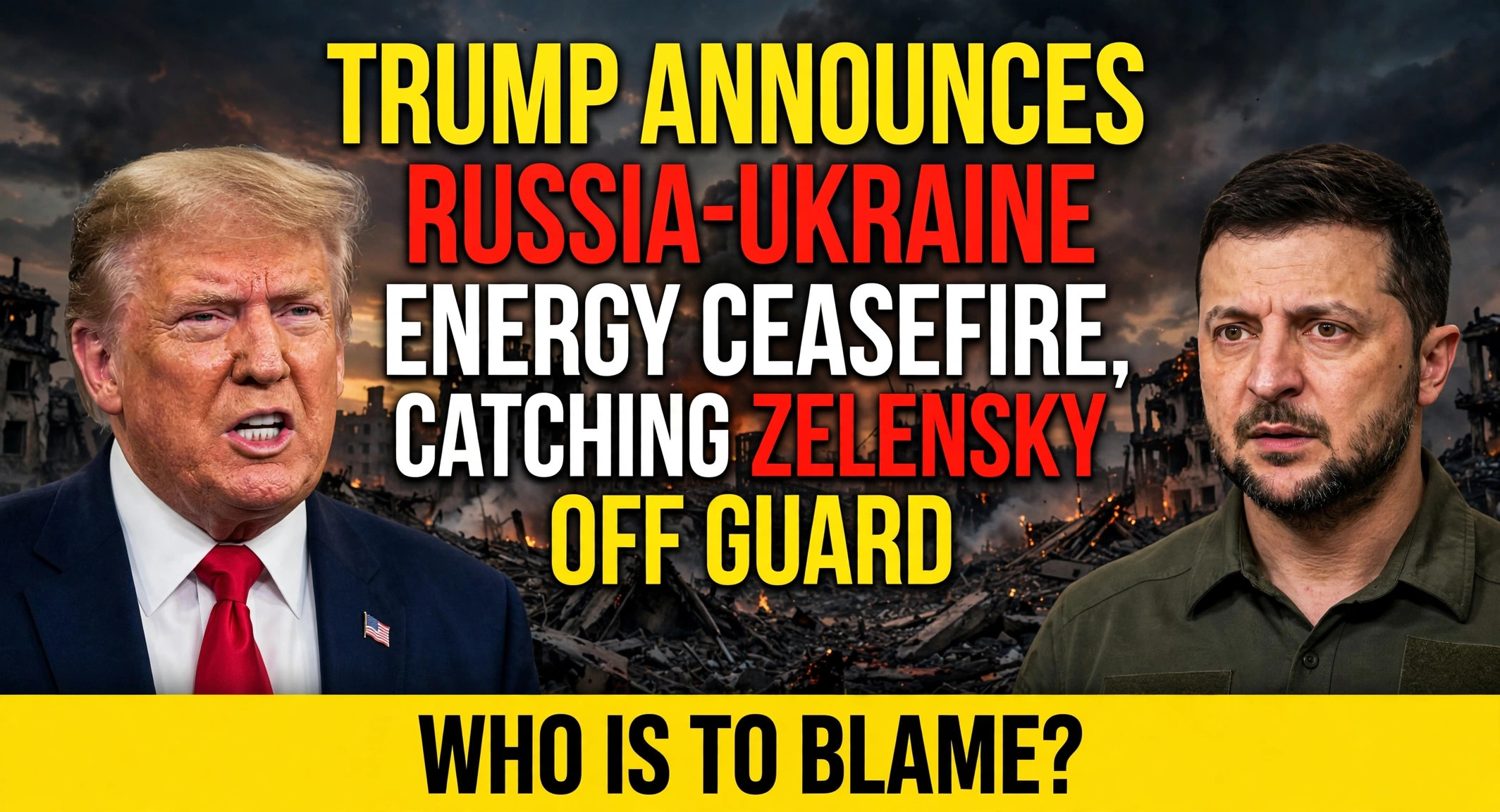
President Donald Trump announced a surprise russia ukraine energy ceasefire on Sunday, declaring on Truth Social that both sides had agreed to stop hitting each other’s energy infrastructure, effective immediately. The post landed like a thunderclap — not least in Kyiv, where President Volodymyr Zelensky admitted the announcement was news to him.
“Effective immediately, there is an ENERGY CEASEFIRE in the War between Russia and Ukraine. Both parties have agreed. Do not break it! Thank you for your attention to this matter,” Trump wrote.
It was classic Trump: all caps, no details, no timeline. And it raised an immediate question — did Moscow actually agree? As of Sunday evening, the Kremlin had not publicly confirmed the deal. Zelensky, speaking to Axios reporter Barak Ravid, was blunt about being blindsided: “The cease-fire announcement was news for me. But if Russians agree to an energy cease-fire Ukraine will agree. If President Trump negotiated it with Putin — please tell us when the cease-fire begins — we are ready and we will accept it.”
That response tells you everything about how these negotiations have been working. Kyiv says it’s in — conditional on Moscow actually being in. The White House hasn’t yet produced any signed document, joint statement, or start date beyond Trump’s “effective immediately.”
How the Russia Ukraine Energy Ceasefire Deal Came Together
The announcement didn’t come out of nowhere, even if it felt like it. Two days earlier, Trump held a 90-minute phone call with Russian President Vladimir Putin — a marathon session that yielded a tangible, if odd, deliverable: Russia agreed to ship 300,000 tonnes of diesel fuel to the United States immediately, with another 1.5 million tonnes to follow.
Why diesel? Because diesel prices in America have become a political headache. AAA put the national average at $6.28 a gallon, and Trump has pointed the finger directly at Ukraine’s campaign of strikes against Russian refineries — what he called “long-range sanctions” — as a driver of the spike. With midterms looming, cheaper fuel matters enormously to the White House.
Trump’s logic has been remarkably consistent: the refinery strikes hurt American drivers at the pump, so stopping them helps the U.S. economy. Critics see it differently — they argue Ukraine’s strikes on Russian energy infrastructure are one of its few real sources of leverage against Moscow, and that trading that leverage away for cheaper diesel hands Putin a win.
Whatever the strategy, the Friday call set the table. The energy ceasefire announcement on Sunday was the follow-through — at least according to Trump’s Truth Social account.
Zelensky Caught Off Guard by the Russia Ukraine Energy Ceasefire — But Says Ukraine Will Honor It
There’s a pattern here worth noticing. Zelensky has repeatedly learned about U.S.-Russia understandings from media reports rather than from direct consultations. His response on Sunday walked a fine line: gracious, non-confrontational, but unmistakably pointed. If Trump negotiated the russia ukraine energy ceasefire with Putin, fine — just tell Kyiv when it starts.
The Ukrainian leader has every reason to be cautious. Russia and Ukraine have struck energy infrastructure throughout the war, and previous pauses in attacks on power grids have been announced, disputed, and quietly violated. An energy ceasefire is only as real as the verification behind it, and right now there appears to be none that anyone has described publicly.
Still, Zelensky said Ukraine will accept and honor the arrangement. That’s a significant commitment from a leader who wasn’t at the table when the deal was allegedly made. It also puts the pressure squarely back on Moscow: Kyiv has agreed, so if strikes on energy targets continue, the world will know who’s breaking it.
The Diesel Deal Behind the Russia Ukraine Energy Ceasefire
The diesel arrangement from Friday’s call deserves a closer look, because it reveals the transactional frame Trump is using. Russia ships fuel; prices ease; Trump gets a win with American voters. Ukraine stops hitting refineries; Russia — in theory — stops hitting Ukrainian energy targets.
But there’s an asymmetry hiding in plain sight. Ukraine’s strikes on Russian refineries were working — they were driving up fuel costs inside Russia and squeezing Moscow’s war economy. Russia’s strikes on Ukrainian energy infrastructure have been brutal but haven’t shifted the strategic picture the same way. In giving up its refinery campaign, Ukraine is surrendering a weapon that was effective. What Russia gives up in return is the ability to keep doing something it was already doing at enormous diplomatic cost.
Trump, for his part, has been open about his priority. He blamed Ukraine’s strikes for the diesel price spike and framed the russia ukraine energy ceasefire as a win for American consumers. Whether voters see it that way — or whether they see a U.S. president trading Ukrainian leverage for pump prices — is a question the midterms will answer.
Zelensky’s 60-Day Election Offer Adds a New Twist
Sunday brought one more bombshell from Kyiv, and it had nothing to do with energy. In an interview with ABC News, Zelensky said he would hold long-delayed presidential elections if Putin agrees to a 60-day total ceasefire.
“Please tell Putin, give us two months, 60 days of total ceasefire, 60 days, and we will organise elections,” he said.
It’s a clever counter. Ukraine’s elections were suspended under martial law after Russia’s full-scale invasion, and both Moscow and Trump himself have questioned Zelensky’s legitimacy as a result. By tying elections to a 60-day ceasefire, Zelensky flips the pressure: want Ukrainian democracy? Give Ukraine two quiet months.
He also pledged that Ukraine would stop its strikes on Russian refineries as part of any broader deal — essentially volunteering the concession Trump announced unilaterally. The message to Washington seems to be: we’ll play ball, but on terms we helped negotiate, not terms we read about on social media.
Meanwhile, the war grinds on. Russia killed 15 people in strikes across Ukraine this weekend even as the U.S. described its latest round of talks as “productive.” The contrast between diplomatic language and battlefield reality hasn’t been sharper.
What Happens Next for the Russia Ukraine Energy Ceasefire
The honest answer is that nobody knows. An energy ceasefire announced by one side, acknowledged with conditions by another, and unconfirmed by the third is a long way from a durable truce. The key questions:
- Has the Kremlin actually agreed? Silence from Moscow is not confirmation.
- When does “effective immediately” actually begin — and who monitors it?
- Does the diesel shipment from Russia actually arrive, and does it move pump prices?
- Does Zelensky’s 60-day ceasefire-for-elections proposal get any traction with Putin?
What is clear: Trump is moving fast, using direct deals with Putin to reshape the war’s economics, and keeping Kyiv at arm’s length from the negotiating table. Zelensky is adapting — agreeing to what he can, countering with proposals of his own, and trying not to be the one who breaks something. The next few days will show whether the russia ukraine energy ceasefire is real or just a Truth Social post.
Sources and Resources on the Russia Ukraine Energy Ceasefire
New York Post: Russia-Ukraine reach energy cease-fire “effective immediately,” Trump announces
The White House — official statements and press briefings
World Reach Daily — more world news and analysis.
Frequently Asked Questions
Wait, so is the russia ukraine energy ceasefire actually in effect or not?
Trump says yes, effective immediately. Zelensky says Ukraine will honor it — if Russia actually agreed to it. The Kremlin hasn’t confirmed anything publicly. So right now the russia ukraine energy ceasefire is an announcement with one-and-a-half parties on board. Until Moscow verifies strikes have stopped, treat it as a claim, not a confirmed truce.
Why does Trump care so much about diesel prices in the russia ukraine energy ceasefire debate?
Politics and pocketbooks. AAA has the national average diesel price at $6.28 a gallon, which is brutal for truckers, farmers, and anyone who drives for a living — and it bleeds into the price of everything shipped by truck. With midterms approaching, Trump blamed Ukraine’s refinery strikes for the spike and decided stopping them was the fastest way to get prices down.
What did Zelensky mean by offering elections for a 60-day ceasefire?
Ukraine suspended elections under martial law after Russia invaded, and critics — including Moscow — have used that to question his legitimacy. He’s saying: give us 60 days of total quiet, and we’ll organize a vote. It’s a way of calling the bluff — if Putin wants Ukrainian democracy, he has to stop shooting for two months. Zelensky also pledged to halt refinery strikes as part of such a deal.
Didn’t Russia and Ukraine try pausing energy strikes before?
Yes, and it didn’t stick. Earlier pauses on attacking energy infrastructure were announced, then disputed, with both sides accusing the other of violations. There’s no public verification mechanism for this new announcement either, which is exactly why analysts are skeptical about how long it’ll hold — if it starts at all.
What’s the diesel deal behind the russia ukraine energy ceasefire?
Following Friday’s 90-minute Trump-Putin call, Russia reportedly agreed to ship 300,000 tonnes of diesel to the U.S. right away, plus another 1.5 million tonnes later. The idea is to flood supply and bring down that $6.28 national average. Whether the shipments actually materialize — and whether they move prices — is still an open question.
Conclusion: Will the Russia Ukraine Energy Ceasefire Hold?
Trump’s Sunday announcement of a russia ukraine energy ceasefire is bold, sudden, and — for now — one-sided. Zelensky has agreed to honor it despite learning about it secondhand, putting the ball firmly in Moscow’s court. Behind the headline sits a transactional logic: Ukrainian refinery strikes stop, American diesel prices fall, and Trump banks a win.
But a ceasefire without Kremlin confirmation, a start date, or verification is more of a proposal than a peace. The coming days will reveal whether this is the beginning of a real de-escalation or just another dramatic post that fades with the news cycle. For now, the russia ukraine energy ceasefire exists mostly on Truth Social — and the world is waiting to see whether Moscow turns it into reality.