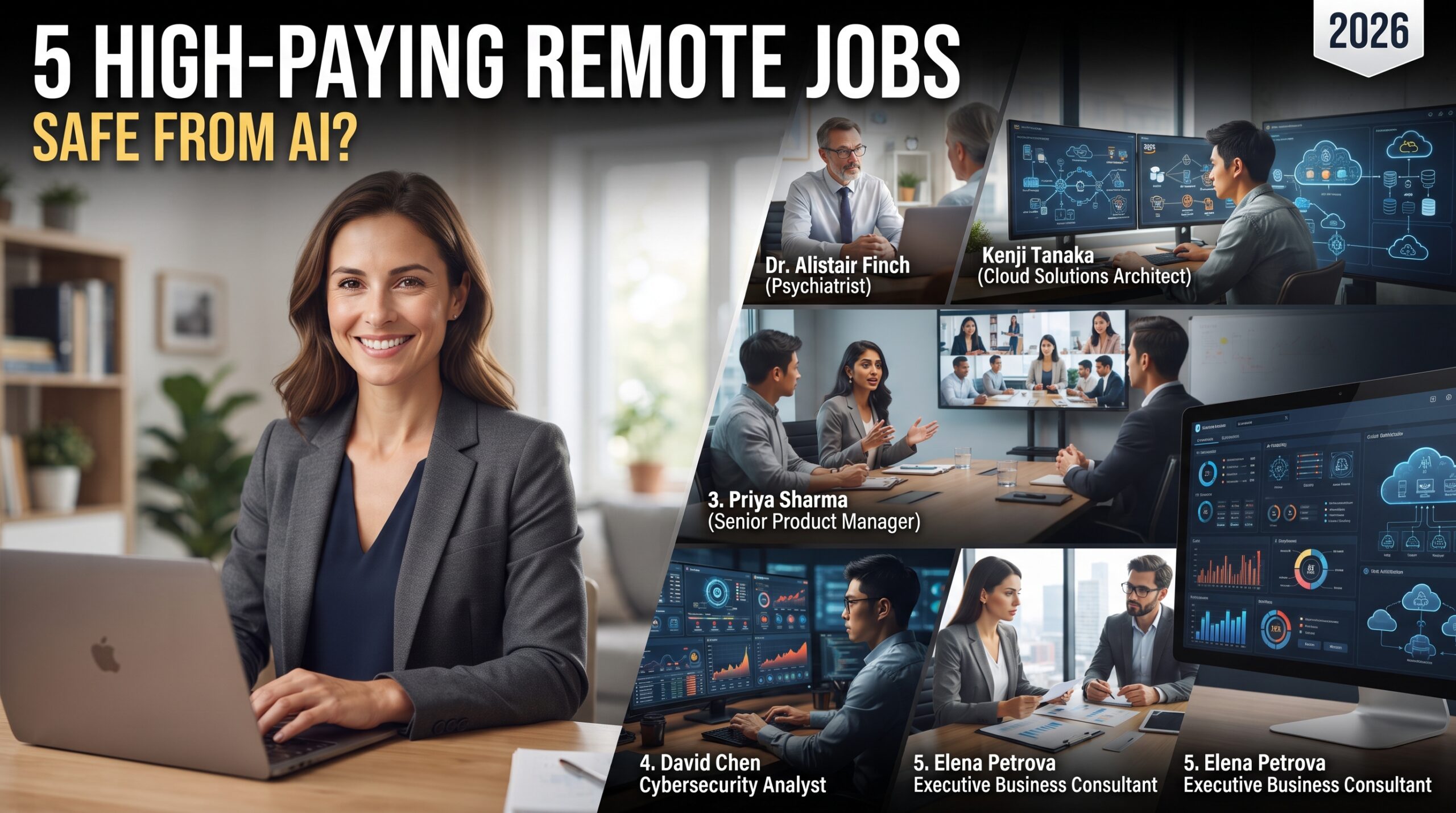
5 High-Paying Remote Jobs Safe From AI Automation in 2026
To understand where human value lies in the current economy, we must look at roles requiring a blend of technical expertise, emotional intelligence, and cross-functional leadership.
1. Telehealth Psychiatrist / Clinical Therapist
Average Salary Range: $150,000 – $300,000+
Core Human Skills: Deep empathy, ethical reasoning, non-verbal cue reading.
Why AI Fails Here: Mental health care requires building a deep, trusting therapeutic alliance over time. While AI chatbots can guide users through basic Cognitive Behavioral Therapy (CBT) exercises, they do not possess emotional attunement. An AI cannot notice the subtle, micro-expressions of a patient shifting on camera, nor can it provide the genuine, shared human connection necessary to treat severe trauma or clinical depression. Furthermore, the immense legal and ethical accountability of prescribing medication remains strictly in human hands. With teletherapy exploding post-pandemic, this is one of the most secure, high-paying remote roles available today.
- Also read:
- Will the Federal Reserve Cut Interest Rates in Late 2026?
2. Remote Solutions Architect
Average Salary Range: $140,000 – $200,000
Core Human Skills: Strategic foresight, systems thinking, stakeholder negotiation.
Why AI Fails Here: AI is excellent at writing functional code snippets or optimizing a localized database query. However, a Solutions Architect is responsible for designing complex enterprise systems from the ground up. This involves balancing technical constraints, budget limitations, data privacy laws, and the conflicting demands of various company departments. AI cannot map out a five-year technical infrastructure strategy while simultaneously convincing a non-technical CFO why an expensive cloud migration is necessary. The human element of organizational dynamics keeps this engineering role incredibly resilient to automation.
3. Senior Product Manager
Average Salary Range: $130,000 – $200,000
Core Human Skills: Leadership, cross-functional persuasion, user psychology.
Why AI Fails Here: Product management is arguably 20% data analysis and 80% human persuasion. A Senior Product Manager must decide what to build and why, often saying “no” to stakeholders with competing egos and priorities. AI can easily generate a list of feature ideas based on user data, but it cannot navigate the political landscape of a tech company to prioritize a roadmap. It cannot align a stubborn sales team, a visionary CEO, and a skeptical engineering lead. Because this role hinges on human leadership and high-stakes decision-making, it remains deeply future-proof.
4. Remote Senior Cybersecurity Analyst
Average Salary Range: $100,000 – $165,000
Core Human Skills: Adversarial intuition, crisis management, ethical judgment.
Why AI Fails Here: Cybersecurity is a fast-paced game of cat and mouse. Threat actors are humans, which means their attacks are often driven by unpredictable human motives, social engineering, and novel exploits. While AI is an incredible tool for spotting anomalies in network traffic and monitoring endpoints, it struggles to anticipate out-of-the-box human behavior. When a critical breach occurs, a human analyst must perform incident response under immense pressure, making high-stakes judgment calls about shutting down systems or interacting with attackers. The adversarial thinking required here cannot be replicated by algorithms.
5. Executive Coach / Remote Management Consultant
Average Salary Range: $100,000 – $200,000+
Core Human Skills: Contextual wisdom, active listening, conflict resolution.
Why AI Fails Here: Executive coaching and management consulting involve advising high-level leaders on organizational change, team culture, and personal development. These roles require massive amounts of credibility and trust. A CEO facing a leadership crisis is not going to take vulnerable, deeply personal advice from a large language model. They need a human who can read the room, draw on lived professional experiences, and challenge powerful people gracefully. The ability to facilitate sensitive conversations and drive cultural shifts makes remote consulting incredibly AI-resistant.
Comparison: AI-Resistant Remote Roles
To summarize the current landscape, here is a quick overview of the market in 2026:
| Job Title | Estimated Salary (USD) | Primary AI-Resistant Skill | Automation Risk (Out of 100) |
| Telehealth Psychiatrist | $150K – $300K+ | Human Empathy & Medical Ethics | 8/100 |
| Solutions Architect | $140K – $200K | Strategic Systems Thinking | 22/100 |
| Senior Product Manager | $130K – $200K | Persuasion & Leadership | 22/100 |
| Cybersecurity Analyst | $100K – $165K | Adversarial Intuition | 15/100 |
| Executive Coach | $100K – $200K+ | Contextual Wisdom & Trust | 16/100 |
(Data aggregated from 2026 industry insights on AI vulnerability)
The Human Advantage: Why AI Cannot Replace These Jobs
If you are looking to future-proof your own career, it is crucial to understand why these specific roles are safe. The common denominator among all these jobs is that they rely on traits inherent only to the human experience.
Emotional Intelligence (EQ): AI can simulate polite conversation, but it cannot genuinely care. Empathy, trust-building, and active listening are non-negotiable in healthcare, coaching, and leadership roles.
Unstructured Problem Solving: Algorithms thrive in structured environments with clear rules (like playing chess or writing boilerplate code). They fail in ambiguous, chaotic situations where rules constantly shift—such as a sudden PR crisis, a novel cyberattack, or a complex software architecture migration.
Accountability and Morality: An AI cannot be sued, nor can it hold legal or ethical responsibility. Doctors, lawyers, and high-level business executives carry the weight of real-world consequences, a burden society will not offload to software.
Frequently Asked Questions (FAQs)
Will AI replace remote tech workers entirely by 2030?
No. While entry-level coding, basic data entry, and routine QA testing are being heavily automated, the demand for senior technical talent is actually growing. Roles that require architectural planning, cross-team coordination, and strategic problem-solving will use AI as a tool, not a replacement.
Can I transition into an AI-resistant career without a tech background?
Absolutely. Roles like Executive Coaching, HR Management, Product Management, and Clinical Therapy rely far more on human skills—like communication, psychology, and leadership—than hard coding skills.
How do I use AI to enhance my job security?
The safest professionals in 2026 are those who view AI as a powerful assistant. By leveraging AI to handle your repetitive tasks (like summarizing meetings, organizing data, or drafting basic emails), you free up your time to focus on the high-level strategic work that actually justifies your salary. Move away from execution and move toward judgment.
Conclusion
The evolution of artificial intelligence in 2026 is not a signal of the end for remote work; rather, it is a massive reshuffling of value. AI has successfully commoditized routine tasks, meaning professionals can no longer compete on speed or basic output alone. The highest-paying remote jobs today are those deeply rooted in human complexity. Whether you are leading a product team, designing secure technical architectures, or providing critical mental health care, your ultimate job security lies in your humanity. Embrace AI for the repetitive work, but double down on your emotional intelligence, strategic thinking, and leadership.
Official News Links & Trust Articles
To read more about the 2026 job market and AI resistance, you can refer to the following industry insights:
1 thought on “High-Paying Remote Jobs in 2026: 5 Careers AI Cannot Replace”