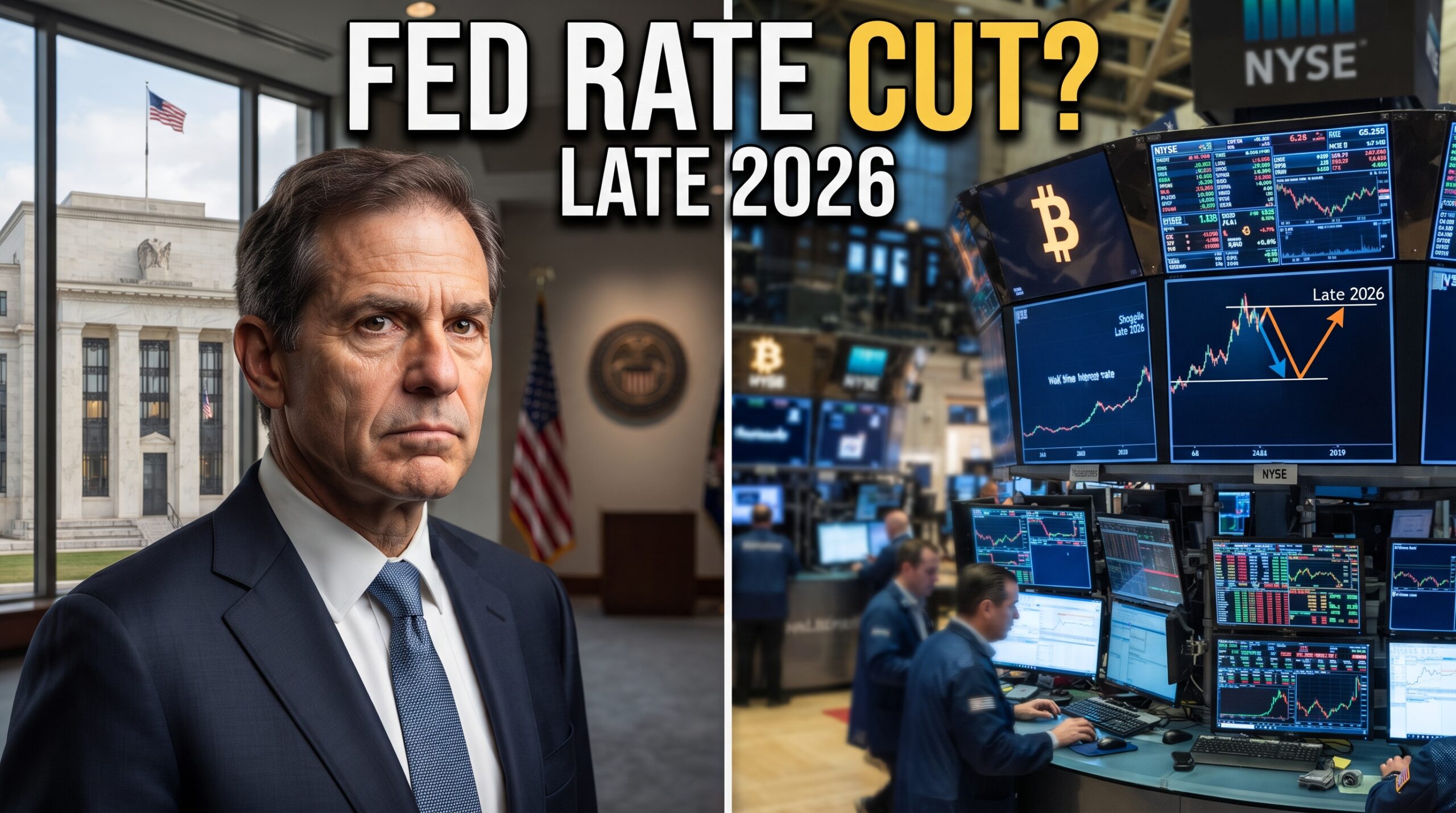
Will the Federal Reserve Cut Interest Rates in Late 2026? Impact on Stocks & Crypto
Navigating the complexities of the financial markets requires a deep understanding of macroeconomic policy, and no entity wields more influence over this landscape than the United States Federal Reserve. As we push through the second half of 2026, investors, traders, and everyday consumers are closely monitoring the central bank’s every move. After years of turbulent monetary policy, the question on everyone’s mind is: Will the Federal Reserve cut interest rates in late 2026?
Also read:
Trump Orders Scale-Back of US-South Korea Military Drills Citing Kim & Iran
Interest rates serve as the gravitational pull for asset valuations, directly influencing everything from the cost of borrowing for major corporations to the liquidity flowing into speculative markets like cryptocurrency. With the federal funds rate currently hovering between 3.50% and 3.75% as of August 2026, the financial ecosystem is at a crossroads. Under the leadership of the newly appointed Fed Chairman, Kevin Warsh, the central bank is taking a fresh look at inflation, employment, and market communication.
In this comprehensive guide, we will dive deep into the Federal Reserve’s current stance, analyze expert forecasts for late 2026, and explore how these potential monetary policy shifts will impact both traditional stock markets and the dynamic cryptocurrency ecosystem.
The Current State of the Federal Reserve and Interest Rates in 2026
To understand where interest rates are heading, we must first examine the current economic climate and the Federal Reserve’s most recent actions.
In its July 2026 meeting, the Federal Open Market Committee (FOMC) voted to hold the benchmark federal funds rate steady at 3.50% to 3.75%. This marked the fifth consecutive meeting where rates remained unchanged, aligning with broad market expectations. However, the decision was not without internal debate. The meeting revealed a split consensus, with a few FOMC members dissenting and advocating for a 25-basis-point hike, citing persistent inflationary pressures.
New Leadership, New Strategy
The landscape of the Federal Reserve has shifted significantly under Chairman Kevin Warsh. Warsh has openly expressed an aversion to traditional “forward guidance”—the practice of explicitly telegraphing the Fed’s future rate path to the market. Instead, he has launched five new policy task forces to review how the Fed makes decisions and communicates them. These task forces are expected to deliver findings by the end of 2026. As a result, the market is flying with less visibility than it had under previous administrations, leading to heightened speculation and interest rate volatility.
The Inflation Battle is Not Over
Why hasn’t the Fed aggressively cut rates yet? The answer lies in the Fed’s dual mandate: maximizing employment and stabilizing prices. While the labor market has shown signs of cooling, with unemployment holding around 4.2%, inflation remains stubbornly above the central bank’s 2% target. Supply chain shocks, particularly in the energy sector driven by ongoing geopolitical conflicts in the Middle East, have kept consumer prices elevated. The Fed remains deeply committed to preventing a “stop-and-go” scenario where premature rate cuts reignite inflation.
Will the Fed Cut Rates in Late 2026? Expert Predictions
At the beginning of 2026, market participants were highly optimistic, pricing in multiple rate cuts by the year’s end. Fast forward to the second half of the year, and that optimism has largely evaporated. The consensus has shifted dramatically from anticipating cuts to bracing for a prolonged pause—or even a potential rate hike.
Here is a breakdown of what major financial institutions are forecasting for the remainder of 2026:
1. The “Higher for Longer” Pause (Morgan Stanley)
Analysts at Morgan Stanley Research predict that the Federal Reserve will stay on hold for the remainder of 2026. Their models suggest that inflation will continue to moderate gradually, eliminating the immediate need for rate hikes, but keeping the environment too warm to justify cuts. They point to cooling labor demand and stabilizing housing and rent inflation as signs that current policy is restrictive enough. According to Morgan Stanley’s Chief U.S. Economist, the market might not see rate cuts until 2027, as the Fed waits for inflation to sustainably normalize.
2. The Potential December Hike (J.P. Morgan)
On the more hawkish side of the spectrum, J.P. Morgan Global Research has recently revised its outlook. Noting the sticky inflation data and the internal division within the FOMC, J.P. Morgan now forecasts a 25-basis-point rate hike in December 2026, which would push the federal funds rate up to the 3.75%–4.00% range. If inflation readings remain hot through the fall, they warn that a hike could come as early as September.
The Verdict on Rate Cuts: Based on current macroeconomic indicators and the Fed’s shift away from dovish forward guidance, a rate cut in late 2026 appears highly improbable. Investors should prepare for rates to remain flat at best, with a realistic chance of a slight increase before the year is out.
How Fed Interest Rate Decisions Impact Stocks in 2026
The stock market has a complex relationship with interest rates. Generally, higher interest rates increase the cost of borrowing for companies, which can suppress corporate earnings and weigh on stock valuations. The “higher for longer” narrative of late 2026 has distinct implications for different sectors of the stock market.
Growth vs. Value Stocks
Growth stocks, particularly in the technology sector, rely heavily on future earnings expectations. When interest rates are high, the present value of those future earnings is discounted at a higher rate, often leading to a contraction in price-to-earnings multiples. However, in 2026, the technology sector has found a unique buffer: Artificial Intelligence. Market strategists note that AI-driven productivity gains have helped insulate certain mega-cap tech stocks from the brunt of elevated real yields.
Conversely, value stocks and companies with robust balance sheets are better positioned to weather a prolonged high-rate environment. Businesses that do not rely on constant debt refinancing are generally favored by investors seeking stability when rates remain restrictive.
The Rise of Fixed Income Alternatives
Because the Fed is maintaining rates around the 3.50%–3.75% mark, risk-free yields remain incredibly attractive. Institutional and retail investors alike are actively utilizing 0-to-3 month Treasuries and short-duration bond ETFs to capture high yields without exposing themselves to the equity market’s volatility. If the Fed does surprise the market with a late-2026 hike, equities could experience a short-term selloff as capital rotates further into these fixed-income assets.
The Impact of Fed Rates on the Crypto Market
Cryptocurrencies, led by Bitcoin and Ethereum, are historically categorized as “risk-on” assets. Their price action is heavily tethered to global liquidity and the monetary policy of the Federal Reserve.
Why Rate Cuts Matter for Crypto
In theory, interest rate cuts are highly bullish for cryptocurrencies. Lower rates reduce the yield on safe-haven assets like government bonds, incentivizing investors to move further out on the risk curve in search of higher returns. Furthermore, rate cuts generally increase the money supply and liquidity in financial markets, providing the capital necessary to drive massive crypto bull runs.
Navigating the 2026 Reality
Since the Fed is widely expected not to cut rates in late 2026, the crypto market is operating in a structurally tighter liquidity environment than many permabulls hoped for at the year’s start.
However, cryptocurrencies have matured. While a lack of rate cuts might delay a euphoric, liquidity-driven supercycle, it does not spell doom. The current federal funds rate of 3.50%–3.75% is historically moderate, and cryptocurrencies have shown resilience in 2026, buoyed by institutional adoption and underlying technological advancements.
If J.P. Morgan’s prediction of a December 2026 rate hike comes to fruition, the crypto market will likely experience a sharp, short-term volatility spike to the downside. Traders often aggressively sell risk assets on hawkish Fed news. Conversely, if Morgan Stanley is correct and inflation cools enough to solidify a definitive pause and tee up early 2027 cuts, crypto markets could begin front-running the 2027 easing cycle by rallying in the fourth quarter of 2026.
Frequently Asked Questions (FAQs)
Q1: What is the current Federal Reserve interest rate in late 2026?
As of August 2026, the benchmark federal funds rate is set at a target range of 3.50% to 3.75%. The Fed has held this rate steady for several consecutive meetings.
Q2: Is the Federal Reserve expected to cut rates before the end of 2026?
No, most major financial analysts do not expect a rate cut in 2026. Expectations have shifted drastically; institutions like Morgan Stanley predict a pause for the rest of the year, while J.P. Morgan anticipates a potential rate hike in December 2026.
Q3: How do interest rate hikes affect the stock market?
Generally, interest rate hikes make borrowing more expensive, which can hurt corporate profitability and slow economic growth. This tends to lower stock prices, particularly for high-growth tech companies that rely on cheap capital, though AI productivity gains have mitigated some of this impact in 2026.
Q4: Why does the crypto market care about the Fed?
Cryptocurrencies are risk assets that thrive on high liquidity. When the Fed cuts rates, borrowing becomes cheaper, and investors are more willing to deploy capital into volatile assets like Bitcoin. Conversely, high or rising rates draw capital away from crypto into safer, yield-bearing assets.
Q5: Who is the current Chairman of the Federal Reserve in 2026?
Kevin Warsh is the current Chairman of the Federal Reserve. He has introduced a new approach that minimizes traditional forward guidance and emphasizes independent policy task forces to dictate future decisions.
Conclusion
The hope for sweeping Federal Reserve interest rate cuts in late 2026 has largely faded, replaced by a sobering reality of persistent inflation and cautious central bank posturing. With the federal funds rate anchored at 3.50% to 3.75%—and financial giants like J.P. Morgan forecasting a potential hike by December—investors must adapt to a “higher for longer” environment.
For the stock market, this means prioritizing companies with strong balance sheets and those benefiting from secular trends like AI, while carefully managing duration risk in fixed-income portfolios. For the crypto market, while the absence of a 2026 rate cut deprives the space of a major short-term liquidity catalyst, underlying institutional demand continues to provide a solid floor. As Fed Chairman Kevin Warsh steers the economy through these turbulent waters, market participants should remain agile, diversifying their portfolios to hedge against the heightened interest rate volatility expected through the end of the year.
1 thought on “Will the Federal Reserve Cut Interest Rates in Late 2026?”