
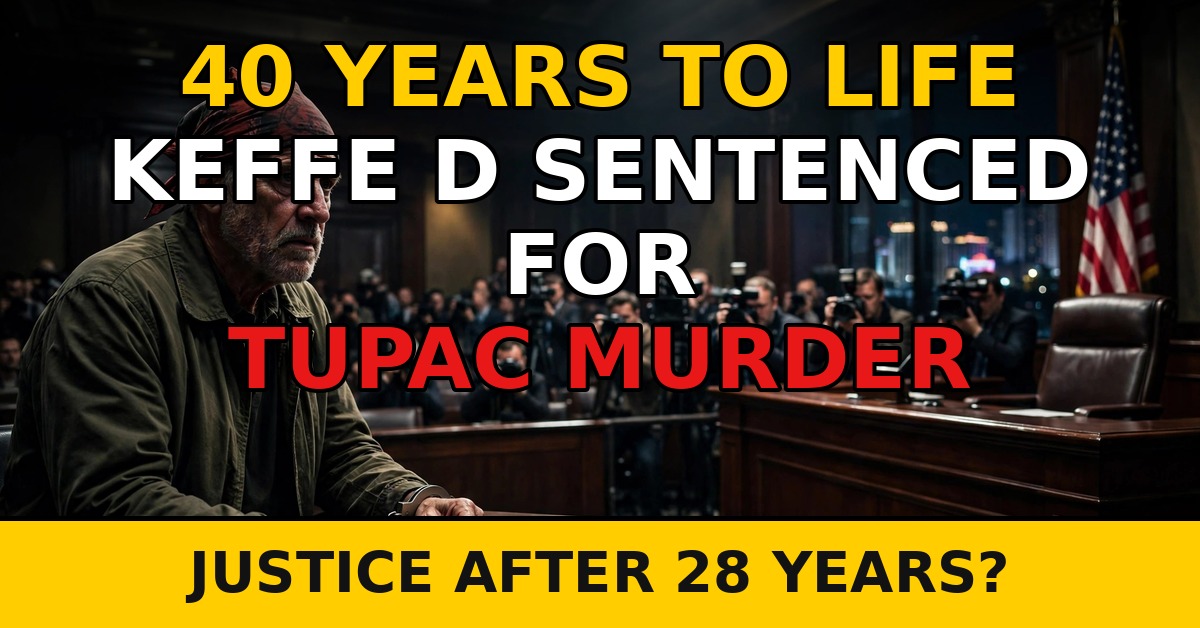
Keffe D Davis sentenced — after nearly 30 years, those words finally landed in a Las Vegas courtroom on Tuesday. Duane “Keffe D” Davis, convicted in August of first-degree murder in the 1996 killing of rapper Tupac Shakur, was sentenced to 40 years to life in prison. For a case that went cold for decades and became one of the most famous unsolved murders in music history, the sentence closed a chapter that generations of fans thought would stay open forever.
He’ll be 83 before he’s first eligible for parole, by most calculations. The judge, Carli Kierny, made it clear the clock starts now — Davis argued for credit for time already served, and the judge shut that down: “the law says I cannot credit that towards your sentence.” Keffe D Davis sentenced to 40 years to life means the man who spent years talking about the shooting on podcasts and in a memoir will spend what remains of his life behind bars.
In this article: keffe d davis sentenced — full story
Keffe D Davis Sentenced After a Conviction That Took Three Decades
The trial itself was remarkable for how ordinary it was. No courtroom theatrics, no celebrity witnesses — just a jury, a prosecutor, and a mountain of Davis’s own words. Prosecutors leaned heavily on the thing that made this case prosecutable at all: Davis himself had described the shooting repeatedly, in interviews and in his 2019 memoir, always presenting himself as an eyewitness. The state argued he was the one who orchestrated it.
The jury convicted him in August 2026. Tuesday’s hearing was about the price. Prosecutor Marc DiGiacomo argued for the maximum, and he didn’t mince words about why. Davis had profited from the killing for years — the book, the interviews, the paid appearances. DiGiacomo told the court: “He’s the only one who’s trying to profit off a killing that he committed, and for that he doesn’t deserve the minimum sentence.”
Shakur’s family was present in court for the sentencing arguments, sitting through a proceeding they’d waited most of their lives to see. The prosecution framed the case as straightforward: “through his actions, his behavior, and who he is,” Davis had earned the harshest sentence the law allowed.
The Night That Sparked a 30-Year Mystery
To understand why this sentencing matters, you have to go back to September 7, 1996. Tupac Shakur — 25 years old, already one of the biggest names in hip-hop — had just watched the Mike Tyson-Bruce Seldon fight at the MGM Grand in Las Vegas. Hours later, sitting in the passenger seat of a BMW driven by Death Row Records founder Suge Knight at a red light on Flamingo Road, he was shot four times in a drive-by. He died six days later.
The murder detonated through American culture. Tupac was at the center of the East Coast-West Coast rap feud, and conspiracy theories about his death multiplied for decades — some claimed he faked it, some blamed rival camps, some pointed at law enforcement. The case officially went cold. Las Vegas police caught flak for years over the investigation’s slow pace and dead ends.
What broke it open wasn’t new forensics. It was Davis’s mouth. Beginning around 2018, he started giving interviews describing the shooting in detail — positioning himself as a witness, not a killer. In his telling, he was in the Cadillac that pulled alongside Shakur’s BMW; his nephew Orlando Anderson, he said, fired the shots. Anderson died in a 1998 shooting, so he couldn’t be charged. But Davis’s own admissions — made publicly, repeatedly, on record — gave prosecutors everything they needed. He was arrested in September 2023.
How Prosecutors Turned Interviews Into a Conviction
Nevada law helped. Under the state’s rules, someone who aids or abets a murder — who plans it, sets it in motion, hands over the gun — is just as liable as the person who pulls the trigger. Prosecutors didn’t need to prove Davis fired the shots. They needed to prove he orchestrated the ambush, and Davis had spent years explaining, in his own voice, exactly how the ambush was organized.
The defense tried to argue the interviews were exaggeration — street storytelling for an audience, a man inflating his role for attention and book sales. It’s not an absurd defense. Davis is exactly the kind of figure who might mythologize himself. But a jury listened to the details — the specific knowledge of the cars, the routes, the timing — and found it credible enough to convict on first-degree murder.
The conviction in August was the legal earthquake. Tuesday’s sentencing was the aftershock — the moment the system put a number on it. Forty years to life is effectively a life sentence for a 63-year-old man, and the judge clearly intended it that way.
What the Family Waited Three Decades to Hear
Shakur’s family has lived with this for longer than most of the people who now stream his music have been alive. His mother, Afeni Shakur, died in 2016 without seeing an arrest. She’d spent years publicly doubting the official story and pushing for answers. The family members in the courtroom Tuesday represented a second generation of that wait.
There’s something poignant about the way this resolved. Not through a dramatic breakthrough or a deathbed confession, but through the killer’s own compulsion to talk. Davis wanted credit — for the book, for the legend, for the street credibility of being adjacent to the most infamous shooting in hip-hop history. The state gave him a different kind of credit: a conviction and a sentence that will likely outlast him.
Why This Case Still Resonates
Tupac’s murder was never just a homicide case. It was a cultural fault line — the symbol of a feud that consumed an era of American music, the source of a thousand conspiracy theories, the moment hip-hop learned that its biggest stars weren’t untouchable. The Notorious B.I.G. was killed six months later in Los Angeles, in a case that remains unsolved. The two murders are forever linked in the public imagination.
For the justice system, the Davis case is a reminder that cold cases don’t stay cold on their own — they warm up when someone can’t stop talking. Prosecutors across the country will study this one. The lesson: the suspect who sells his story to the public is also selling evidence to the state.
And for Las Vegas, it’s the closing of a file that haunted the city for 30 years. The shooting happened on a tourist strip, in front of witnesses, in a city that lives on its reputation. The failure to solve it became part of the story of 1990s Vegas. Now it’s solved — sentenced, sealed, done.
Sources and Resources
- New York Post — Duane ‘Keffe D’ Davis Sentenced for Tupac Shakur’s Murder
- Clark County, Nevada District Court — official court records and case filings
Additional context: courtroom reporting from the Associated Press and Reuters pool coverage (John Locher/Pool AP photos), Aug 2026 conviction and Oct 13, 2026 sentencing proceedings.
Frequently Asked Questions
What sentence did Keffe D get for Tupac’s murder?
Duane “Keffe D” Davis was sentenced to 40 years to life in prison on Oct 13, 2026, after his August 2026 first-degree murder conviction. The judge denied him credit for time served, so the sentence runs from now — effectively a life term for the 63-year-old.
Why did it take almost 30 years to convict anyone?
The case went cold for decades despite happening in public with witnesses. It broke open because Davis himself spent years publicly describing the shooting — in interviews and his 2019 memoir — which gave prosecutors his own admissions to work with. He was arrested in September 2023.
Did Keffe D actually pull the trigger?
Under his own account, his nephew Orlando Anderson fired the shots from a Cadillac that pulled alongside Shakur’s BMW. Anderson died in 1998 and couldn’t be charged. But Nevada law treats someone who plans and enables a murder as equally liable — prosecutors argued Davis orchestrated the ambush, and the jury agreed.
Was Tupac’s family in court?
Yes — members of Shakur’s family were present for the sentencing arguments. Prosecutor Marc DiGiacomo argued Davis deserved the maximum sentence, pointing to years of profiting from the killing through his book and paid interviews.
Will Davis appeal the sentence?
His defense team is expected to appeal, as is standard after a first-degree murder conviction. Appeals in Nevada focus on legal errors at trial rather than re-arguing the facts, so the conviction faces a high bar to overturn. Davis will remain in custody during the process.
Conclusion
Keffe D Davis sentenced to 40 years to life — it’s the kind of headline people assumed they’d never read. For 27 years the case was a cold file and a cultural myth. Then the suspect started talking, kept talking, and talked himself into a conviction.
The sentence won’t bring back a 25-year-old rapper, and it won’t settle the conspiracy theories — those have a life of their own. But for the record, finally, there’s an answer. A Las Vegas jury said Duane Davis was responsible for one of the most infamous murders in American music history, and a judge put a number on it: 40 to life.
There’s a rough justice in how it happened. Davis spent years selling his version of the story for money and attention. The state took his words at face value — and gave him back a prison sentence. The street credibility he was chasing turned out to be the evidence that buried him.
More Coverage
Follow the latest on the Keffe D Davis sentenced case and other developing stories in our World Reach Daily newsroom. We are tracking every development as Keffe D Davis sentenced headlines continue — from the appeals process to reactions across hip-hop — and will keep this page updated with confirmed details. Read more of our U.S. news coverage for the full story of how Keffe D Davis sentenced finally brought closure to a 30-year mystery.