
Trump Orders Scale-Back of US-South Korea Military Drills Citing Kim & Iran
In a dramatic pivot shaking Indo-Pacific security dynamics, United States President Donald Trump announced that he has ordered the Pentagon to substantially reduce ongoing joint military exercises with South Korea. The decision affects the US-South Korea military drills that form the backbone of the alliance’s deterrence posture.
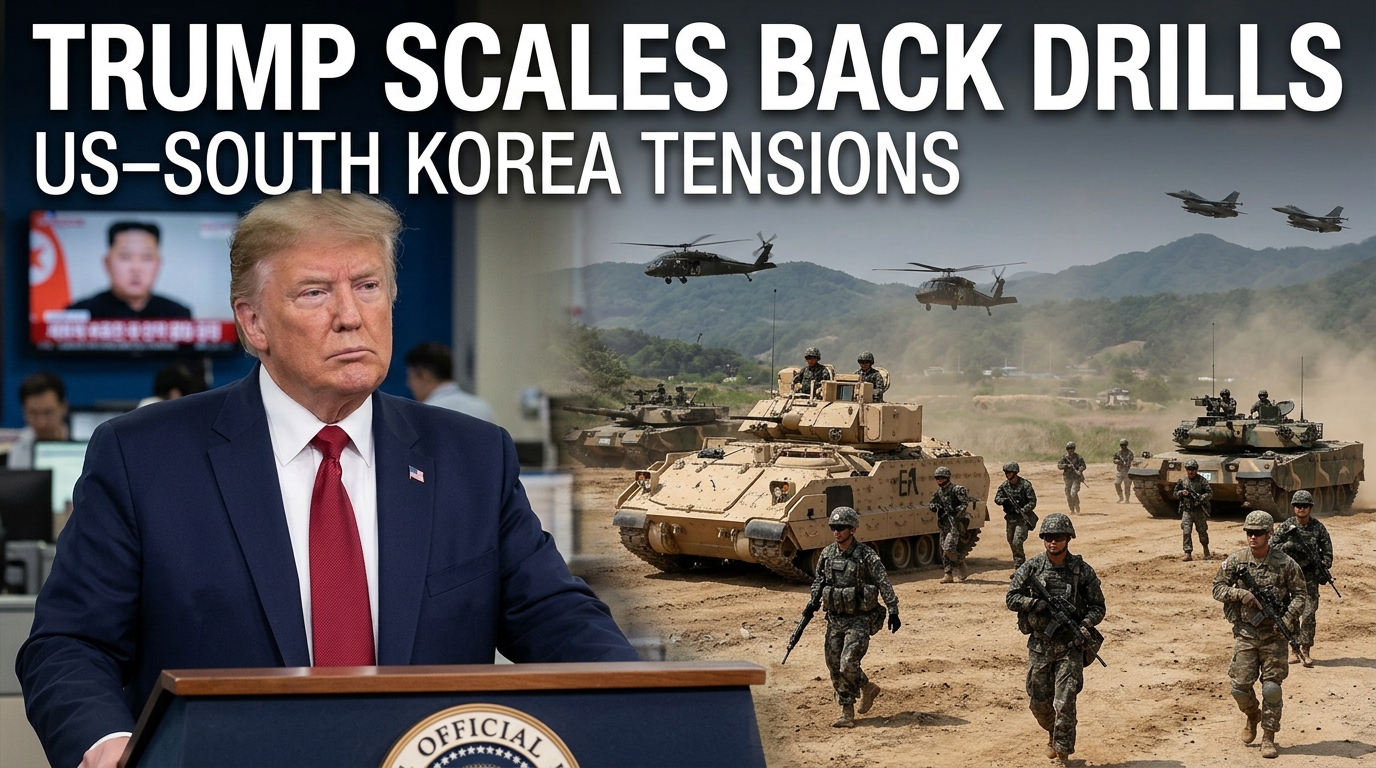
Writing on his social media platform, Truth Social, Trump pointed to two distinct geopolitical friction points: his warm personal rapport with North Korean leader Kim Jong Un and South Korea’s refusal to join Washington’s pressure campaign regarding the Denuclearisation of Iran.
The announcement landed just as the 11-day annual Ulchi Freedom Shield exercises were scheduled to kick off, involving approximately 18,000 South Korean service members alongside American personnel.
Also Read:
Will UPI No Longer Be Free? India Considers Merchant Discount Rate (MDR)
The Truth Social Announcement: A Dual Grievance
Trump’s social media statement combined financial complaints, defense strategy, and a pointed diplomatic snub. He noted that while it was “too late to cancel” the drills entirely because they were set to begin on Monday, he had instructed the Secretary of Defense, Pete Hegseth, to drastically scale back participation. Scaling back the US-South Korea military drills, Trump argued, would save money and ease tensions with Pyongyang.
- The North Korea Factor: Trump criticized the drills as costly and counterproductive, arguing they send a “totally inappropriate and hostile” message to Pyongyang. He emphasized his “very good relationship” with Kim Jong Un, framing North Korea as respectful during his time in office.
- The Iran Connection: In the same post, Trump revealed that he had recently asked South Korean leadership to assist in the U.S. push to denuclearize Iran, only to be met with a flat refusal: “No thanks!” Though he added a playful or rhetorical question mark regarding how closely tied the two matters were, the juxtaposition drew an immediate link between Seoul’s diplomatic non-alignment on Iran and Washington’s security posture on the Korean Peninsula.
Strategic Fallout and Regional Reactions
The surprise directive has created mixed signals for Seoul. On one hand, South Korean officials have long maintained a desire for Washington to keep diplomatic channels open with Pyongyang. On the other, abruptly cutting back on defensive coordination — especially while North Korea continues ballistic missile tests and deepens military cooperation with Russia — raises deep security concerns. The US-South Korea military drills serve as a cornerstone of regional deterrence, and any reduction sends ripples through allied planning.
Pyongyang’s foreign ministry had previously condemned the Ulchi Freedom Shield exercises as a “rehearsal for an aggressive war” — standard rhetoric ahead of major allied deployments.
With approximately 28,500 U.S. troops stationed in South Korea, the alliance serves as a cornerstone of regional stability. The US-South Korea military drills remain central to the alliance’s readiness despite the announced scale-back. Analysts note that Trump’s latest declaration highlights ongoing friction over burden-sharing, alliance expectations, and divergent strategies toward Middle Eastern and Asian flashpoints.
US-South Korea Military Drills FAQs
Here are answers to common questions about the US-South Korea military drills decision.
What did President Trump order regarding US-South Korea military exercises?
Trump instructed the Pentagon and Defense Secretary Pete Hegseth to substantially curtail the scale of the ongoing US-South Korea military drills, calling them costly and hostile toward North Korea.
Did Trump cancel the exercises completely?
No. Trump stated that it was “too late to cancel” entirely because the exercises were already scheduled to begin, opting instead for a substantial reduction.
Why did Trump link the decision to Iran?
Trump noted in his announcement that South Korea declined a request to join U.S. efforts aimed at the denuclearization of Iran, a diplomatic refusal he factored into his frustration with regional allied cooperation.
How has South Korea responded?
While South Korean military authorities initially indicated drills would proceed as scheduled, the abrupt directive from Washington has sparked intense discussions and anxiety within policy circles regarding alliance commitments.
Disclaimer
This article is for informational purposes only, synthesizing recent geopolitical announcements, public statements, and media reports. International defense policies and diplomatic stances are subject to rapid change. Readers are advised to consult official government and defense department communications for real-time policy updates.
Resources & Official Links
For official updates on the US-South Korea military drills and regional security policy, consult these sources:
- For official updates on regional security and defense policy, visit the U.S. Department of Defense.
- For official announcements regarding South Korean foreign and defense policy, check the Ministry of National Defense South Korea.
- For ongoing international coverage of diplomatic developments, review reports from Reuters and Associated Press.
1 thought on “Trump Orders Scale-Back of US-South Korea Military Drills Citing Kim & Iran”