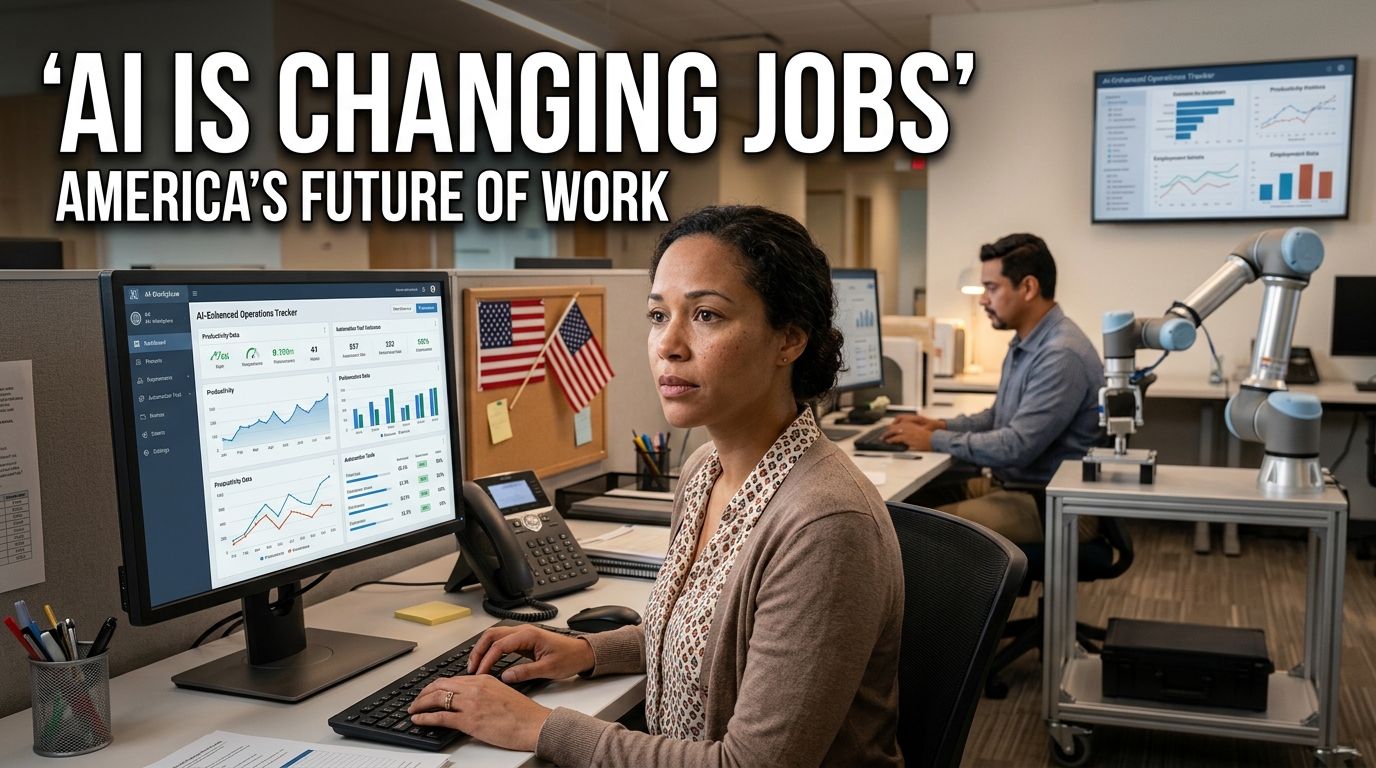
How AI Is Changing Jobs in America
Artificial intelligence is no longer a technology limited to research laboratories or large technology companies. In 2026, AI is becoming part of everyday work across the United States, changing how employees complete tasks, how companies hire workers, and which skills employers value.
Also read:
Best AI Tools for Work in 2026: Top AI Productivity Tools
From customer service and marketing to healthcare, finance, software development, manufacturing, and transportation, businesses are increasingly using AI to automate repetitive work and help employees make faster decisions.
However, the impact of AI on American jobs is more complicated than simply saying that robots will replace workers. In many occupations, AI is changing tasks rather than eliminating entire jobs. At the same time, some occupations may face declining demand while new positions emerge around artificial intelligence, data, cybersecurity, automation, and AI management.
According to the U.S. Bureau of Labor Statistics (BLS), total U.S. employment is projected to increase by about 5.2 million jobs between 2024 and 2034, reaching approximately 175.2 million jobs. BLS also expects AI and other technologies to affect employment differently across occupations.
So, how exactly is AI changing jobs in America?
AI Is Automating Repetitive Tasks
One of the most visible effects of artificial intelligence is automation.
Many employees spend part of their working day performing repetitive tasks such as entering information, organizing documents, answering common questions, preparing basic reports, scheduling appointments, or searching through large amounts of data.
AI tools can perform some of these activities much faster.
For example, an office employee may use AI to summarize a long document instead of reading every page manually. A customer service representative can use an AI assistant to find information and generate a response. A marketing professional can use AI to create an initial draft of an advertisement or analyze customer feedback.
This does not necessarily mean the employee disappears.
Instead, the employee may spend more time on tasks requiring judgment, communication, creativity, and decision-making.
The BLS says occupations whose core tasks are more easily replicated by current generative AI may experience greater AI-related impacts. At the same time, some occupations that are highly exposed to AI are still projected to grow.
AI Is Creating New Jobs in America
While AI can reduce demand for certain tasks, it is also creating demand for new skills and occupations.
Companies need people who can develop, deploy, monitor, secure, and manage AI systems. This has increased interest in jobs related to:
- Artificial intelligence
- Machine learning
- Data science
- Cybersecurity
- Software engineering
- AI product management
- Data analysis
- Cloud computing
- AI governance
- Automation
- Technology consulting
The BLS’s latest projections illustrate this shift. Employment for data scientists is projected to grow 33.5% from 2024 to 2034, while information security analysts are projected to grow 28.5%. Computer and information research scientists are projected to grow 19.7%.
These figures demonstrate an important point: technological change can reduce demand for some tasks while increasing demand for workers who build and use the technology.
Software Jobs Are Changing, Not Simply Disappearing
Software development is one of the occupations frequently discussed in conversations about AI and employment.
AI coding assistants can generate code, explain programming concepts, identify errors, and help developers work faster. This may change the amount of time developers spend writing routine code.
But software developers still need to understand system architecture, security, requirements, testing, business objectives, and how different technologies work together.
Interestingly, BLS projections show software developer employment increasing from approximately 1.69 million in 2023 to nearly 2 million in 2033, a projected increase of 17.9%.
This suggests that AI does not automatically translate into fewer software jobs. Instead, the role of the software developer may evolve.
Healthcare Could Become One of the Biggest AI-Enabled Industries
Healthcare is another major area where AI is changing work.
AI can help healthcare organizations analyze medical information, organize records, support administrative operations, and assist professionals with certain forms of analysis.
Doctors, nurses, technicians, and other healthcare professionals still require human judgment and direct interaction with patients. However, AI may reduce some administrative workloads and help professionals process information more efficiently.
The broader healthcare sector is also expected to be one of America’s strongest sources of employment growth over the next decade. BLS projects healthcare and social assistance to grow by 8.4% from 2024 to 2034, with demographic trends such as an aging population playing an important role.
This means AI may become an important tool within an industry that is already expected to need more workers.
Customer Service Jobs Are Being Reshaped
Customer service is another field experiencing rapid AI adoption.
AI-powered chatbots can answer frequently asked questions, provide basic troubleshooting, and handle simple customer requests. Businesses can use these systems 24 hours a day, potentially reducing the amount of routine work handled by human agents.
But complicated complaints and sensitive customer situations still often require human communication.
As a result, customer service jobs may increasingly focus on difficult cases, relationship management, problem-solving, and situations where empathy is important.
Workers who know how to work alongside AI systems could therefore have an advantage over workers who rely entirely on traditional processes.
Finance and Office Work Are Changing
AI is also transforming financial and administrative jobs.
Banks, insurance companies, accounting firms, and other organizations can use AI to process documents, identify patterns, analyze large datasets, and automate certain routine operations.
Some administrative tasks may require fewer hours of human labor. This could put pressure on jobs heavily focused on repetitive paperwork.
However, financial professionals still need to interpret results, communicate with clients, understand regulations, and make decisions.
BLS projections show that business and financial operations occupations are expected to grow 5.2% from 2024 to 2034.
The lesson is important: AI exposure does not necessarily equal job elimination.
Which American Workers Could Face the Greatest Risk?
AI is likely to have the strongest effect on occupations containing large numbers of predictable, repetitive, and computer-based tasks.
Potentially affected areas include:
- Data entry
- Basic administrative work
- Routine customer support
- Simple content production
- Document processing
- Basic research
- Routine accounting tasks
- Certain claims-processing activities
- Some entry-level analytical work
BLS projections already show that some occupations susceptible to AI impacts may decline. For example, claims adjusters, examiners, and investigators are projected to decrease 5.1% between 2024 and 2034.
However, it would be misleading to attribute every projected job decline directly to AI. Employment is influenced by many factors, including consumer demand, economic conditions, demographics, business models, and other technologies.
The Most Valuable Skill May Be Working With AI
As AI becomes more common, knowing how to use AI tools could become a standard workplace skill.
Employees may increasingly be expected to understand how to:
- Write effective instructions for AI systems.
- Check AI-generated information.
- Identify errors and hallucinations.
- Protect confidential information.
- Combine AI outputs with human judgment.
- Use AI to automate repetitive workflows.
- Understand the limitations of AI.
This creates an important shift.
In the past, workers often competed based primarily on what they could do themselves. In an AI-assisted workplace, employees may increasingly compete based on how effectively they can use technology to accomplish meaningful work.
AI Could Increase Worker Productivity
One of the biggest potential benefits of artificial intelligence is productivity.
An employee who previously needed several hours to complete a routine task may be able to complete the first stage much faster with AI assistance.
That could allow businesses to produce more without increasing labor hours at the same rate.
The productivity effect could benefit both companies and employees, but the distribution of those benefits matters. If productivity increases substantially, companies could invest more, expand operations, lower costs, or create new products.
But if businesses primarily use AI to reduce headcount, some workers could experience job displacement.
The final impact will therefore depend not only on what AI can do, but also on how employers choose to use it.
Education and Reskilling Will Become More Important
The changing labor market means workers may need to continually update their skills.
A person entering the workforce today may use technologies that did not exist when their parents started working. AI could accelerate this process.
Workers can prepare by developing skills such as:
- AI literacy
- Data analysis
- Digital communication
- Critical thinking
- Problem-solving
- Creativity
- Leadership
- Cybersecurity awareness
- Industry-specific technical skills
Human skills will remain important because AI cannot completely replace trust, accountability, interpersonal relationships, leadership, and many forms of physical or social work.
America’s Job Market Is Bigger Than AI Alone
It is also important not to blame every change in America’s labor market on artificial intelligence.
The U.S. employment market is influenced by many factors.
As of June 2026, the BLS reported an unemployment rate of 4.2% and total nonfarm payroll employment growth of 57,000 for the month.
These figures represent the entire economy, not an isolated measurement of AI’s impact.
BLS also warns that its long-term projections assume technological change follows historical patterns. Because AI capabilities can develop rapidly, the actual effects could differ from current projections.
Therefore, it is too early to claim that AI will either destroy the American job market or create unlimited new employment.
The more realistic expectation is a mixture of job displacement, job transformation, productivity gains, and new opportunities.
What the Future of Work Could Look Like
The American workplace of the future may involve humans and AI working together.
A marketing employee might use AI to analyze customer data and generate campaign ideas before making the final strategic decisions.
A software developer might use AI to write routine code while concentrating on architecture and security.
An accountant might use AI to analyze financial documents while focusing on compliance and client advice.
A doctor might use AI-assisted tools to organize information while remaining responsible for clinical decisions and patient care.
In this model, AI becomes less like a replacement for every worker and more like a powerful workplace assistant.
The workers most likely to benefit may be those who understand both their profession and the technology supporting it.
Frequently Asked Questions
1. How is AI changing jobs in America?
AI is changing jobs by automating repetitive tasks, increasing productivity, creating new technology-related positions, and changing the skills employers expect from workers.
2. Will AI replace American workers?
AI may replace some tasks and reduce demand for certain occupations, but many jobs are expected to evolve rather than disappear completely. BLS projections show growth in several occupations that are also affected by AI.
3. Which jobs are growing because of AI?
Data science, cybersecurity, computer research, software development, and other technology-related careers are among areas with strong projected growth.
4. Is AI good or bad for employment?
AI can have both positive and negative effects. It can increase productivity and create new jobs while also reducing demand for certain repetitive tasks.
5. What skills should workers learn for an AI-powered workplace?
AI literacy, data analysis, critical thinking, communication, problem-solving, cybersecurity, and industry-specific expertise can help workers adapt.
6. Will AI affect office jobs?
Yes. Office workers may see significant changes because AI can automate document processing, scheduling, research, data analysis, and other repetitive activities.
7. Are software developers going to lose their jobs?
AI is changing software development, but current BLS projections still show strong projected employment growth for software developers through 2033.
8. What should American workers do about AI?
Workers should learn how AI tools work, experiment with relevant tools, strengthen human skills, and develop expertise that allows them to use AI effectively in their profession.
Conclusion
How AI Is Changing Jobs in America is not a simple story of machines replacing humans.
Artificial intelligence is transforming the American workplace by automating repetitive activities, improving productivity, creating new careers, and changing the skills workers need.
Some occupations will face pressure as AI becomes more capable. Other careers are likely to grow as companies invest in technology, cybersecurity, data, software, and AI-related services. Even within the same occupation, the daily responsibilities of workers may change significantly.
The latest BLS projections reinforce this mixed picture. U.S. employment is projected to grow by 5.2 million jobs between 2024 and 2034, while individual occupations experience very different effects from technological change.
For American workers, the most important question may not be “Will AI take my job?”
A better question is:
“How can I use AI to become more valuable at my job?”
Workers who continuously learn, understand their industries, and know how to combine artificial intelligence with human judgment may be best positioned for the changing American labor market.
1 thought on “How AI Is Changing Jobs in America in 2026: Opportunities, Risks, and the Future of Work”