
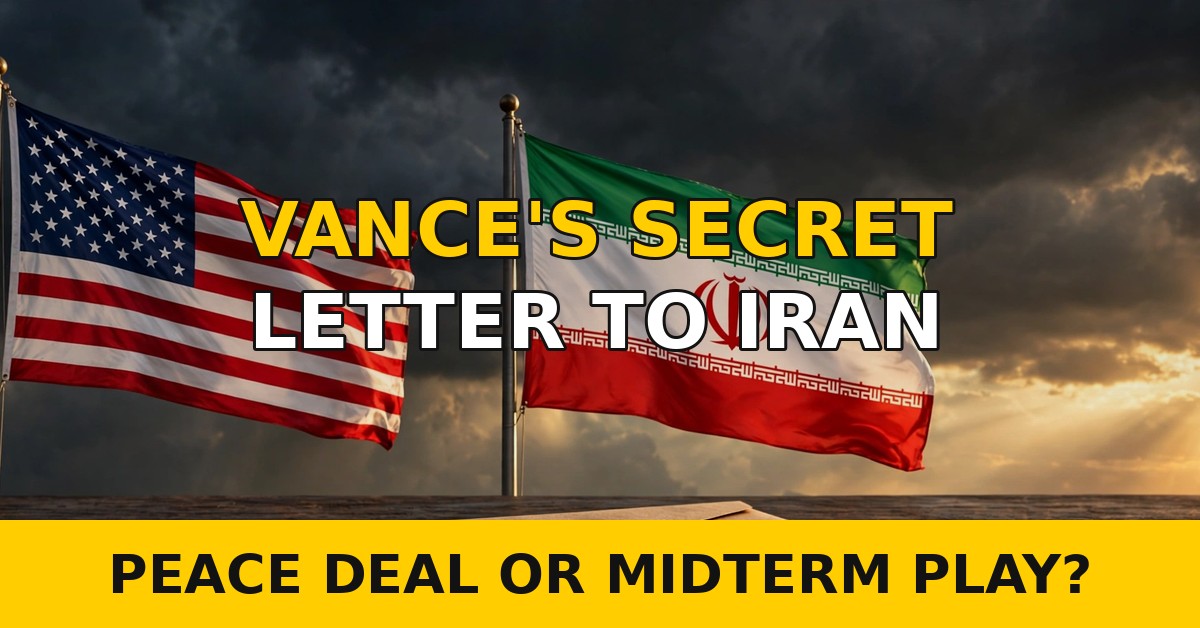
The Vance Iran letter is no longer a rumor whispered around Washington. On October 28, 2026, President Donald Trump confirmed that Vice President JD Vance wrote to Mohsen Rezaei, secretary of Iran’s Supreme National Security Council, in a fresh attempt to reopen talks with Tehran. The confirmation came just days before the November 3 midterm elections, turning a quiet diplomatic move into a public story.
Trump did not hide his own role. Asked about the letter, he said Vance had come to him first. “He asked me what I thought and I said if you want to do that that’s OK,” Trump said. This was not a rogue move; the Vance Iran letter had the president’s blessing.
What happens next is far less clear. The precise timing of Vance’s outreach and the full content of the letter were not immediately clear. What has emerged points to a message in the Vance Iran letter that mentioned a new framework for negotiations, suggesting Washington is trying to reset talks, not simply restart them.
Vance Iran Letter Arrives Days Before the Midterms
The timing here is hard to miss. The letter surfaced days before the November 3 congressional elections, when the administration’s Iran policy is under intense scrutiny. Vance himself was on the campaign trail on October 28, stumping in Kinston, North Carolina, for Republican candidates: a vice president asking voters to back his party at home while quietly reaching out to a tough adversary abroad.
The choice of recipient makes this outreach different. Rezaei is not a career diplomat known for careful, back-channel talks. He is a hardliner, and sending him the Vance Iran letter is a deliberate choice. It signals Washington is willing to talk to the people who hold power inside Iran’s security establishment, not just the officials who have fronted talks in the past.
It also raises a political question: if talks are genuinely on the table, what does the United States hope to get, and what is it prepared to give? If the letter was mainly a signal, its impact may be measured in Tehran’s reaction rather than in any deal.
Who Mohsen Rezaei Is and Why He Matters
Mohsen Rezaei is the secretary of Iran’s Supreme National Security Council, and his influence in Tehran is rising. He is also a former commander of the Islamic Revolutionary Guard Corps, the powerful military force at the center of Iran’s security state. He speaks for the security hardliners, not for the diplomats.
Rezaei has been hostile to negotiations with the United States. This month, he threatened to expand Iranian attacks on targets in neighbouring Arab countries, including data centers and internet cables, the Journal reported. Those are the words of an official warning Washington and its regional partners that Iran still has cards to play.
Yet Rezaei is also active regionally. On Sunday, he met with a delegation from Pakistan, Saudi Arabia and Turkey, talking to key regional players at the same time Washington is trying to reach him.
What the Letter Reportedly Says
So far, the public record on the Vance Iran letter itself is thin. The Wall Street Journal first reported the outreach, and Trump then confirmed it, but neither account has laid out the letter word for word. The message reportedly mentioned a new framework for negotiations. That careful phrase does not promise a deal or set out terms. It opens a door and suggests the conversation could be structured differently from before.
A new framework could mean new topics, new people in the room, or a new sequence for talks. It could also mean a simpler idea: the old approach had run its course and both sides needed a fresh starting point. Until more detail emerges, Tehran’s response, or its silence, may say as much as the letter itself.
That uncertainty cuts both ways. For supporters of diplomacy, a vague opening gives both sides room to talk without locking into positions they cannot defend at home. For critics, secret letters to hardliners, revealed only after a newspaper report, leave Congress and the public guessing about what America is offering and why.
A Shift From the Old Negotiating Table
The choice of Rezaei also marks a shift from who has led Iran’s side in the past. Parliament speaker Mohammad Bagher Ghalibaf and foreign minister Abbas Araghchi previously were the country’s lead negotiators, including meetings with Vance and special envoys Steve Witkoff and Jared Kushner for 21 hours during April talks in Islamabad.
Reaching out to Rezaei breaks that pattern. It suggests Washington now sees the Supreme National Security Council as central to any real decision in Tehran. A deal, or even a serious conversation, has to run through the security establishment too. That is a frank recognition of how power works inside Iran, even if it makes some observers uneasy.
It also fits this administration’s style, where personal outreach often comes before formal talks. Vance writing directly is faster than a formal channel and easier to downplay if it goes nowhere, though it can look improvised when it fails.
The Threat Hanging Over Any New Talks
No account of this letter is complete without the threat hanging over it. Trump has threatened to resume bombing Iran after the November 3 congressional elections. At a Friday rally in Fort Myers, Florida, he put it bluntly: “We may do another little Epic Fury. Or they’ll agree. If they’re smart, they’ll just say, let’s get down to business.”
That is a stark backdrop for a peace overture: the Vance Iran letter about a new framework for negotiations, alongside a public warning that military action could return once the elections are over. Supporters will say the two messages work together, diplomacy backed by a credible threat. Critics will say the threat undercuts the letter, making it harder for Tehran to engage without looking like it caved under pressure.
For Rezaei, that tension is the whole calculation. He has threatened to widen attacks on regional targets and opposed talks with Washington. If he replies, he risks looking soft to hardliners at home. If he ignores it, he risks a confrontation after November 3 that Iran may not want.
Read also: Vance Iran letter revealed in new peace overture — earlier coverage
Sources and Resources
- NY Post report on the Vance letter: https://nypost.com/2026/10/28/us-news/jd-vance-pens-letter-to-iran-hardliner-in-peace-talk-overture/
- Reporting credit: This article is based on reporting by the NY Post and the Wall Street Journal, including the Journal’s first report of the letter and its account of Rezaei’s recent threats and meetings.
FAQs
What is the Vance Iran letter?
The Vance Iran letter is a letter Vice President JD Vance wrote to Mohsen Rezaei, secretary of Iran’s Supreme National Security Council, as part of a new peace overture. President Donald Trump confirmed the letter on October 28, 2026, after the Wall Street Journal first reported it.
Who is Mohsen Rezaei?
Rezaei is a former commander of the Islamic Revolutionary Guard Corps whose influence in Tehran is rising. He now serves as secretary of Iran’s Supreme National Security Council and has been hostile to negotiations with the United States.
What did the letter reportedly mention?
The Vance Iran letter reportedly mentioned a new framework for negotiations. The precise timing of the outreach and the full content of the letter were not immediately clear, so the details of that framework have not been made public.
Why does the timing matter?
The Vance Iran letter was confirmed days before the November 3 midterm elections, while Vance was campaigning for Republican candidates. Trump has also threatened to resume bombing Iran after the elections, so the outreach sits alongside a very public warning.
Who led Iran’s negotiations before Rezaei?
Parliament speaker Mohammad Bagher Ghalibaf and foreign minister Abbas Araghchi previously were Iran’s lead negotiators, including meetings with Vance and envoys Steve Witkoff and Jared Kushner for 21 hours during April talks in Islamabad.
Conclusion
The Vance Iran letter does not settle the future of US-Iran relations. It does not announce a deal, and it does not guarantee talks will even happen. What it does reveal is a choice: to reach past the usual negotiators and speak directly to a rising security hardliner, days before an election, with a threat of renewed bombing still on the table.
That choice could open a new channel, or it could go nowhere. The next move belongs to Tehran.