
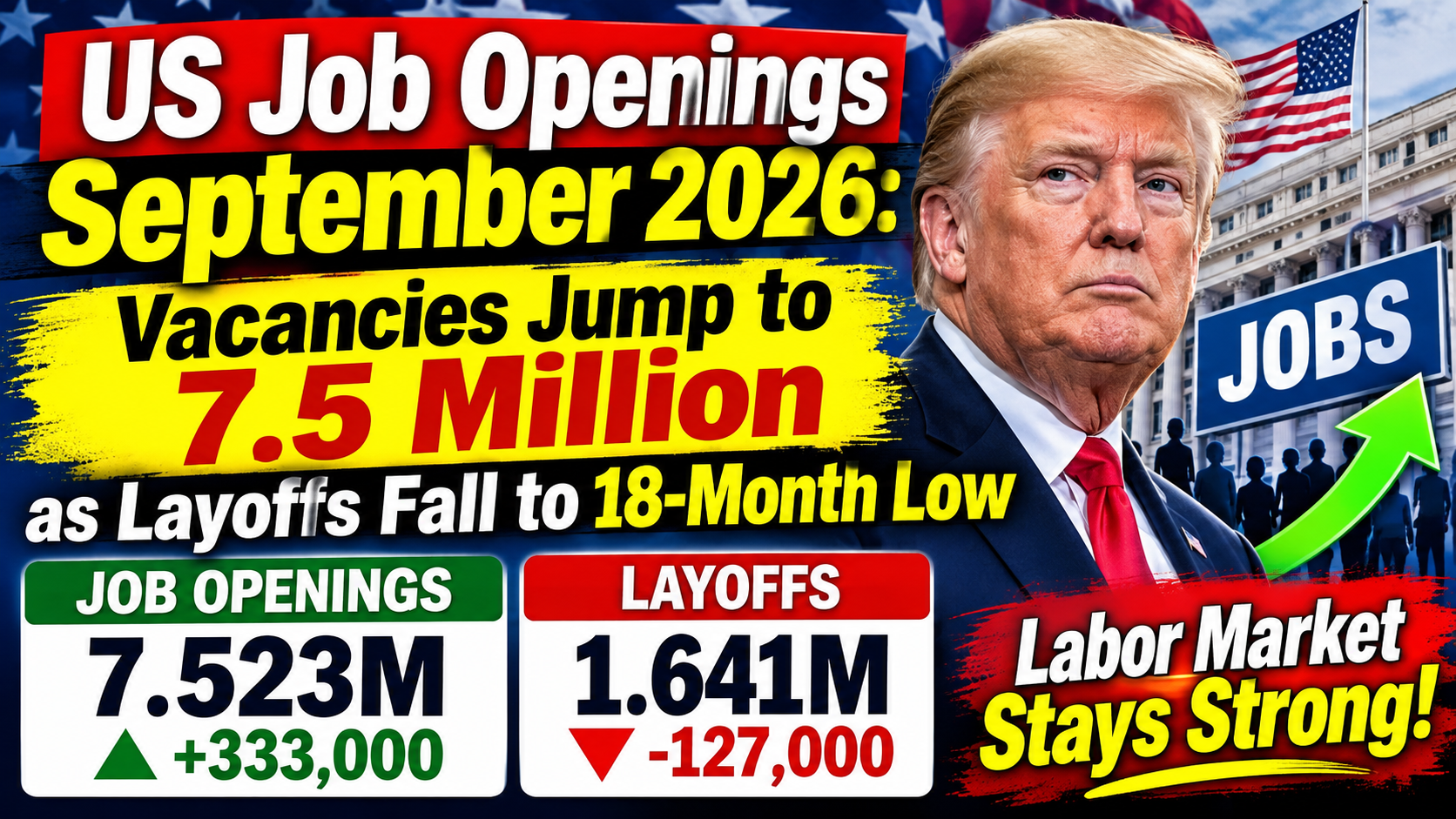
US Job Openings September 2026: Vacancies Jump to 7.5 Million as Layoffs Fall to 18-Month Low
The latest US job openings September 2026 report shows a resilient labor market, with advertised vacancies rising by 333,000 to hit a seasonally adjusted 7.523 million. Released by the U.S. Bureau of Labor Statistics (BLS) in its Job Openings and Labor Turnover Survey (JOLTS), the data highlights an unexpected surge from August’s revised total of 7.19 million vacancies. Simultaneously, employer layoffs dropped by 127,000 to 1.641 million—the lowest level recorded in approximately 18 months—signaling that companies remain hesitant to let go of existing staff.
While total vacancies rebounded, economists note that actual hiring activity grew at a more modest pace. Total hires reached 5.402 million in September, up slightly from 5.271 million in August, pushing the overall hiring rate to 3.4%. This disparity between high job openings and cautious hiring reflects a market where employers continue to post open positions while proceeding carefully with final hiring decisions.
Also Read:
Oil Plunges 8% and Gold Gains 3.3% as Markets Reassess Iran War Outlook
                SEPTEMBER JOLTS METRIC BREAKDOWN

  Total Job Openings: 7.523 Million (Up 333,000 MoM)
                          │
         ┌────────────────┴────────────────┐
         ▼                                 ▼
   [ Separations & Quits ]        [ Layoffs & Discharges ]
   • Quits: 3.365 Million          • Layoffs: 1.641 Million
   • Quits Rate: 2.1%              • Layoffs Rate: 1.0%
   • 18-Month High Confidence      • 18-Month Record Low
Voluntary Quits Signal Worker Confidence
A standout figure in the US job openings September 2026 statistics is the sharp uptick in voluntary resignations. The number of workers quitting their jobs jumped by 321,000 to reach 3.365 million, moving the national quits rate up from 1.9% to 2.1%.
A rising quits rate typically serves as a key indicator of worker confidence. Employees generally leave roles voluntarily when they either have another opportunity lined up or feel assured about finding alternative employment quickly. September’s quit total represents the highest level of voluntary turnover since early 2025.
Accommodation and Food Services: Led the rise in worker mobility, adding 197,000 voluntary quits alongside 158,000 new hires.
Construction & Trade Services: Experienced steady voluntary departures, though construction also recorded localized pressure in employer separations.
Arts & Entertainment: Saw a slight reduction in voluntary exits, dropping by 19,000 during the month.
Layoffs Drop Across Key Business Sectors
The drop in total layoffs to 1.641 million pulled the national layoff rate down to 1.0%. This represents a broad retrenchment in corporate downsizing across multiple core business lines.
                     LAYOFF RETRENCHMENT DYNAMICS

                [ Overall Layoffs Drop to 1.641M ]
                                │
       ┌────────────────────────┼────────────────────────┐
       ▼                        ▼                        ▼
[ Healthcare & Social ]   [ Professional & Biz ]   [ Trade & Transport ]
 Significant Reduction     Low Staff Discharges     Decreased Separation
The reluctance of employers to reduce headcount reinforces a “low-churn, low-layoff” environment. Businesses that struggled with post-pandemic recruitment continue to hoard talent, choosing to pause non-essential hiring rather than execute sweeping workforce reductions.
Key Labor Indicators: August vs. September 2026
The following table summarizes the monthly shifts across major indicators within the JOLTS data release:
| JOLTS Labor Metric | August 2026 | September 2026 | Net Monthly Change |
| Total Job Openings | 7.190 Million | 7.523 Million | +333,000 |
| Job Openings Rate | 4.3% | 4.5% | +0.2% |
| Total Hires | 5.271 Million | 5.402 Million | +131,000 |
| Hiring Rate | 3.3% | 3.4% | +0.1% |
| Voluntary Quits | 3.044 Million | 3.365 Million | +321,000 |
| Quits Rate | 1.9% | 2.1% | +0.2% |
| Layoffs & Discharges | 1.768 Million | 1.641 Million | -127,000 |
| Layoffs Rate | 1.1% | 1.0% | -0.1% |
Economic Implications & Policy Outlook
Analyzing the broader US job openings September 2026 metrics provides crucial context for Federal Reserve officials as they evaluate interest rate decisions and overall economic momentum.
Key macroeconomic implications include:
Available Jobs Ratio: The ratio of job openings per unemployed job seeker held around 1.05 to 1.1. This indicates that open positions still outnumber active job seekers, maintaining structural balance without overheating wage inflation.
Net Employment Growth: Total monthly hires (5.402 million) exceeded total separations (5.3 million) by a narrow net margin of roughly 83,000, underscoring steady but non-aggressive job additions.
Monetary Policy Stance: Because layoffs remain at multi-month lows and job openings remain stable above 7.5 million, central bank policymakers have flexibility to adjust interest rates gradually without facing immediate recessionary labor collapse.
Frequently Asked Questions (FAQs)
Q1: What were the main takeaways from the US job openings September 2026 JOLTS report?
Total job openings rose unexpectedly by 333,000 to reach 7.523 million, while layoffs dropped to an 18-month low of 1.641 million, and voluntary quits increased to 3.365 million.
Q2: Why did voluntary quits rise in September 2026?
Voluntary quits rose by 321,000 as workers demonstrated greater confidence in finding new opportunities, particularly in sectors such as accommodation, food services, and construction.
Q3: Does high job opening volume mean hiring is accelerating rapidly?
Not necessarily. While job openings surged, actual hires increased by a modest 131,000, showing that companies are maintaining open position listings while remaining selective during final onboarding.
Q4: How does the September job opening data affect Federal Reserve rate decisions?
Solid vacancy levels combined with record-low layoffs indicate that the labor market is resilient, reducing pressure on monetary authorities to enact emergency rate cuts while allowing for steady policy adjustments.
Disclaimer: This article is intended for informational and educational purposes only and does not constitute financial, investment, legal, or career advisory guidance. Economic figures cited are based on official government reports and are subject to routine statistical revisions by the U.S. Bureau of Labor Statistics.