
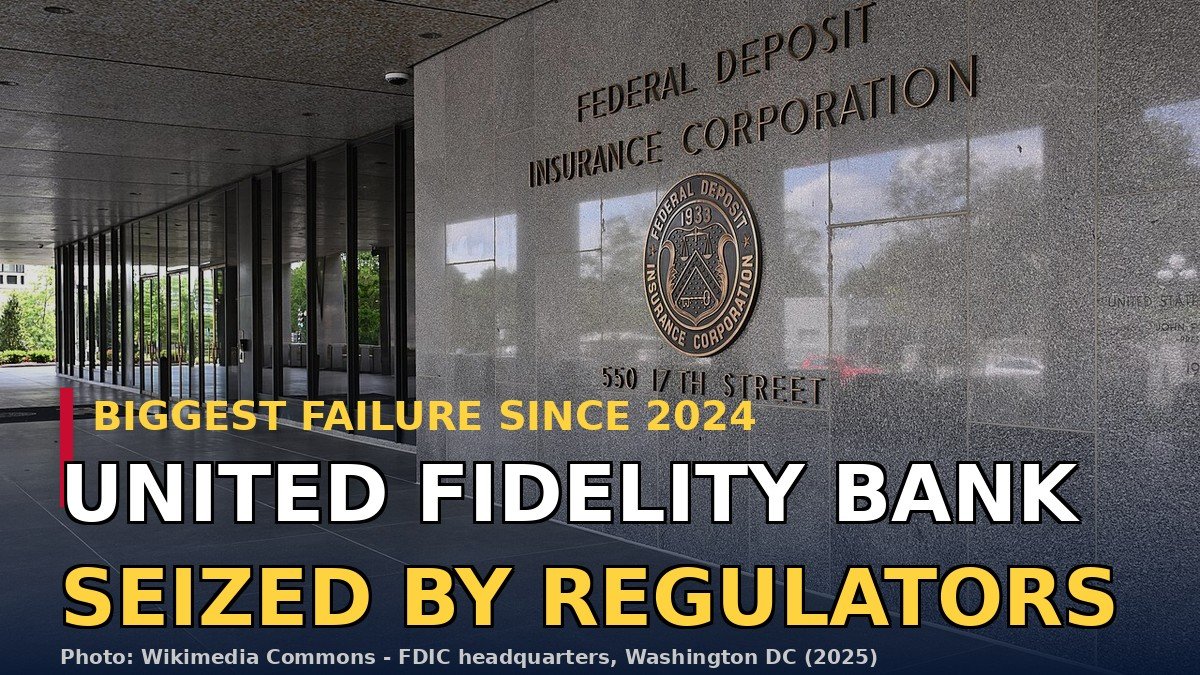
United Fidelity Bank seized by federal regulators on Friday in the biggest US bank failure in more than two years, a sudden collapse that has left depositors asking how a lender with $5.9 billion in assets could fail so fast — and whether more banks are at risk. The Office of the Comptroller of the Currency (OCC) closed the Evansville, Indiana-based bank and appointed the Federal Deposit Insurance Corporation (FDIC) as receiver, ending a troubled run that regulators had been watching for years.
The closure, announced on Friday evening, is the largest American bank failure since April 2024, when Philadelphia-based Republic First Bank collapsed with roughly $6 billion in assets. It is also the seventh US bank failure of 2026 — the most in a single year since 2017 — and the second-biggest since the regional banking crisis of 2023 that claimed Silicon Valley Bank and First Republic.
United Fidelity Bank Seized: Why Regulators Closed It
The OCC said it acted after finding that United Fidelity was in an “unsafe or unsound condition” and was likely to be unable to pay its obligations or meet its depositors’ demands in the normal course of business. Regulators have not disclosed a specific cause for the failure, and no single event has been blamed publicly.
What is known is that the bank had been losing money. United Fidelity reported a loss of $250 million in the first nine months of 2026, and its balance sheet had been shrinking under the weight of bad loans. As of September 30, it held $5.9 billion in total assets and $5.4 billion in total deposits.
The speed of the seizure surprised many observers. The bank operated 22 branches across Indiana, Illinois, Florida, Colorado and the US Virgin Islands, and customers had given no public sign of a run on deposits. But the FDIC’s own estimate of the damage tells its own story: the failure is expected to cost the Deposit Insurance Fund about $1.83 billion — an unusually high loss equal to roughly 31 percent of the bank’s assets.
What Happens to Depositors and the $1.83 Billion Cost
For ordinary customers, the message from regulators is reassuring. Depositors will keep all of their funds and their deposit insurance coverage as customers of the bank taking over, and they can still use checks, ATMs and debit cards over the weekend. Accounts transfer automatically, and branches reopen under the new name — some on Saturday, the rest on Monday.
The FDIC has set up a hotline for United Fidelity customers, open Saturday from 9am to 5pm Central Time, Sunday from noon to 4pm, and Monday from 8am to 5pm.
The $1.83 billion hit to the Deposit Insurance Fund — the industry-financed pot that protects insured deposits when a bank fails — is the largest since the collapse of First Republic Bank in 2023, which cost the fund more than $15.5 billion. A loss rate of 31 percent of assets is far above normal for a bank of this size, and it suggests regulators found far less value in the loan book than the bank’s own books showed.
First Citizens Steps In — Again
First-Citizens Bank & Trust Company of Raleigh, North Carolina, has agreed to assume about $4.5 billion of United Fidelity’s deposits and buy about $3.1 billion of its loans. The deal was struck at a discount of roughly $2.6 billion, and First Citizens paid no premium for the deposits. It will also take over FedCorp Homes, the bank’s real estate development and management subsidiary.
It is a familiar role for First Citizens. The same bank stepped in to buy Silicon Valley Bank in 2023, the second-largest bank failure in American history, and it has built a reputation as the buyer regulators call when a regional lender collapses.
First Citizens said the 22 branches will reopen as First Citizens branches, with normal operations resuming on Monday.
A Troubled Bank With a Long Warning Trail
The seizure did not come out of nowhere. In October 2023, the OCC put United Fidelity under a consent order and labelled it in troubled condition, citing problems with board oversight, capital planning, credit review, data, audit and controls. In June 2024, the Federal Reserve hit the bank’s holding companies — Pedcor Financial and Fidelity Federal Bancorp — with a written agreement covering the same family of problems: capital planning, risk management, contingency funding and board oversight.
Three years of warnings, in other words, ended in a Friday-night closure — the way regulators prefer to handle failed banks, with the weekend to complete the handover before branches reopen.
The Seventh Failure of 2026 — What It Means for Banking
Seven bank failures in a year is the most since 2017, but the picture is very different from the crisis of 2023. Then, three large banks failed in a matter of weeks and the government had to guarantee all deposits to stop the panic spreading. This time, each failure has been handled the traditional way: the bank is closed on a Friday, a stronger bank takes it over, and insured depositors are protected without drama.
Even so, United Fidelity is the biggest failure since 2024, and its 31 percent loss rate will worry regulators. It is a reminder that the US banking system still has weak spots — smaller regional lenders carrying loans that are worth far less than they appear — even as the wider market stays calm. Wall Street finished the week strongly, with the S&P 500 posting its best week since April 2025, and there has been no sign of the wider panic that followed the 2023 collapses.
For now, the official line is that the system worked as designed: a troubled bank was closed, its depositors protected, and a stronger bank took over. The unanswered question is what, exactly, went wrong inside United Fidelity — and whether other banks are carrying the same risks.