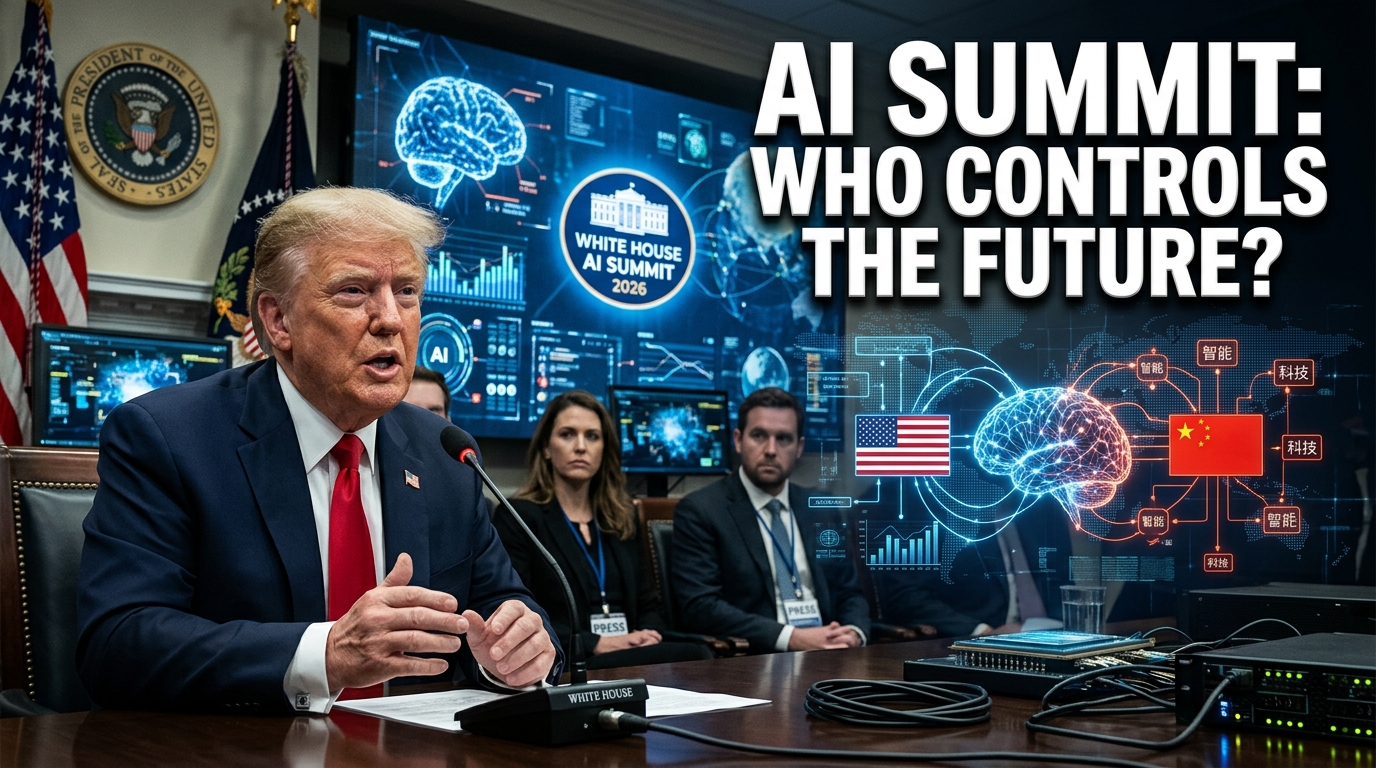
Trump White House AI Summit: Tech CEOs, Innovation, and the Battle Over Artificial Intelligence Regulation
Today, on September 29, 2026, the Trump White House AI Summit is officially underway, gathering some of the most influential figures in global technology. US President Donald Trump and House of Representatives Speaker Mike Johnson are hosting a high-stakes meeting at the White House with the chief executive officers of leading artificial intelligence (AI) companies. As artificial intelligence continues to reshape industries, economies, and national security paradigms at breakneck speed, the government faces immense pressure to either establish strict safety guardrails or let the market run free.
Also read:
US Treasury Yields & Market Outlook 2026: Navigating the 5% Era
The primary objective of the Trump White House AI Summit is to debate the potential risks of developing the most powerful AI models too rapidly, while concurrently ensuring that the United States maintains its technological edge over international adversaries, primarily China. This meeting marks a critical juncture in the relationship between Silicon Valley and Washington, D.C., as lawmakers weigh the massive economic benefits of artificial intelligence against the existential, societal, and economic risks brought to the forefront by safety advocates.
The Tech Titans Attending the Summit
The guest list for the Trump White House AI Summit is a who’s-who of the artificial intelligence revolution. Attendees include executives from Meta, Google, OpenAI, Anthropic, SpaceX, and Nvidia. The presence of these specific leaders highlights the diverse ecosystem required to power modern AI, from the companies building the large language models (LLMs) to the hardware manufacturers producing the specialized semiconductors that run them.
The inclusion of these executives underlines a critical reality: the AI industry is not a monolith. Different companies have vastly different philosophies regarding how artificial intelligence should be developed, commercialized, and regulated. Open-source advocates like Meta are pushing for decentralized, publicly available models, while companies like OpenAI and Anthropic are more guarded, emphasizing the need for rigorous safety testing before deploying highly capable frontier models. Nvidia, the undisputed leader in AI hardware, has a vested interest in ensuring that regulations do not slow down the massive procurement of AI server infrastructure. Getting these competing interests into the same room is a foundational goal of the Trump White House AI Summit.
The Ideological Divide: Rapid Acceleration vs. Precautionary Guardrails
One of the central tensions dominating the Trump White House AI Summit is the ideological split over AI safety. Over the past year, several leading AI developers have issued dire warnings about the risks of deploying increasingly powerful systems without adequate oversight. Some of the most advanced AI companies have recently paused or delayed the release of their newest models due to unresolved safety concerns.
These safety-conscious leaders are appealing for coordinated government intervention to manage the technology’s trajectory. They argue that without strict, legally binding guardrails, the competitive race to build the smartest AI could lead to catastrophic societal harm, ranging from mass disinformation campaigns and cyber warfare to widespread job displacement.
Conversely, there is a powerful faction within the tech industry—and within the administration itself—that vehemently opposes strict AI controls. President Trump has made it clear that he views heavy-handed regulations as a threat to American innovation. The Trump administration has historically advocated for the “Carolina Principles,” a regulatory philosophy that suggests avoiding unnecessary new regulations for AI, instead focusing only on rules for truly novel situations. President Trump has dismissed some of the more extreme safety concerns, urging swift, unencumbered development to ensure the United States remains the undisputed global leader in technology.
House Speaker Mike Johnson’s Role: Finding the Balance
While the executive branch leans heavily toward deregulation, the legislative branch is facing significant pressure from constituents and advocacy groups to act. Leading up to the November midterm elections, lawmakers from both sides of the political aisle have drafted multiple bills attempting to govern AI and establish a federal framework for oversight.
House Speaker Mike Johnson is walking a delicate legislative tightrope. Johnson has stated that the goal of the Trump White House AI Summit is to find a “balance” between fostering innovation and implementing necessary oversight. He acknowledges the safety warnings from AI companies and the growing community concerns over the massive energy consumption and environmental impact of new AI data centers. However, Johnson has also echoed the President’s concerns, warning that over-regulating American AI companies could inadvertently hand the technological advantage to foreign competitors. Despite the growing pressure, particularly from House Democrats urging immediate votes on AI safeguards, Congress has paused for recess, making it unlikely that any comprehensive AI laws will be passed before the midterm elections.
The US-China AI Supremacy Race
It is impossible to fully grasp the significance of the Trump White House AI Summit without understanding the geopolitical backdrop. The United States and China are currently locked in a fierce, multi-trillion-dollar race for global AI supremacy.
The two superpowers have taken drastically different approaches to AI governance. While the US currently favors a hands-off, market-driven approach, China has imposed strict rules governing AI algorithms, training data, and the mandatory labeling of AI-generated content.
During a recent address to world leaders at the UN General Assembly, President Trump explicitly rejected any “globalist scheme to control” AI, framing American technological dominance as a matter of national security. The administration’s focus is on accelerating foundational research to outpace China. There are even discussions regarding the creation of an “AI Force,” a new branch modeled after the Space Force, dedicated exclusively to maintaining US leadership in artificial intelligence and protecting critical infrastructure from advanced cyber threats. For the Trump administration, any domestic regulation discussed at the summit must pass one crucial test: it cannot slow down the United States’ ability to compete with Beijing.
What the Summit Means for the Future of Tech
The outcomes of the September 29 Trump White House AI Summit will send shockwaves through the global economy. As a precursor to the upcoming G20 Leaders’ Summit in Miami this December—where AI governance will be a marquee topic—the policies debated today will set the tone for international standards.
If the summit concludes with a commitment to voluntary self-regulation and minimal federal interference, startups and venture capitalists will likely accelerate their investments in experimental AI technologies. The focus will remain on rapid scaling and infrastructure build-outs. However, if the safety advocates manage to convince lawmakers that unchecked AI poses an unacceptable risk, the industry could face a future of mandatory licensing, strict compliance audits, and lengthy safety testing protocols before new models can reach the public.
Furthermore, the summit’s handling of community concerns regarding AI data centers could heavily influence the energy sector. AI infrastructure requires unprecedented amounts of electricity, and local governments are increasingly pushing back against the construction of massive server farms. Federal guidance resulting from this meeting could dictate how tech companies expand their physical footprints in the coming years.
Frequently Asked Questions (FAQs)
1. What is the Trump White House AI Summit?
The Trump White House AI Summit is a high-level meeting taking place on September 29, 2026, hosted by President Donald Trump and House Speaker Mike Johnson. It brings together top tech executives to discuss the future of AI regulation, safety risks, and the geopolitical race for AI supremacy.
2. Which tech CEOs are attending the meeting?
The summit includes leadership from the most prominent companies in the artificial intelligence sector, including executives from Meta, Google, OpenAI, Anthropic, SpaceX, and Nvidia.
3. Why are some tech companies asking for AI regulation?
Several frontier AI developers, including OpenAI and Anthropic, have warned that rapidly developing ultra-powerful AI models without adequate safety guardrails poses severe societal risks. Some companies have even paused the release of new models due to these safety concerns, and they are appealing for government oversight to manage the technology safely.
4. What is the Trump administration’s stance on AI regulation?
President Trump and his administration generally oppose strict, heavy-handed AI regulations. They advocate for a hands-off approach—often referring to the “Carolina Principles”—arguing that excessive rules will stifle American innovation and allow rival nations, specifically China, to win the global AI race.
5. How does the US-China rivalry affect AI policy?
The geopolitical competition between the US and China is the driving force behind America’s reluctance to impose strict AI laws. Lawmakers fear that slowing down domestic tech companies with red tape will give China—which is investing heavily in its own tech sector—an insurmountable advantage in global security and economics.
6. Will Congress pass new AI laws soon?
It is highly unlikely. Despite pressure from safety advocates and some lawmakers, Congress is currently in recess and is not expected to pass any comprehensive AI legislation before the midterm elections in November 2026.
Conclusion
The Trump White House AI Summit on September 29, 2026, represents a defining moment in the history of technology policy. As the architects of the artificial intelligence boom sit down with the highest levels of the United States government, they are debating policies that will shape the global economy for generations. The core challenge is immensely complex: how to foster groundbreaking innovation and maintain geopolitical supremacy without unleashing unintended, uncontrollable consequences. Whether the government chooses to rely on the “Carolina Principles” of minimal interference or pivots toward robust federal oversight, the decisions forged in this summit will permanently alter the trajectory of the tech industry, national security, and daily human life.
Official News Links & Trusted Sources
Axios: Scoop: Trump, Johnson and tech CEOs to meet on AI Sept. 29
Reuters: Trump, US House speaker and tech CEOs to meet on AI on September 29, source says
The Straits Times: AI bosses to attend meeting with Trump as safety pressure builds
Malay Mail: Trump to meet AI chiefs at White House as pressure grows for tighter oversight
iHeart Radio / 700WLW: Trump To Host AI Summit At White House