
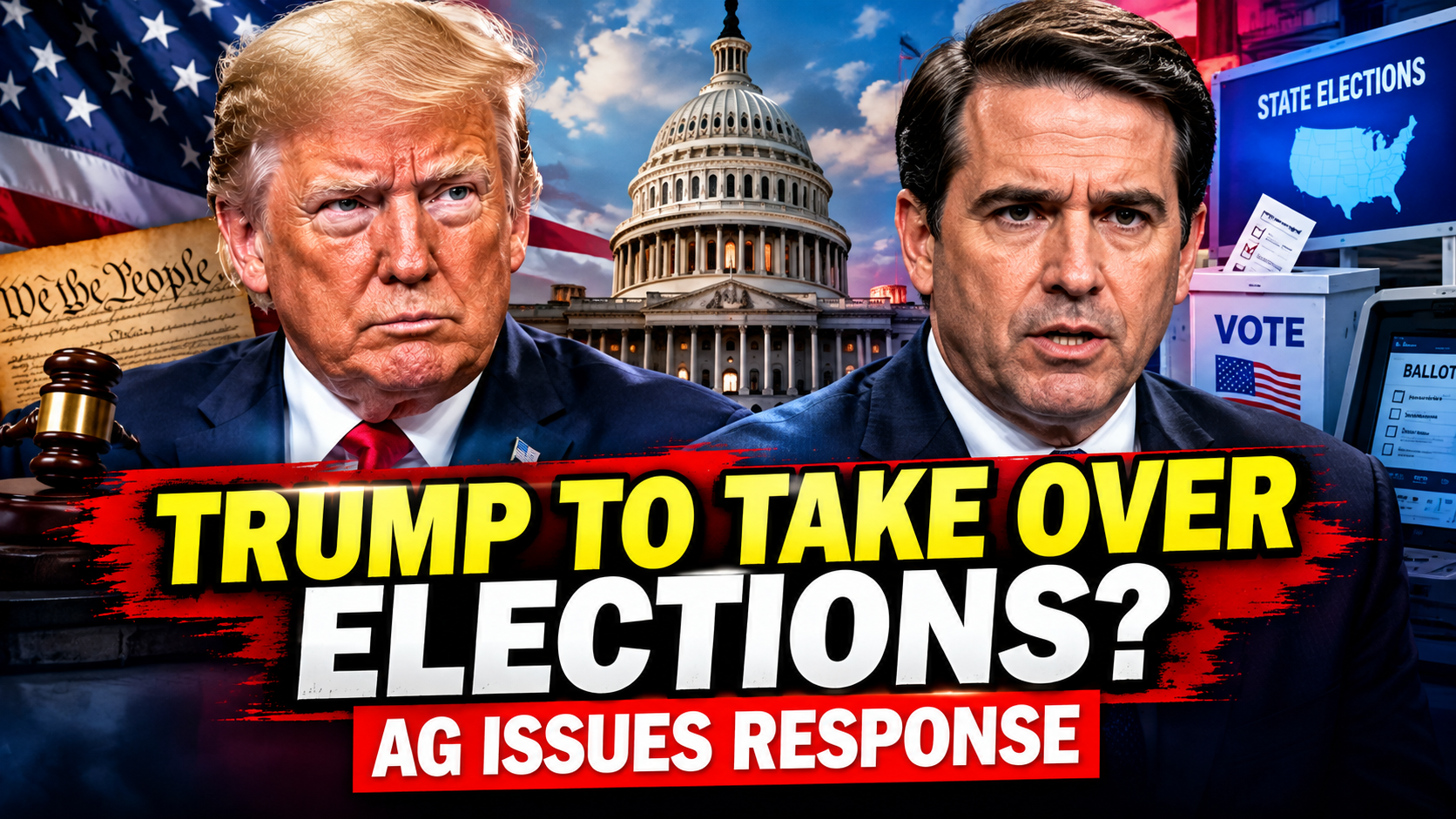
If you saw the headline and figured a single tip was suddenly worth a million dollars, hold on. That is not what happened. The Trump $1 million election fraud reward, announced by President Donald Trump on October 26, comes with a very specific catch — and that catch changes the whole story.
Put simply, the money is not for talking. It is for a result.
Trump put the offer out on Truth Social, and it was also raised before he boarded Air Force One for Corinth, Mississippi. The offer covers information about voter fraud in past elections, and it covers the 2026 midterms too. But the payout, as described, only comes after an arrest and a conviction.
Trump $1 million election fraud reward: only after arrest and conviction
That one sentence is worth repeating, because it is easy to lose in a shareable headline.
A tip that leads nowhere does not trigger it. An arrest on its own does not trigger it either. The reward is tied to both steps happening: someone is arrested, and that case ends in a conviction.
Think about how long that takes in real life. A tip has to be checked. Investigators have to find evidence they can actually use. Prosecutors have to decide whether to bring charges. Then a court has to hear the case.
Some claims will fall apart at the first hurdle. Others might look strong at first and still not survive that process. That is the point of having a legal process, of course — but it also means this is not a quick payday.
It also means the headline, on its own, is misleading if you stop there. A million dollars sounds instant. This version is not.
Why the Trump $1 million election fraud reward landed now
Timing is doing a lot of work here.
The midterms are close enough that every election story lands differently. Voters are already hearing about battlegrounds, turnout, and who controls Congress, and our 2026 midterm elections guide lays out just how tight those races are shaping up to be.
By reaching back to past elections as well as forward to the midterms, the offer tries to do two things at once: revisit old arguments and shape the next contest. Supporters will likely call that a deterrent — a big, public warning that cheating will be hunted down. Critics will likely ask a different question: does a prize this large bring in solid evidence, or just a flood of shaky claims from people hoping to cash in?
Both reactions are predictable, and both miss something if they ignore the condition. The argument is not really about a million dollars for a phone call. It is about whether a financial incentive can produce a conviction that would not have happened otherwise.
A tip is not a conviction
We use those words interchangeably in everyday conversation. In a courtroom, they are miles apart.
A tip is a lead. It might be a name, a document, a video, a story someone heard secondhand. Useful, sometimes. Decisive, not by itself.
An arrest means authorities believe they have enough to act. A conviction means a court has been persuaded, under the rules that apply in that case, that the person committed the offence.
That gap matters for anyone trying to work out whether this offer is realistic. It also matters for public trust. If people expect a million-dollar payout for every allegation, disappointment — and suspicion — will follow when most cases do not end that way.
And there is another wrinkle worth stating plainly: an announcement does not change election law. It does not change how votes are counted, who can vote, or what a court must find before convicting someone. It adds an incentive on top of a system that already exists.
The money question nobody has answered
Here is where the story gets thinner, and honesty requires saying so.
Trump did not say how the reward would be funded. He did not say who would run it, how tips would be submitted, or how eligibility would be judged if several people pointed investigators in the same direction.
Those are not footnotes. They are the difference between a formal scheme and a public pledge.
Would the money come from Trump personally, from a campaign, from a fund, from somewhere else entirely? Would there be a deadline? Would a tipster have to be the first person to come forward, or the person whose evidence proved decisive?
None of that was settled in the announcement described here, so this article will not fill in the blanks. Until those details appear, anyone describing the funding or administration as already worked out is getting ahead of the facts.
That is also why the closing line of any responsible version of this story has to include the word “only.” Only upon arrest and conviction. Not for a tip. Not for a suspicion. Only then.
What to watch, in plain terms
So what actually happens next?
First, watch for a process. A real programme would need one: where to send information, what counts, who decides, and when a payment would be made. Without that, the offer stays at the level of an announcement, however loudly it is shared.
Second, watch for any clarification on funding. That will tell readers a lot about how seriously to take the offer as a working scheme rather than a campaign message.
Third, and most boringly, watch the courts. Criminal cases move at their own pace, and they do not bend to a news cycle. If a tip ever does lead to an arrest and then a conviction, that is when — and only when — the million-dollar question becomes real.
Until then, the sensible way to read this is as a conditional promise with a high bar, announced at a politically charged moment, with the practical details still missing.
The bottom line
President Donald Trump announced on October 26, on Truth Social and before boarding Air Force One for Corinth, Mississippi, a $1 million reward for information on election fraud.
The $1 million is payable only upon the arrest and conviction of those who committed voter fraud, for past elections or the 2026 midterms.
Trump did not say how the reward would be funded or administered, and that detail should not be presented as settled.
Source: Guardian via StockBiz, October 27, 2026. More Politics coverage is available on World Reach Daily.