
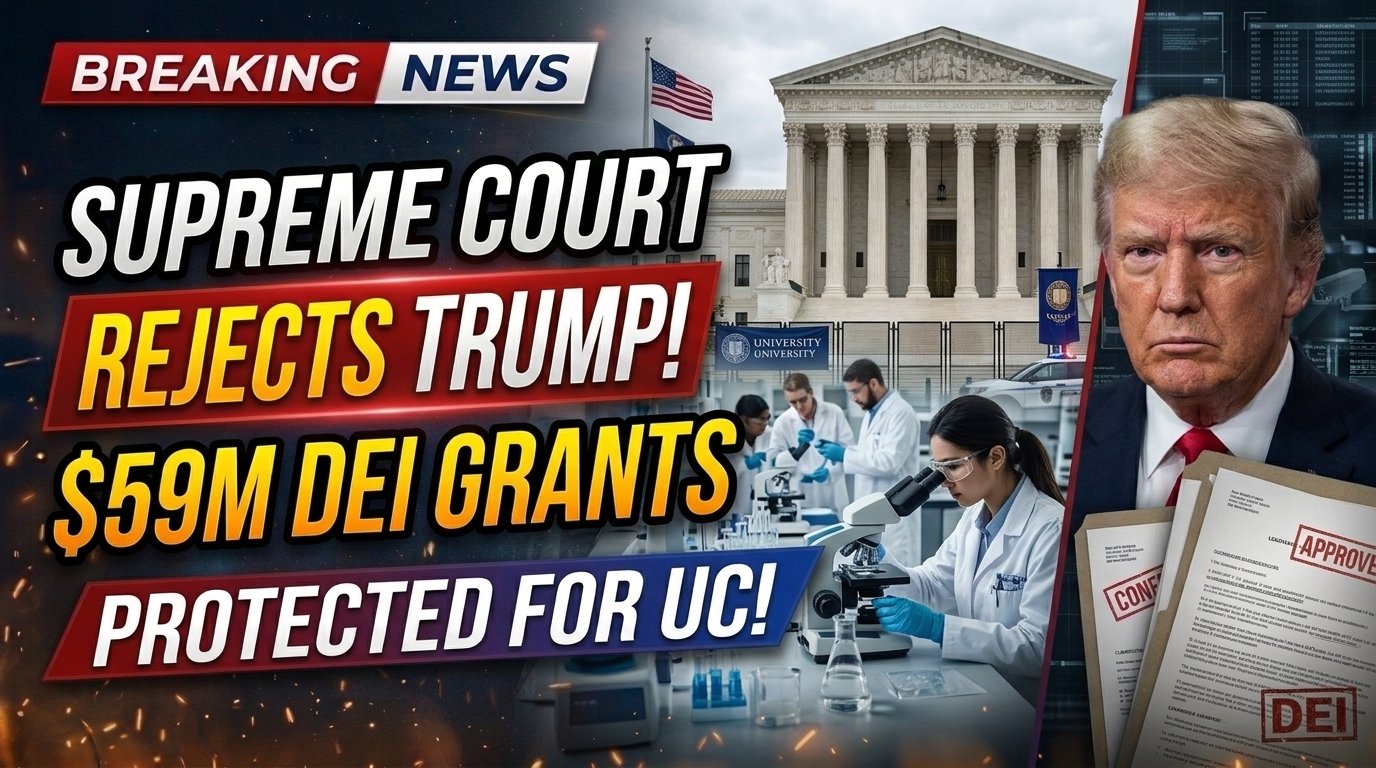
Supreme Court Rejects Trump Appeal Over DEI Funding Cuts to UC Researchers
In a significant constitutional setback for the White House’s campaign against diversity initiatives in higher education, the Supreme Court rejects Trump appeal over DEI funding cuts to UC researchers, leaving intact lower-court orders that restored millions of dollars in federal academic grants. On Monday, November 16, 2026, the justices denied the administration’s petition for a writ of certiorari in Trump v. Thakur without explanation and with no noted dissents.
The refusal to take up the case preserves a May 2026 ruling by the U.S. Court of Appeals for the Ninth Circuit and a preliminary injunction issued by U.S. District Judge Rita Lin. Those decisions concluded that federal agencies likely violated the First Amendment by abruptly terminating peer-reviewed research grants awarded to University of California (UC) scholars based on perceived support for diversity, equity, and inclusion (DEI).
Also Read:
UK Hands US Army Officer to US Military in Espionage Probe Linked to Russia
Origins of the Dispute and the First Amendment Challenge
When the Supreme Court rejects Trump appeal over DEI funding cuts to UC researchers, it effectively shields approximately $59 million in remaining federal grant funds from the National Science Foundation (NSF) and the National Endowment for the Humanities (NEH)—awards slated to run through as late as November 2029.
The legal battle traces back to April 2025, when the NSF, NEH, and Environmental Protection Agency (EPA) terminated dozens of active grants across the University of California system. Key milestones in the litigation include:
Class-Action Lawsuit (Thakur v. Trump): Six UC researchers filed a class-action lawsuit in federal court in San Francisco, challenging the cancellation of projects spanning U.S. history, disease research, dementia, and biology.
Keyword Purges and Injunction: In June 2025, U.S. District Judge Rita Lin ordered the agencies to reinstate the canceled grants, finding substantial evidence that officials used keyword searches to target and terminate projects based on viewpoints opposed by the administration.
Ninth Circuit Affirmation and EPA Settlement: On May 26, 2026, the Ninth Circuit upheld the injunction protecting the NSF and NEH grants, ruling that singling out researchers for their viewpoints likely breached First Amendment protections. While the appeal was pending, the plaintiffs reached a separate settlement resolving the EPA grant terminations.
Competing Legal Arguments Before the High Court
In an August 18, 2026, filing urging the Supreme Court to intervene, Solicitor General D. John Sauer argued that the dispute centered on executive funding priorities rather than free speech. The Justice Department contended that the First Amendment “does not prohibit the government from declining to award competitive grants that fund research projects that promote DEI”.
Attorneys representing the UC researchers countered that once competitive grants are awarded through peer review, the government cannot revoke them mid-stream merely because officials dislike the ideas or topics explored. In their Supreme Court brief, the researchers’ legal team argued that the abrupt cancellations inflicted both material and expressive harm—stripping away laboratory funding, graduate students, and postdoctoral staff while preventing scholars from publishing their findings and contributing to public discourse.
Broader Impact on Higher Education Litigation
The Supreme Court’s order represents the latest courtroom defeat for the administration in its broader legal confrontation with major American universities. It follows recent judicial setbacks for the Justice Department in grant-termination disputes involving Harvard University as well as the dismissal of a federal admissions-records lawsuit.
Because Monday’s decision leaves the preliminary injunction in place without resolving the ultimate merits, Trump v. Thakur will now return to the U.S. District Court for the Northern District of California for further proceedings. Simultaneously, UC researchers are continuing separate lower-court litigation challenging the administration’s cancellation of Department of Energy research grants. As the Supreme Court rejects Trump appeal over DEI funding cuts to UC researchers, academic institutions nationwide gain powerful First Amendment precedent safeguarding existing federal research awards from ideological cancellations.
Frequently Asked Questions (FAQs)
What did the U.S. Supreme Court decide in Trump v. Thakur? On November 16, 2026, the U.S. Supreme Court declined to hear the Trump administration’s appeal without comment or noted dissent, leaving intact lower-court rulings that blocked the cancellation of federal research grants awarded to University of California researchers.
How much research funding is protected by the Supreme Court’s decision? The ruling preserves a preliminary injunction protecting approximately $59 million in remaining grant funding from the National Science Foundation (NSF) and the National Endowment for the Humanities (NEH), with grant terms extending as late as November 2029.
Why did lower courts rule against the Trump administration’s grant cuts? Both U.S. District Judge Rita Lin and the U.S. Court of Appeals for the Ninth Circuit found that federal agencies likely violated the First Amendment by singling out and terminating existing grants based on viewpoints associated with diversity, equity, and inclusion (DEI).
What happened to the Environmental Protection Agency (EPA) grants involved in the lawsuit? While the case was progressing through the courts, the UC researchers and the federal government reached a separate settlement resolving the dispute over the EPA grants, leaving only the NSF and NEH awards before the Supreme Court.
Does the Supreme Court’s denial end the Thakur v. Trump lawsuit? No. Denying review leaves the preliminary injunction protecting the grants in place while the underlying class-action lawsuit continues in the U.S. District Court for the Northern District of California.
Disclaimer
This article is for informational and legal news reporting purposes only. Case summaries, dollar figures, and procedural timelines are based on U.S. Supreme Court docket filings, Ninth Circuit appellate rulings, and verified news reports as of November 2026.