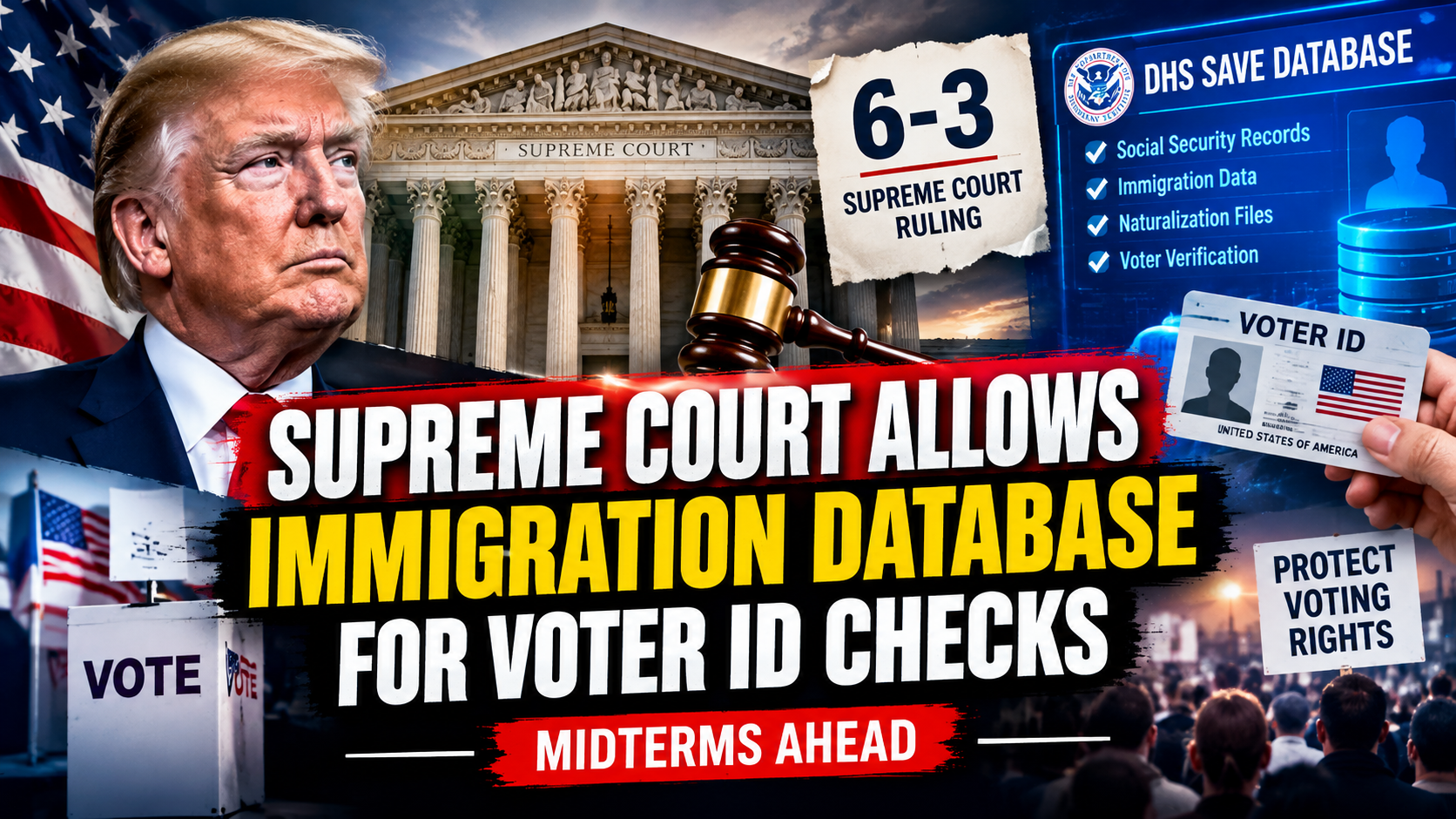
Supreme Court Allows Immigration Database for Voter ID Checks Ahead of Midterms
In a pivotal 6-3 emergency order, the Supreme Court allows immigration database for voter ID screening and citizenship verification across state voter rolls ahead of the November midterm elections. The decision grants a temporary legal victory to the Trump administration by unblocking an expanded version of the Department of Homeland Security’s (DHS) Systematic Alien Verification for Entitlements (SAVE) program.
The emergency ruling lifts a lower court injunction that had previously halted the federal government from aggregating Social Security Administration records, naturalization files, and immigration data into a searchable citizenship repository. While the decision enables state election officials to query federal records voluntarily, it also raises intense national debate regarding privacy rights, voter disenfranchisement, and federal election authority.
Also Read:
OpenAI Privacy Breach 2026: How ChatGPT Leaked User Images
1. The Legal Battle: 6-3 Ideological Split and Judicial Opinions
The Supreme Court’s per curiam ruling placed a temporary stay on a federal district judge’s injunction that found the expanded SAVE system violated the Privacy Act, the Social Security Act, and the Administrative Procedure Act. The conservative majority held that forcing DHS to rely on older, fragmented verification systems caused irreparable harm to federal efforts to assist states with election administration.
                [ Supreme Court Emergency Order on DHS SAVE Database ]
                                          |
         +--------------------------------+--------------------------------+
         |                                                                 |
         v                                                                 v
[ 6-Justice Majority (Per Curiam) ]                       [ 3-Justice Liberal Dissent ]
* Grants emergency stay to DHS                             * Authored by Justice Jackson
* Cites harm to federal-state coordination                 * Warns of erroneous voter purges
* Points to 90-day NVRA quiet period                       * Argues voter rights outweigh government harm
         |                                                                 |
         +--------------------------------+--------------------------------+
                                          |
                                          v
               [ Expanded SAVE System Restored for Voluntary State Use ]
In a sharp dissent joined by Justices Sonia Sotomayor and Elena Kagan, Justice Ketanji Brown Jackson criticized the majority for prioritizing bureaucratic convenience over the constitutional rights of lawful voters.
“In my view, the harm caused by burdening or disenfranchising even a few lawful voters outweighs the nonexistent harm that the government experiences when it is prevented from taking an action that it likely lacks the authority to take,” Jackson wrote.
2. What Is the Expanded SAVE System?
Originally established to help government agencies verify noncitizen eligibility for public benefits, the SAVE framework was heavily modified under executive directives during the Trump administration. The modernized platform transformed from a case-by-case inquiry portal into a centralized data repository.
Key upgrades to the system include:
Social Security Data Integration: Directly cross-referencing Social Security numbers (SSNs) with Department of Homeland Security citizenship files.
Bulk Screening Capability: Enabling state agencies to upload large batches of voter roll records simultaneously for automated matching.
Natural-Born Citizen Records: Expanding the database parameters beyond noncitizen documentation to index native-born American citizens.
Proponents argue these updates provide states with modern tools to prevent noncitizen voting. Conversely, civil rights groups argue that creating an aggregate citizenship lake creates unprecedented privacy exposure for millions of Americans.
3. The 90-Day NVRA “Quiet Period” vs. Individualized Inquiries
A critical factor in the Supreme Court’s rationale is the National Voter Registration Act (NVRA) of 1993. Federal law imposes a strict “quiet period” prohibiting states from conducting systematic voter roll purges within 90 days of a federal election.
However, the legal distinction between mass purges and individualized inquiries remains at the heart of how states will use the revived database.
| Process Type | Systematic Purge (Restricted) | Individualized Inquiry (Permitted) |
| Timing Window | Blocked during the 90-day pre-election quiet period. | Permitted up to Election Day under NVRA guidelines. |
| Operational Scope | Automated, bulk removal of thousands of flagged names. | Case-by-case review following specific flagged discrepancies. |
| Database Use | Scanning full voter rolls to generate automatic drop lists. | Using SAVE to verify specific questionable registration profiles. |
| Voter Safeguards | High risk of catching naturalized citizens in mass updates. | Requires direct notice and opportunity for individual cure. |
Because the Supreme Court allows immigration database for voter ID verification, election law experts emphasize that states cannot legally use SAVE to execute sweeping list maintenance right before the midterms. Instead, queries must be framed as targeted, individual status checks.
4. Privacy Risks and Historical Record Error Rates
Plaintiffs in the lawsuit—including the League of Women Voters and the Electronic Privacy Information Center (EPIC)—presented evidence that government immigration databases frequently contain outdated or missing records.
When immigrants become naturalized U.S. citizens, federal records across the Social Security Administration and DHS are not always updated simultaneously. Consequently, newly naturalized citizens are disproportionately vulnerable to being mistakenly flagged as noncitizens.
Texas Pilot Audit Errors: In Travis County, Texas, county officials audited 97 voters flagged as noncitizens by SAVE records, discovering that between 10% and 21% were actually naturalized U.S. citizens fully eligible to vote.
Social Security Lag: Federal whistleblowers noted that Social Security Administration databases do not routinely collect citizenship proof for natural-born citizens who obtained cards in childhood.
Chilling Effect: Voting rights advocates warn that receiving a formal citizenship challenge weeks before an election causes undue anxiety and may discourage lawful voters from casting ballots.
5. Strategic Implications for the Upcoming Midterm Elections
The Supreme Court order reinforces state-level discretion. Participation in the SAVE program remains entirely voluntary for state election directors. Republican-led states are expected to integrate the tool rapidly into their election verification protocols, whereas Democratic-led states have signaled hesitation over potential false-positive errors.
As the midterm elections approach, the ruling establishes a landmark precedent regarding federal involvement in voter registration verification. While the full constitutional challenge against the expanded SAVE system proceeds through lower federal courts, state election offices now possess emergency clearance to query federal citizenship records.
Frequently Asked Questions (FAQs)
What did the Supreme Court decide regarding the voter database?
The Supreme Court granted an emergency stay allowing the Trump administration to restore the expanded DHS SAVE database, enabling states to check the citizenship status of registered voters ahead of the midterm elections.
Does this ruling mean states can immediately purge voter rolls?
No. Federal law under the National Voter Registration Act (NVRA) prohibits states from conducting systematic voter roll purges within the 90-day window before a federal election, though individualized status checks remain allowed.
What is the main criticism of using the SAVE database for elections?
Critics and civil rights organizations argue that federal databases contain outdated citizenship information—particularly for newly naturalized citizens—creating a high risk of false matches and unlawful voter disenfranchisement.
Is participation in the SAVE database mandatory for all states?
No. Using the DHS SAVE database for voter eligibility verification remains completely voluntary for state election officials.
Disclaimer
This article is an analytical news synthesis based on public court dockets, Supreme Court emergency orders, and official press briefings. It is published strictly for educational, informational, and news reporting purposes.