
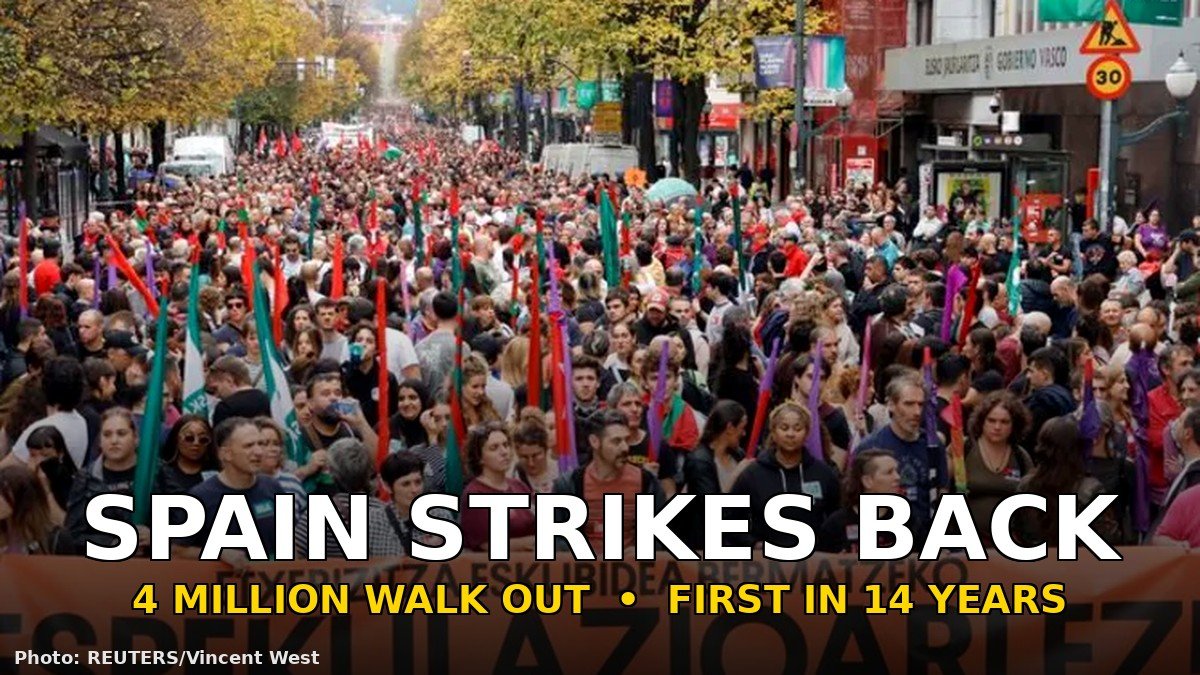
Four million Spanish workers took part in a Spain general strike on Wednesday, November 11, downing tools in the country’s first nationwide general strike in 14 years in protest against a housing affordability crisis that has pushed rents beyond the reach of ordinary families. Unions said around one in five of Spain’s roughly 23 million workers joined the 24-hour walkout, braving stormy weather to mount picket lines and march through Madrid, Barcelona, Bilbao and cities across the country less than three weeks before a snap general election on November 29.
It was the first general strike since workers walked out in 2012 against austerity measures during the eurozone debt crisis. This time the trigger was not austerity but housing: soaring rents, a shortage of affordable homes and a wave of evictions that unions and tenants’ associations say have made decent housing unattainable for millions of Spaniards.
Spain General Strike Brings Cities to a Standstill
The walkout was backed by Spain’s two largest unions, the General Union of Workers (UGT) and the Workers’ Commissions (CCOO), which together represent more than a million workers, along with tenants’ associations angry about rising rents and evictions. The strike was organised under the slogan “Salaries, Housing, Prices,” and it disrupted public transport, ports, factories, distribution centres and other businesses across Spain.
On Madrid’s Gran Via, one of the capital’s main shopping streets, protesters cheered as stores including Primark, H&M and Pull & Bear drew their shutters amid a heavy riot police presence. “We’re going to close the Mango store,” the protesters chanted as they jangled sets of house keys above their heads. Many shops in Barcelona were also closed and boarded up in anticipation of unrest.
Turnout was strongest where Spain’s industrial muscle lies. According to UGT and CCOO, participation reached 90% at ports and in the automotive sector, with “total stoppages” reported at factories including Volkswagen’s plant in Navarre and SEAT’s in Barcelona. Electricity demand dropped by as much as 15.5% between 10 a.m. and 11 a.m., according to Spain’s grid operator Red Electrica, a measure of how much of the country had stopped work.
Barcelona’s metro said no trains would run outside peak commuting hours, while Madrid’s metro said peak-hour usage was down 42% compared with the same period last week. Unions described the strike as a success even though participation was uneven across Spain, with the strongest support in coastal regions where housing pressures have been particularly acute.
A Housing Crisis Priced Beyond Young Workers
The numbers behind the protest explain why housing, rather than wages alone, brought four million people out. Spain has a deficit of about 750,000 homes, which is set to grow to more than a million by 2028, according to the country’s central bank. With fewer people able to afford a home, renting has increased sharply, putting pressure on that market.
The average rental price of €1,176 ($1,315) is equivalent to about 98.7% of a young person’s average monthly salary in Spain, according to the Youth Council of Spain. For many young Spaniards, that arithmetic means living with parents well into adulthood or not living independently at all.
“I’m 36 years old and I still can’t move out on my own,” said Madrid resident Jesus Gonzalez, who works in a hospital IT department and supports the strike. “Rents just keep going up, house prices just keep going up, and it’s simply impossible.”
The tenants’ union said it still expected participation in the strike to reach five million people by the end of the day.
Clashes in Madrid and Barcelona as Evening Falls
The day was mostly peaceful, unions said, though by the evening clashes erupted in some areas of Barcelona and Madrid. Police had reported 40 arrests by midday from 476 incidents linked to the general strike, including blockades of offices and industrial estates and burning of rubbish containers. By 9 p.m. GMT, police reported at least 73 arrests nationwide from at least 1,044 incidents.
Unions said they would file a criminal complaint against what they described as a “disproportionate” response during a police operation involving tear gas and batons that left 20 protesters injured.
Plans for massive protest marches in the afternoon were threatened by two heavy storms, dubbed Charles and Bruna, with unions suspending a demonstration in the southern port city of Cadiz.
Sanchez Bets the Election on Housing
Prime Minister Pedro Sanchez hopes to harness voter resentment over housing in the November 29 election to shift the political narrative away from corruption cases involving his inner circle and a deadly train crash last month. So far, his Socialist Party still trails in opinion polls.
The strike follows weeks of demonstrations provoked by the eviction and subsequent death of an 87-year-old woman in Madrid. Those protests, along with parliament’s rejection last month of government decrees aimed at curbing evictions and limiting rent pressures, prompted Sanchez to call the snap election.
Business leaders pushed back. Angela de Miguel, vice president of Spain’s main business lobby CEOE, said the strike was counterproductive because small businesses were also affected by the housing crisis, since shortages of homes made recruitment more challenging. Speaking on state broadcaster TVE, she said the solution was to build more homes and to lower taxes in construction and the home-buying process.
With more people able to work remotely and the increasing weight of services in Spain’s economy, the impact of the strike is likely to be less pronounced than in previous years, according to Miguel Cardoso, chief economist at BBVA Research. He estimated that the strike could shave 0.1%-0.2% off Spain’s annual gross domestic product. Spain’s fast-growing hospitality and finance industries are less unionised than the public and industrial sectors.
Whether the walkout moves votes on November 29 is the question now facing Sanchez. What is already clear is that housing has become Spain’s defining political issue — and that four million workers were willing to lose a day’s pay to say so. For more on how political upheaval is playing out elsewhere, see our coverage of other global security stories.
Source: CNN