September Market Trends: The Impact of Surging Treasury Yields and Oil Prices on the Stock Market
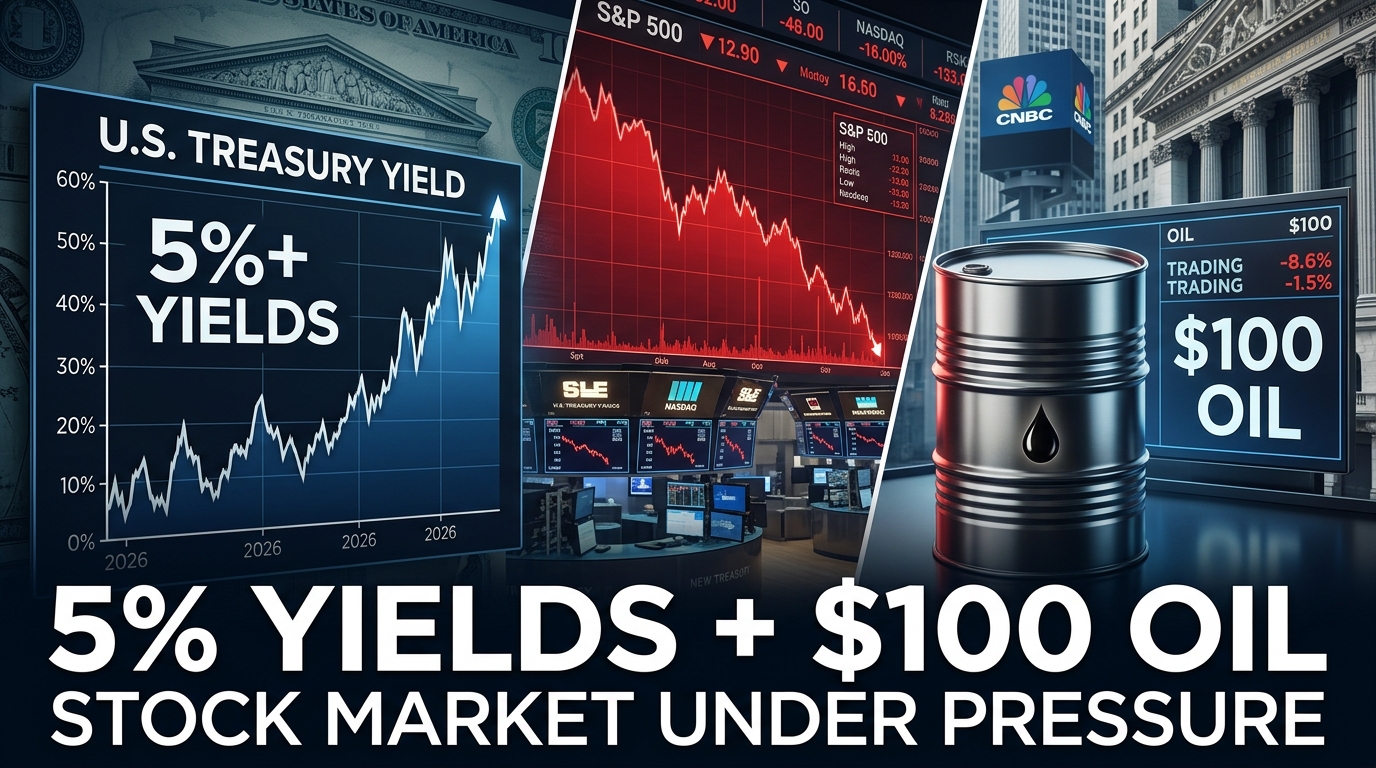
The month of September has historically been a turbulent period for Wall Street, a phenomenon widely known among investors as the “September Effect.” However, the market dynamics unfolding in September 2026 have amplified this historical trend into a complex macroeconomic storm. A powerful convergence of multi-decade highs in US Treasury yields and crude oil prices rapidly approaching $100 per barrel is sending shockwaves through equities.
Also read:
Asian Games 2026 Aichi-Nagoya: Schedule, Venues & Sports Guide
For investors, understanding the interplay between the bond market, global energy commodities, and stock market valuations is critical. This comprehensive breakdown explores why Treasury yields are skyrocketing, what is driving the oil price rally, and how these twin pressures are dictating stock market performance as we head into the fourth quarter.
The Return of the September Effect
Historically, the stock market tends to underperform in the weeks following Labor Day. Portfolio managers return from summer vacations, reassess risk, and often harvest tax losses or rebalance portfolios. While some dismiss the September Effect as a mere psychological quirk or statistical anomaly, this year, the market slump is anchored by undeniable fundamental triggers.
Instead of a routine seasonal sell-off, the current market contraction is being driven primarily by the bond market. The foundational risk-free rate of the global economy—the yield on US Treasury bonds—has repriced dramatically, dragging equity valuations down with it. Coupled with persistent inflation fears reignited by soaring energy costs, the traditional September weakness has morphed into a structural reassessment of how much risk investors are willing to take.
Decoding the Treasury Yield Surge
The most significant driver of recent stock market losses has been the relentless march upward in bond yields. In late September, the benchmark 10-year US Treasury yield surged past 5%, reaching as high as 5.14%—levels not seen in nearly two decades. The 30-year Treasury yield similarly climbed to 5.37%. Because bond prices and yields move inversely, this indicates a massive sell-off in government debt.
Several converging factors are driving this yield spike:
Stronger-Than-Expected Economic Data: Recent business activity indicators have crushed expectations. The S&P Global manufacturing PMI rose to 57 in September (well above the 53.7 estimate), while the services sector PMI hit 58.7. A robust economy suggests that the Federal Reserve will have to keep interest rates “higher for longer” to cool down demand.
The Global Debt Burden: The US national debt has swelled to staggering levels, currently sitting around $32 trillion, with net interest costs surpassing $1.1 trillion. To fund this deficit, the Treasury must issue a flood of new bonds. As the supply of government debt increases, buyers demand higher yields (a higher term premium) to absorb the issuance.
Hawkish Central Bank Policy: With core inflation still lingering above the Fed’s 2% target, central bank officials have explicitly signaled that further rate hikes remain on the table to ensure price stability.
The Crude Awakening: Oil Prices Nearing $100
Running parallel to the bond market sell-off is a fierce rally in the energy sector. Brent crude, the international benchmark, has surged toward $100 a barrel, while US West Texas Intermediate (WTI) crude has firmly crossed the $93 mark.
This energy shock is deeply problematic for the broader market for a few reasons. First, the ongoing geopolitical conflicts in the Middle East—specifically escalations involving Iran—have raised severe supply disruption fears. Second, the Organization of the Petroleum Exporting Countries (OPEC) and its allies have maintained tight production quotas, intentionally constraining global supply to prop up prices.
The most immediate domestic consequence is the cost of fuel. US diesel prices recently hit a record national average of $6.52 per gallon. Because diesel is the lifeblood of global logistics and transportation, higher fuel costs are rapidly passed down to consumers in the form of higher prices for goods, food, and services.
How Yields and Oil Prices Impact the Stock Market
When Treasury yields and oil prices rise simultaneously, they create a vice grip on the stock market. Here is exactly how these macroeconomic trends are impacting equities:
1. The Valuation Squeeze on Tech Stocks
The technology sector, particularly the Nasdaq Composite, is highly sensitive to interest rates. High-growth tech companies are valued based on their expected future cash flows. When Treasury yields rise, the “discount rate” used to calculate the present value of those future earnings increases. Consequently, future profits look much less valuable today. We have seen immediate pullbacks in major chipmakers and software giants as the 10-year yield crossed the 5% threshold. The S&P 500’s forward Price-to-Earnings (P/E) ratio has already compressed down to roughly 19x, moving back in line with historical averages.
2. Corporate Borrowing and Margin Compression
Higher bond yields mean higher borrowing costs across the economy. Companies looking to refinance debt, expand operations, or fund stock buybacks are now facing steep interest rates. At the same time, rising oil and diesel prices are inflating operating expenses. This combination of higher debt-servicing costs and rising input costs leads directly to profit margin compression, making stocks inherently less attractive to institutional investors.
3. The Threat to Consumer Spending
The US economy is heavily driven by consumer spending. As energy prices rebound, consumers are forced to spend a larger portion of their disposable income at the gas pump and on utility bills. This acts as a regressive tax, leaving less money for discretionary purchases like retail, dining out, and travel.
4. The Competition for Capital
Perhaps the simplest explanation for the stock market slump is the emergence of a viable alternative. For the last decade, the investing mantra was “TINA” (There Is No Alternative) because bond yields were practically zero. Today, investors can lock in a guaranteed, risk-free return of over 5% on a US Treasury bond. For many portfolio managers, the risk-to-reward ratio of holding volatile stocks is no longer justifiable when fixed-income assets offer such high, safe yields.
Conclusion
The September market trends are not isolated events; they are the result of a paradigm shift in global finance. The era of cheap money and abundant energy has paused, replaced by a climate of 5% Treasury yields, $100 oil, and elevated geopolitical tension. Until the bond market stabilizes and energy prices find a ceiling, equities are likely to remain under pressure. Investors must navigate this environment by focusing on companies with robust balance sheets, strong pricing power, and the ability to defend their profit margins against the twin threats of higher borrowing costs and inflation.
Frequently Asked Questions (FAQs)
Q1: Why do rising Treasury yields cause the stock market to fall?
A: Rising Treasury yields offer investors a higher guaranteed, risk-free return on government bonds. This makes risky assets like stocks less attractive. Additionally, higher yields increase corporate borrowing costs and reduce the present value of a company’s future earnings, directly lowering its stock valuation.
Q2: What is the “September Effect”?
A: The September Effect is a historical market anomaly where the stock market generally underperforms and experiences higher volatility during the month of September compared to any other month of the year.
Q3: How do high oil prices impact inflation?
A: Oil is a foundational input for the global economy. When crude prices rise, it costs more to manufacture goods and transport them (due to high diesel and aviation fuel costs). Businesses pass these increased logistical costs onto consumers, causing broad-based inflation.
Q4: Why are tech stocks specifically hit hard by high interest rates?
A: Tech stocks are usually “growth stocks,” meaning their valuations rely heavily on earnings projected many years into the future. Higher interest rates increase the discount rate applied to those future earnings, making them worth less in today’s dollars.
Q5: Will the Federal Reserve continue to raise rates?
A: It depends on economic data. If high oil prices cause inflation to spike again, or if business activity continues to run too hot, the Federal Reserve may implement further rate hikes or keep rates at their peak for a longer duration to cool the economy down.
Trusted Sources & News Links
Financial Times / BNN Bloomberg: U.S. markets point to more losses as Treasury yields hover near two-decade highs, energy prices rise. (September 24, 2026)
Yahoo Finance & S&P Global: Economic data reporting September Manufacturing PMI at 57.0 and Services PMI at 58.7.
Federal Reserve Economic Data (FRED): Tracking US Treasury yield curves and WTI Crude pricing metrics.
CT Examiner: The September Effect and the US Debt Doom Loop. (September 2026)