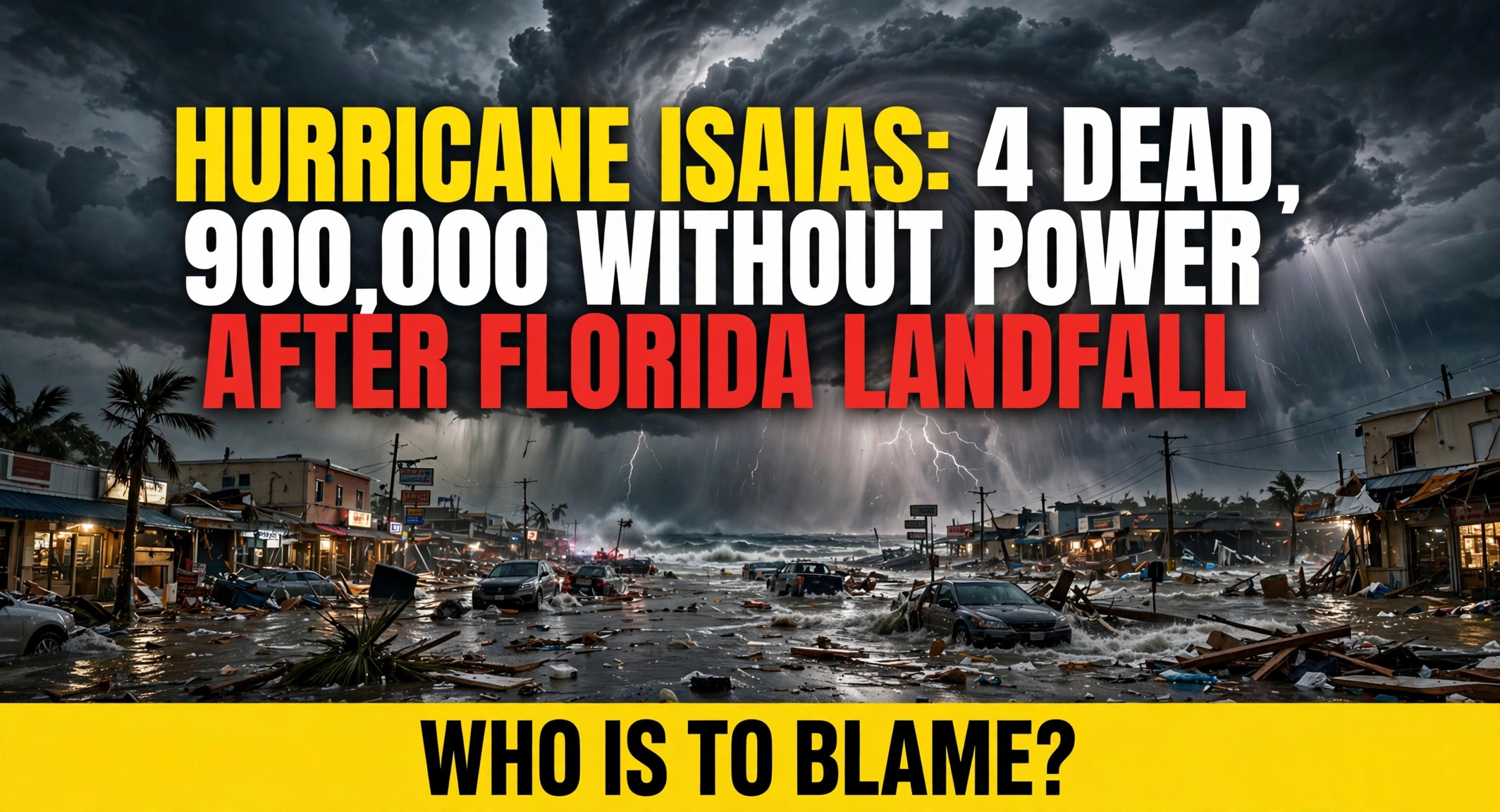
Hurricane Isaias tore into the Florida Panhandle on Friday night, October 9, 2026, and by Saturday morning the scope of the damage was coming into focus. The storm made landfall near Destin around 8:30 p.m. as a Category 2 hurricane with 105-mph winds, then pushed north through Alabama, weakening to a post-tropical cyclone by the early hours. Four people are dead. Nearly a million customers lost power. And for residents across the Panhandle, the cleanup is just beginning.
The National Hurricane Center issued its final advisory on Isaias in the pre-dawn hours, but forecasters warned the danger wasn’t over: flash flooding remained a risk, and rivers in the western Panhandle could crest at their highest levels Saturday before receding Sunday. As of Saturday afternoon, the remnant system was still grinding north with winds near 35 mph, dumping heavy rain across Alabama and Georgia.
How Hurricane Isaias came ashore
Isaias weakened from a Category 3 to a Category 2 just before coming ashore — small comfort to anyone in its path. Along the coast, the storm ripped trees out of the ground, peeled roofs off buildings, and flooded roads across the Panhandle. A weather station near Santa Rosa Sound recorded a gust of 116 mph, with sustained winds hitting 91 mph. At Panama City Beach, storm-driven water rose about 5.6 feet above the higher-high-tide reference at a coastal gauge — enough to swamp roads and low-lying homes.
In Destin, floodwaters submerged streets and left roads underwater. In Pensacola, winds knocked down trees and power lines and scattered debris across neighborhoods — part of an inn’s roof was torn away. In Navarre Beach, the wind overturned multiple camper vans. Gulf Breeze, Fort Walton Beach, and Okaloosa Island all took a beating.
Destin-Fort Walton Beach Airport and Pensacola International Airport remained closed Saturday for damage assessment and cleanup. Both Destin and Fort Walton Beach were placed under an extreme wind warning and flash flood emergency warning during the worst of it.
The toll: four lives, hundreds of thousands in the dark
Two people were killed in Escambia County, Florida, officials said — the highest death toll in a single county. One woman was pinned beneath a tree that crashed through her home; she was dead by the time fire rescue crews arrived, according to Melony Peterson, a spokesperson for the Escambia County Sheriff’s Office. The other victim died from carbon-monoxide fumes after a generator was run indoors without proper ventilation, Sheriff Chip Simmons said. Four members of that victim’s family — aged 72, 24, 5, and 4 — were hospitalized.
Two more people were killed in Alabama after trees fell onto their homes, Governor Kay Ivey confirmed. “This storm cannot clear fast enough. It brought in heavy winds throughout Alabama, taking down trees, knocking out power and doing some damage,” Ivey said. At least five others were hospitalized across the region.
Power was the biggest immediate crisis. More than 900,000 customers across Florida, Alabama, and Georgia were reported without power Saturday morning, according to USA Today data. By Saturday afternoon, nearly 800,000 remained out, per outage tracker PowerOutage.com — Florida accounting for more than half. Bay County alone reported roughly 53,400 outages, about 39.4% of its accounts. The Pensacola News Journal reported that some residents may wait days — or even weeks — for their lights to come back on.
Governor Ron DeSantis said more than 16,000 line workers had been positioned ahead of the storm, with repair work starting around 3 a.m. Saturday. “We’ll get everything back up and running and let people go on with their lives as soon as possible,” DeSantis said at a Saturday morning press conference. All state bridges were open, and I-10 and U.S. 98 were passable. No search-and-rescue requests had come in as of Saturday morning.
Alabama and beyond: the storm’s inland march
Isaias didn’t stay a coastal problem for long. The storm crossed into Alabama overnight, still strong enough to down trees and close roads across southern Alabama, where officials told people to stay home while crews cleared debris. Birmingham — deep inland — saw a death when a tree fell on a home. The Milton High School gymnasium had its roof ripped off.
The flooding threat followed the storm north. Tennessee and the Carolinas faced flash-flood risks Saturday. Nashville was under a wind advisory. Several weekend events were canceled outright: the Making Strides Against Breast Cancer walk in Nashville, Columbia’s Pride celebration in Tennessee, and a Spooky Market event in the region all called off.
The National Weather Service expects up to 8 inches of rain over the weekend across southern Alabama, the Florida Panhandle, and southwest Georgia. Even as Isaias winds down — expected to subside entirely by Sunday — the water keeps moving, and rivers crest after the rain stops. That’s the part people underestimate.
The quiet season that woke up
Isaias was the first Atlantic hurricane of 2026 — remarkable for how late it arrived in a season that had been unusually quiet. That quiet lulled some people. A state of emergency had been expanded by DeSantis on October 8 to 27 North Florida counties, and officials scrambled to get the word out as the storm organized quickly, forming as a tropical storm and hurricane only on October 7, two days before landfall.
Two other systems are being tracked elsewhere: Hurricane Simon off Mexico’s west coast and Tropical Storm Rachel, headed toward the US-Mexico border. The Atlantic may have started late, but October is proving it isn’t finished.
What to do if you’re in the affected area
- Treat every downed line as live. Don’t drive through flooded roads — six inches of moving water can knock you off your feet, and twelve inches can carry a car.
- Generator safety saves lives. The Escambia County death is a textbook warning: never run a generator indoors or in a garage. Keep it at least 20 feet from the house, exhaust pointing away. A carbon-monoxide detector with a battery backup costs less than the generator fuel.
- Check on neighbors who may not have power or cell service, especially elderly residents and families with medical devices.
- Report outages through your utility’s outage map or hotline rather than assuming it’s known.
Sources and Resources
- National Hurricane Center — Hurricane Isaias advisories
- National Weather Service — alerts and forecasts
- Pensacola News Journal: Isaias damage and outages
- New York Post: Hurricane Isaias hit Florida ‘like a freight train’
FAQs
Where did Hurricane Isaias make landfall?
Near Destin, Florida, around 8:30 p.m. on Friday, October 9, 2026. The National Hurricane Center reported 105-mph sustained winds at landfall — a Category 2. It had weakened from a Category 3 just before coming ashore.
How many people died in Hurricane Isaias?
Four, as of Saturday afternoon. Two in Escambia County, Florida — one crushed by a fallen tree, one killed by carbon-monoxide from a generator run indoors. Two in Alabama, where trees fell on homes, including one in Birmingham.
How many people lost power?
More than 900,000 customers across Florida, Alabama, and Georgia at the Saturday morning peak, according to USA Today data. By Saturday afternoon nearly 800,000 were still out, per PowerOutage.com, with Florida accounting for more than half. Bay County alone had about 53,400 outages — nearly 40% of its accounts.
Is Hurricane Isaias still a hurricane?
No. By Saturday morning the National Hurricane Center classified it as Post-Tropical Cyclone Isaias, with winds down around 35 mph, and issued its final advisory. But the flood threat continues: up to 8 inches of rain was forecast across parts of Alabama, Georgia, and the Panhandle, and rivers may crest Saturday before receding Sunday.
Was this the first hurricane of the 2026 season?
Yes — for the Atlantic, Isaias was the first hurricane of 2026, after what local coverage called a “quiet” summer. The storm formed as a tropical storm and hurricane on October 7, just two days before landfall, which left officials little time to prepare.
Conclusion
Hurricane Isaias arrived late, organized fast, and hit hard — a Category 2 landfall in Destin that left four people dead, close to a million without power, and damage stretching from the Panhandle deep into Alabama. The storm itself is gone, downgraded to a post-tropical cyclone and fading over the Southeast, but the work it left behind isn’t: nearly 800,000 customers still in the dark Saturday afternoon, roads to clear, roofs to fix, and families grieving two kinds of tragedy — the wind, and the preventable generator death that didn’t have to happen. The season’s quiet start bought complacency; October just collected on it.