
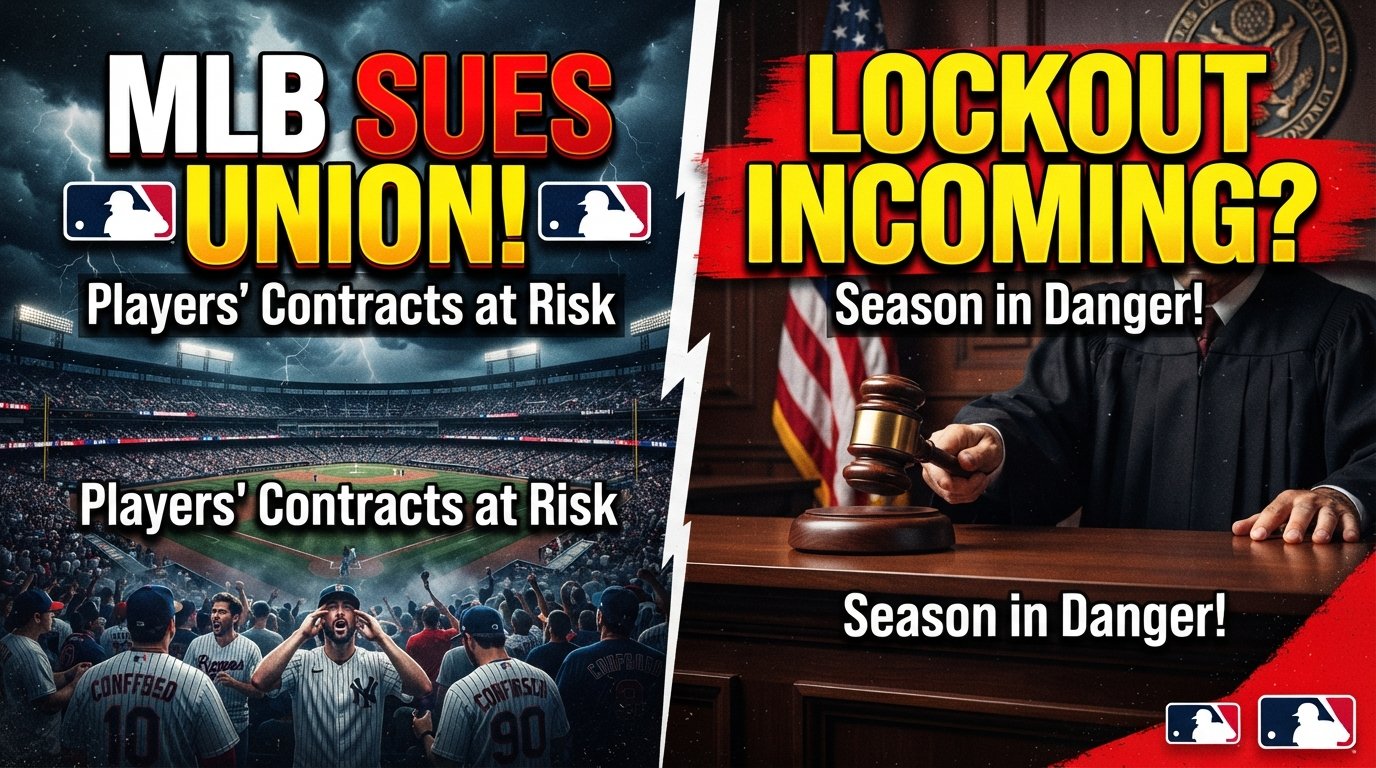
MLB Sues Players’ Union Ahead of Lockout, Seeking Ruling That Work Stoppage Is Legal
Major League Baseball has escalated its labor dispute with the Major League Baseball Players Association (MLBPA) by filing a preemptive federal lawsuit in New York. With the current Collective Bargaining Agreement (CBA) set to expire next week and a management-led lockout looming, MLB is asking a federal judge to declare that its anticipated work stoppage is completely legal under federal labor and antitrust laws.
The legal filing marks an aggressive opening salvo before a single day of the offseason stoppage has even begun. By heading to the U.S. District Court for the Southern District of New York, the league aims to neutralize the players’ most potent legal countermeasure before negotiations break down completely.
Also Read:
Brad Pitt and Angelina Jolie Settle Four-Year Winery Lawsuit
Why MLB Filed a Preemptive Lawsuit
At the core of Major League Baseball’s legal strategy is the prevention of union decertification—often referred to in sports labor circles as the “nuclear option.” In previous labor disputes across the NFL, NBA, and NHL, players’ unions have temporarily dissolved or “disclaimed interest” as bargaining representatives. Doing so strips away the non-statutory labor exemption, allowing individual players to sue the league under federal antitrust laws and seek treble (triple) financial damages.
In the complaint, Office of the Commissioner of Baseball v. Major League Baseball Players Association, MLB argues that any potential union disclaimer would be a sham maneuver designed solely to gain unlawful leverage at the bargaining table. The league is asking the court for a declaratory judgment confirming that its bargaining conduct and subsequent lockout cannot be enjoined by a judge, even if the MLBPA attempts to dissolve.
“Today’s filing is a defensive measure simply intended to keep the parties at the bargaining table to work towards a new collective bargaining agreement and a full 2027 season,” MLB spokesman Glen Caplin stated following the filing. Notably, the league indicated it would withdraw the lawsuit if the MLBPA formally agrees to remain intact as a certified union throughout the negotiation process.
Key Players Named in the Legal Action
The lawsuit lists all 30 Major League Baseball clubs as plaintiffs. On the other side of the ledger, MLB named the MLBPA alongside the eight members of the union’s executive subcommittee as defendants:
Tarik Skubal (New York Mets)
Paul Skenes (Pittsburgh Pirates)
Marcus Semien (Texas Rangers)
Chris Bassitt (Toronto Blue Jays)
Jake Cronenworth (San Diego Padres)
Cedric Mullins (Baltimore Orioles)
Pete Fairbanks (Tampa Bay Rays)
Brent Suter (Cincinnati Reds)
The inclusion of Skubal highlights the frantic pre-lockout spending spree occurring across the league. Earlier this week, the star left-hander signed a record-shattering nine-year, $450 million contract with the Mets—the largest deal ever awarded to a pitcher—as clubs and players rushed to finalize agreements before transactions freeze.
To lead its legal charge, MLB retained high-profile representation, including former U.S. Solicitor General Paul D. Clement and the law firm Keker, Van Nest & Peters.
The MLBPA Fires Back
The Players Association wasted little time condemning the league’s courtroom maneuver, characterizing the lawsuit as a distraction from meaningful negotiations.
“The lawsuit filed today by MLB is completely frivolous,” the MLBPA said in an official statement. “We will respond appropriately, but MLB’s decision to run to court in the middle of negotiations rather than bargain in good faith is incredibly disappointing.”
Labor experts note that while preemptive declaratory judgment filings are not unheard of in high-stakes corporate disputes, the union is likely to challenge the suit on ripeness grounds—arguing that a court cannot rule on the legality of a lockout that has not yet occurred or a union decertification that has not been initiated.
The Salary Cap Standoff Behind the Impasse
Beneath the complex legal maneuvering lies a fundamental economic divide: team owners are pushing aggressively for a strict salary cap, while the players remain vehemently opposed.
Major League Baseball remains the only major North American professional sports league operating without a salary cap, relying instead on a Competitive Balance Tax (luxury tax) to curb payroll disparity. MLB Commissioner Rob Manfred has framed the implementation of a cap as essential for competitive integrity, citing internal polling suggesting 70% of baseball fans favor payroll limits. If implemented, a hard cap would force major-market spenders—such as the Los Angeles Dodgers, New York Mets, and New York Yankees—to drastically slash their payrolls.
MLBPA leadership, led by executive director Bruce Meyer, has historically viewed a salary cap as a “nuclear bomb” and a strict non-starter. Players argue that capping salaries artificially suppresses player compensation while doing nothing to force low-revenue owners to invest revenue-sharing money back into their on-field rosters.
What a Lockout Means for the 2027 Season
If no agreement is reached before the CBA expires next week, MLB owners are expected to institute a formal lockout. During a lockout:
Transaction Freeze: All major league free-agent signings, trades, and contract extensions are immediately suspended.
Facility Access: Players are barred from entering team stadiums, spring training complexes, and training facilities, and cannot communicate with team coaching or medical staff.
Minor League Exceptions: Players on minor league contracts not on a 40-man roster generally continue normal offseason activities.
Baseball fans still remember the 2021–2022 lockout, which lasted 99 days and forced the cancellation of early spring training games before a deal was struck just in time to preserve a 162-game schedule (though Opening Day was delayed by one week). With owners demanding structural economic changes and both sides already entrenched in federal court, the threat to the 2027 regular season is significantly higher.
Frequently Asked Questions (FAQs)
Why did MLB sue the players’ union before the lockout even started?
MLB filed a preemptive lawsuit seeking a declaratory judgment that its planned lockout is legal under antitrust and labor laws. The league wants to stop the MLBPA from dissolving (decertifying) as a union to file an antitrust lawsuit against team owners.
What is union decertification (the “nuclear option”)?
Union decertification occurs when a players’ association voluntarily steps down as the official collective bargaining agent for the athletes. Once there is no union, players can sue the league as individual employees under federal antitrust laws, potentially exposing team owners to triple financial damages.
Why are MLB owners locking out the players?
The current Collective Bargaining Agreement is expiring next week. Team owners want to introduce a strict salary cap to address payroll disparities between large-market and small-market teams, a proposal the MLBPA firmly rejects.
Will the 2027 MLB season be delayed or canceled?
An offseason lockout does not automatically cancel regular-season games, as spring training does not begin until February. However, if negotiations remain deadlocked into late February or March 2027, spring training and Opening Day will face delays or cancellations.
Who are the specific players named in MLB’s lawsuit?
MLB named the eight members of the MLBPA’s executive subcommittee: Tarik Skubal, Paul Skenes, Marcus Semien, Chris Bassitt, Jake Cronenworth, Cedric Mullins, Pete Fairbanks, and Brent Suter.
Disclaimer: This article is for informational and news reporting purposes only and does not constitute formal legal advice. Labor litigation and collective bargaining negotiations are subject to rapid developments and ongoing court rulings.