
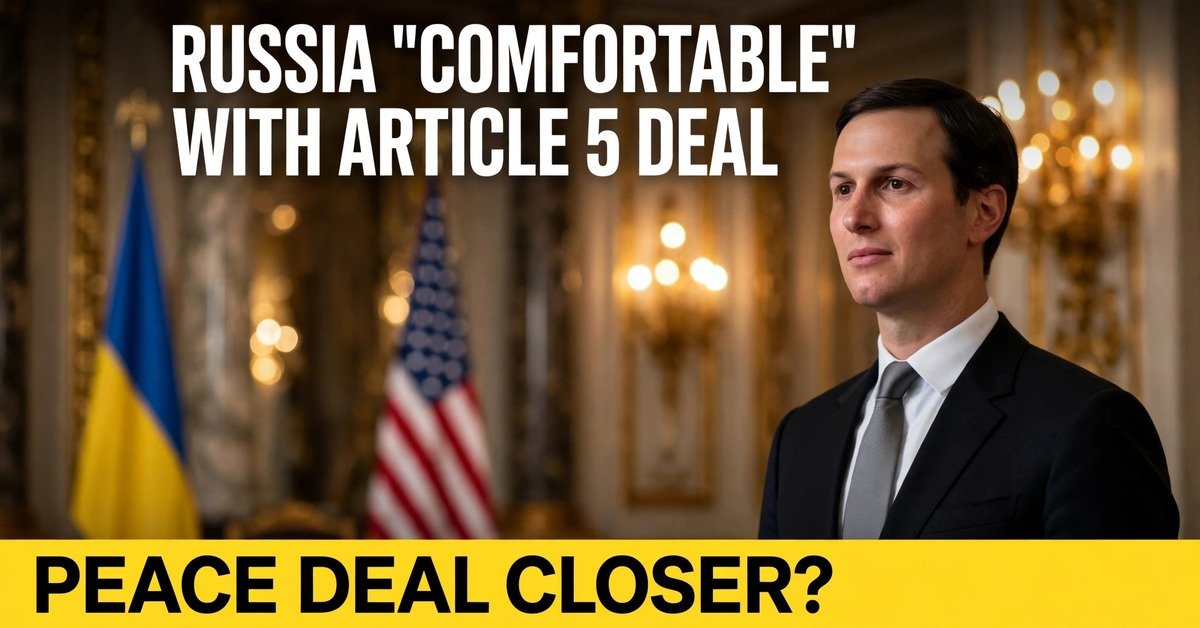
European allies met in Berlin on Thursday: no peace deal for Ukraine can be cut over their heads. US envoy Jared Kushner, standing beside German Chancellor Friedrich Merz, said President Donald Trump is open to security guarantees for Ukraine modelled on NATO’s Article 5 mutual defence pact — and that Russia has grown “comfortable” with the idea. The Kushner Article 5 guarantees claim now sits at the centre of the push to end the war.
Days earlier, Trump had greeted Russia’s Vladimir Putin warmly as a “friend” at a summit with China’s Xi Jinping in Shenzhen. The greeting alarmed European leaders, who feared Ukraine’s fate might be settled without them.
Kushner Article 5 guarantees: What They Would Mean for Ukraine
NATO’s Article 5 is the alliance’s core promise: an attack on one member counts as an attack on all. Ukraine is not a member, so it has none. An “Article 5-like” guarantee would copy that promise without full membership — a pledge by the US and its allies to defend Ukraine if Russia attacks again.
“From America’s perspective, giving an article 5-like security guarantee is a really, really big deal. And I think that that’s something that President Trump is open to,” Kushner said. For Kyiv, the Kushner Article 5 guarantees proposal answers the key question — what stops Russia attacking again? No detail yet on who signs it or what triggers it.
The Berlin Meeting That Set the Tone
Berlin brought together the “Coalition of the Willing”: leaders of Germany, France, Britain, Poland, Italy and NATO, plus US envoys Witkoff and Kushner. Trump dialled in, and, according to Kushner, came away believing “peace is achievable.”
Kushner also said Trump wanted a peace deal with Europe at his side, and that Russia had agreed to multilateral talks. Europe, which provides most aid to Ukraine, has long felt sidelined. The Kushner Article 5 guarantees announcement was the headline, but a seat at the table mattered just as much.
Why Europe Pushed Back Against a Yalta-Style Deal
The Shenzhen summit drew instant comparisons with the 1945 Yalta Conference, when the US, Britain and the Soviet Union carved up influence. “Yalta” has since become shorthand for great-power deals imposed on smaller countries — and European leaders said they would not accept a repeat.
“A ‘Yalta’ format will not bring peace,” Merz told reporters. “The US understands that there can be no peace without us,” Merz added.
Zelensky said Europe had to be included in peace talks going forward. For Kyiv, the Kushner Article 5 guarantees offer only works if Europe helps shape it.
What Russia Has Agreed To — and What It Has Not
Kushner’s account had two parts: Moscow has grown “comfortable” with an Article 5-style pledge, and it has agreed to multilateral talks.
Putin proposed that European envoys come to Moscow to clarify their position before talks take shape. That format is still undecided: Europeans attended Abu Dhabi talks last week, but the Kremlin said Russia had not agreed to a repeat. Moscow has not confirmed the Kushner Article 5 guarantees claim in public.
Russian drone attacks on Kyiv killed at least one person and injured five more, the city’s mayor said. The Dutch and Austrian embassies and Saint Volodymyr Cathedral were damaged. Moscow says it does not attack civilian targets.
Reaction in Washington and Across Europe
“Mr Putin is not our friend and will never be,” Poland’s Donald Tusk said. Denmark’s Mette Frederiksen called it “very incomprehensible that a US president wants to sit down with President Putin,” warning Putin “will be even more emboldened after today’s meeting.”
In Washington, Senate Democratic leader Charles Schumer called the Shenzhen meeting a “historic embarrassment.” NATO chief Mark Rutte praised Trump’s “Herculean efforts” for peace in Ukraine. The Kushner Article 5 guarantees talk gives European leaders something concrete to hold on to — if the pledge is real.
What Happens Next
Three questions will decide whether these words turn into a deal. Will Russia confirm in public what Kushner says it accepted in private? Who signs the guarantee, and what triggers it? Will Europe get the seat it has been demanding?
Frequently Asked Questions
What did Kushner actually say about Russia and Article 5?
He said Trump is open to Article 5-based security guarantees for Ukraine, and that Russia has got “comfortable” with that. In plain terms, the Kushner Article 5 guarantees idea means a NATO-style defence pledge without joining NATO — though the fine print is still missing.
What is NATO Article 5, in plain words?
It is NATO’s core promise: if one member is attacked, all treat it as an attack on all of them. It is the model Kushner says could be copied for Ukraine.
Does this mean Ukraine is joining NATO?
No. An Article 5-style guarantee is not membership, and the Kushner Article 5 guarantees plan would be a separate pledge to defend Ukraine if attacked again — without a seat in the alliance or a vote in its decisions.
Why are people talking about Yalta?
Because the Shenzhen summit recalled the 1945 Yalta Conference, where the US, Britain and the Soviet Union divided up influence in Europe. Merz used the comparison to warn that Ukraine’s future must not be settled by great powers behind closed doors.
Is a peace deal close now?
Not yet. Kushner’s comments are a hopeful sign, but Russia has not confirmed the guarantee in public, the format of talks is undecided, and fighting is still killing people in Kyiv. The pieces are moving — the deal is not done.
Conclusion
Kushner’s Berlin remarks gave the peace effort its clearest shape yet: an American president open to an Article 5-style guarantee, a Russia described as “comfortable” with it, and allies insisting they will not be sidelined. The Kushner Article 5 guarantees proposal could be the safety net that makes a deal possible — or fade into hopeful words. Much now depends on Moscow confirming it, and on the fine print.
Sources and Resources
- Ukraine’s allies warn against Yalta-style carve-up — Sowetan (Reuters)
- Reuters reporting from Berlin, via Sowetan, published November 19, 2026.