
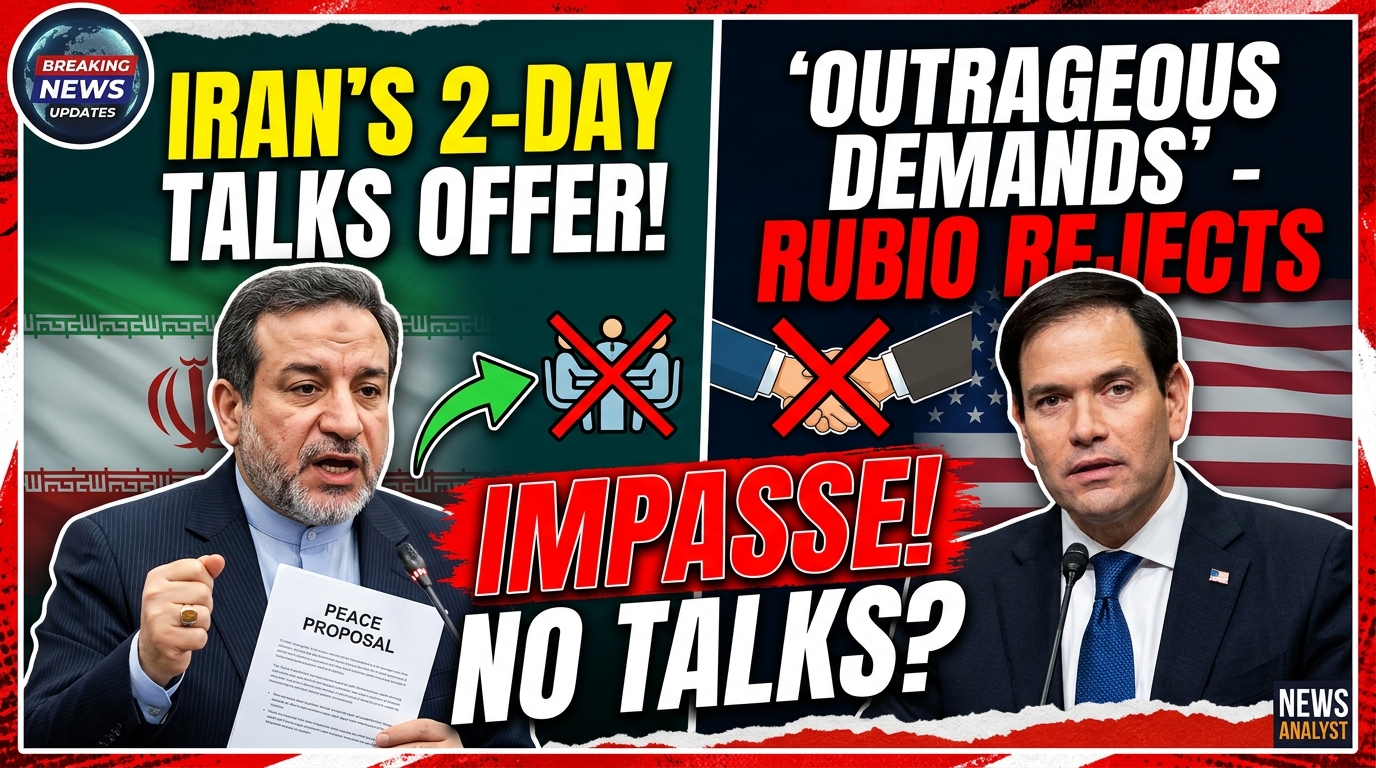
Iran Peace Talks Proposal Defended by Tehran After Rubio Rejects Terms as Outrageous
The diplomatic standoff between Washington and Tehran has intensified after Iranian officials firmly defended their Iran peace talks proposal to restart diplomatic negotiations within two days. The pushback comes directly after United States Secretary of State Marco Rubio rejected Tehran’s baseline prerequisites, characterizing key conditions of the offer as “outrageous and ridiculous”.
Despite Washington’s sharp public pushback, Iranian Foreign Ministry representatives insist that their two-day timeline presents the most reasonable framework available to de-escalate tensions and halt ongoing military hostilities across West Asia. However, with both nations holding fundamentally opposing stances on prerequisites, international mediation efforts continue to face severe diplomatic roadblocks.
Also Read:
Senate GOP Leadership Vote Delay: Sen. McCormick Urges Pause After Midterm Losses
The Core Elements of the Iran Peace Talks Proposal
Tehran’s revised diplomatic initiative centers on initiating formal bilateral discussions within a strict 48-hour window. Iranian Foreign Minister Abbas Araghchi and Foreign Ministry Spokesman Esmaeil Baghaei have maintained that the offer remains on the table, calling on Washington to accept the framework rather than dismiss it.
However, the Iran peace talks proposal is explicitly contingent upon the United States fulfilling several key prerequisites prior to the start of formal negotiations:
Lifting Economic Sanctions: The immediate removal of U.S. economic sanctions targeting Iranian financial institutions and energy export sectors.
Ending Maritime Blockades: The de-escalation and termination of U.S. naval operations and trade blockades restricting regional maritime transportation.
Regional Hostility Freeze: A total, multi-front halt to ongoing military strikes and armed hostilities across the region.
Iranian officials defend these conditions by asserting that asking for an end to economic warfare and military blockades prior to sitting down at the negotiating table is a standard diplomatic prerequisite.
Washington’s Reaction: Rubio Brands Terms Unrealistic
Speaking to reporters during diplomatic engagements in Paris, U.S. Secretary of State Marco Rubio made clear that the United States does not view Tehran’s current terms as a viable starting point. Rubio emphasized that while the administration remains open to diplomatic solutions, pre-conditions requiring unilateral U.S. concessions upfront render constructive dialogue impossible.
Washington maintains that any credible Iran peace talks proposal must address core security concerns, including nuclear enrichment limits, restrictions on ballistic missile development, and guarantees for the unimpeded movement of commercial vessels through critical waterways such as the Strait of Hormuz. From the perspective of U.S. officials, waiving sanctions or easing maritime enforcement prior to binding commitments would undermine Washington’s economic and strategic leverage.
Regional Mediation and Strategic Obstacles
The disagreement over baseline terms underscores the broader challenge facing third-party mediators, including Qatar, which have sought to facilitate back-channel communication between Washington and Tehran.
| Strategic Priority | United States Position | Iranian Position |
| Negotiation Timeline | Favors open-ended diplomatic discussions without heavy preconditions. | Proposes a strict 48-hour timeline under the Iran peace talks proposal. |
| Sanctions & Blockades | Preserves economic sanctions and naval enforcement as diplomatic leverage. | Requires immediate lifting of sanctions and blockades before entering talks. |
| Regional Hostilities | Demands comprehensive non-proliferation and regional security guarantees. | Requires an immediate, multi-front cessation of military actions upfront. |
Future Outlook for US-Iran Diplomacy
As rhetoric between Washington and Tehran sharpens, the immediate prospects for formal negotiations remain constrained. While Iranian officials assert that their Iran peace talks proposal offers the quickest route to avoiding further conflict, Washington’s firm rejection indicates that formal talks will require significant adjustments to baseline terms from both sides.
Until a consensus is reached regarding preconditions, regional and international partners will continue working through back channels to prevent further escalation and establish a mutually acceptable framework for peace talks.
Frequently Asked Questions (FAQs)
What is the core offer in the Iran peace talks proposal? The Iran peace talks proposal offers to restart diplomatic negotiations within 48 hours, provided the U.S. agrees to lift economic sanctions and cease military blockades beforehand.
Why did Marco Rubio reject the Iran peace talks proposal? U.S. Secretary of State Marco Rubio rejected the terms as “outrageous and ridiculous,” stating that requiring the U.S. to lift sanctions and stop blockades upfront without Iranian concessions is unrealistic.
Which countries are mediating between the U.S. and Iran? Regional nations such as Qatar have actively served as third-party mediators attempting to bridge the diplomatic gap between Washington and Tehran.
Disclaimer: This article is published for informational and news reporting purposes only. Statements and geopolitical positions cited reflect official public declarations made by government representatives and international diplomatic bodies.