
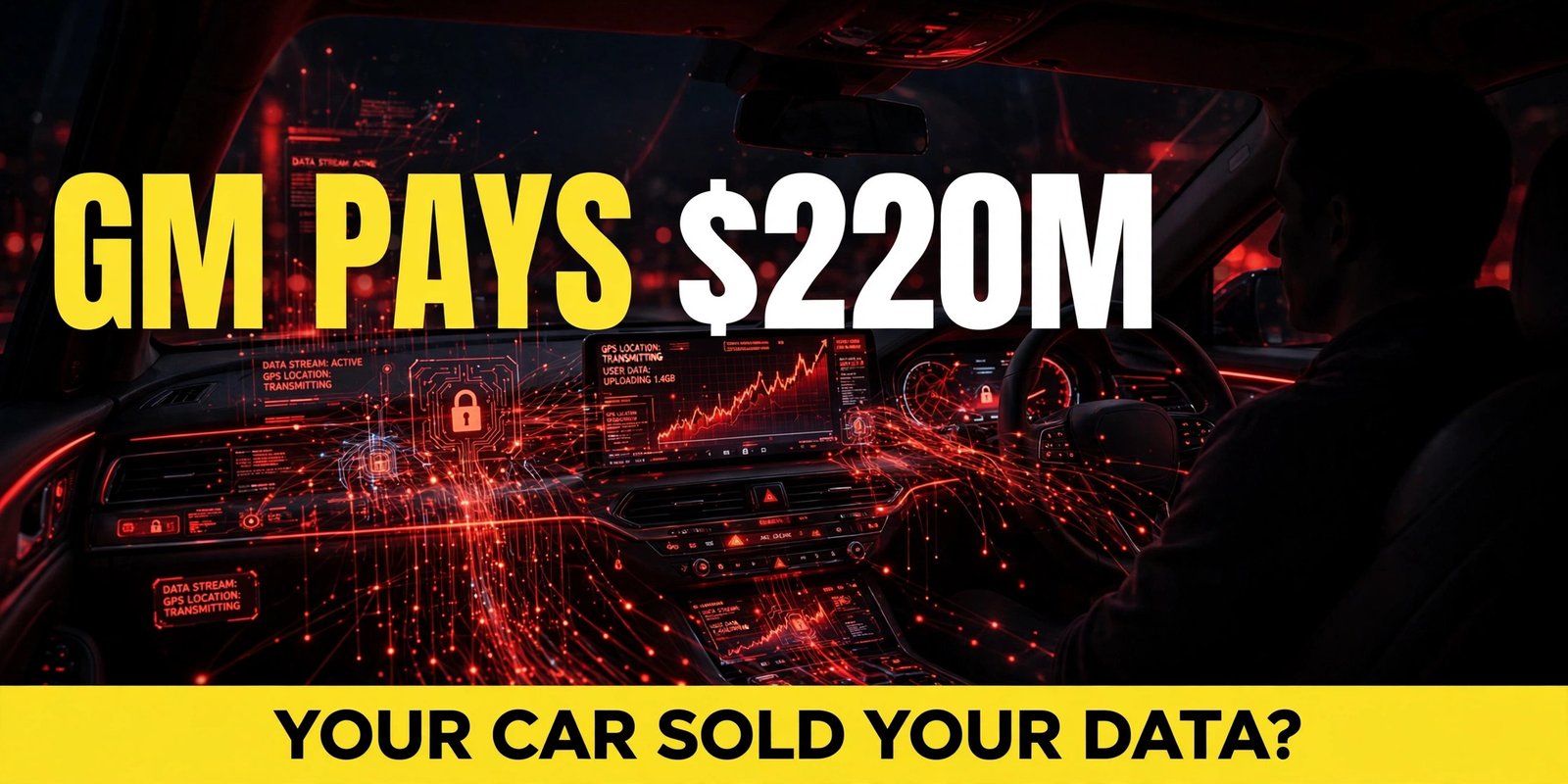
The GM drivers data settlement will cost General Motors $220 million. The Detroit automaker agreed to pay that sum to resolve a lawsuit filed by the attorneys general of 35 states and the District of Columbia, who accused GM of illegally selling drivers’ private behaviour and location data to brokers, who then sold it to insurers that used it to set and increase rates.
- GM Drivers Data Settlement: What Was Collected and Sold
- A Bipartisan Coalition Behind the GM Drivers Data Settlement
- GM Drivers Data Settlement: What GM Must Change
- Why the GM Drivers Data Settlement Matters Beyond GM
- Frequently Asked Questions
- Conclusion
- Sources
The case strikes at one of the least visible bargains of modern motoring: the idea that a car quietly watches how it is driven, and that the record of that driving can be turned into a product. Millions of drivers were enrolled in the programme at the heart of the case, most of them, the states argued, without understanding what their vehicles were collecting or where that information would end up.
GM Drivers Data Settlement: What Was Collected and Sold
At the centre of the case is GM’s Smart Driver programme. The states said the programme collected detailed information about drivers’ behaviour and location, then passed it to data brokers, who sold it on to insurers. Those insurers used the data to set premiums and raise rates, meaning a driver’s everyday journeys could come back to them as a higher bill, without their knowledge.
Millions of drivers were enrolled from 2016 until the programme was discontinued in 2024. It was pitched as a tool to help drivers improve their personal driving safety, a framing that made enrolment sound like a benefit rather than a transaction. The states’ case was that the reality was different: the data was a commercial asset, traded onward through a chain the driver never saw.
A Bipartisan Coalition Behind the GM Drivers Data Settlement
The settlement was co-led by Oregon Attorney General Dan Rayfield and Washington Attorney General Nick Brown, and it drew support from a bipartisan coalition including Alabama, Massachusetts, and Pennsylvania. That breadth matters. Data privacy has often split along party lines, but a coalition stretching across the political map suggests the issue has moved beyond partisan argument into common ground.
Rayfield’s theme captured the argument in a single line: a car is not a tracking device. The point was not that vehicles should collect nothing, but that a machine people depend on for work, family, and freedom should not be silently converted into a surveillance tool whose output is sold to the highest bidder.
GM Drivers Data Settlement: What GM Must Change
The money is only part of the settlement. GM is also required to limit the driving data it collects and to obtain drivers’ express consent before collecting or sharing such data in future. That second requirement is arguably the more important one, because it changes the default. Consent must now be explicit, not buried in enrolment language or assumed from participation in a safety programme.
The settlement follows earlier actions over the same data, including an action by the Federal Trade Commission and an action by California. The pattern is familiar in privacy enforcement: a practice is challenged in one forum, then pursued in others, until the company faces a settlement that addresses the conduct nationally rather than state by state.
Why the GM Drivers Data Settlement Matters Beyond GM
The significance of this case extends well beyond one automaker. Modern vehicles generate enormous quantities of data, from location and speed to braking patterns and journey times, and every manufacturer faces the same temptation to monetise it. A $220 million settlement, backed by 36 jurisdictions and paired with consent requirements, sends a signal to the whole industry that driving data is not a free resource.
For drivers, the case is a reminder to ask what a connected car is recording and who receives it. For regulators, it is a template: a bipartisan coalition, a clear theory of harm, and a remedy that changes future behaviour rather than merely pricing past misconduct. The question now is whether other manufacturers will change their own practices voluntarily, or wait for their own version of this lawsuit.
Frequently Asked Questions
How much will GM pay in the drivers data settlement?
GM agreed to pay $220 million to resolve the lawsuit brought by 35 states and the District of Columbia.
What data was GM accused of selling?
Drivers’ private behaviour and location data, collected through the Smart Driver programme and sold via brokers to insurers.
How were drivers affected?
Insurers used the data to set and increase insurance rates, so drivers could face higher premiums based on information they did not know was shared.
How many drivers were enrolled?
Millions were enrolled from 2016 until the programme was discontinued in 2024.
What must GM change under the settlement?
GM must limit the driving data it collects and obtain drivers’ express consent before collecting or sharing such data.
Conclusion
The GM drivers data settlement closes a case about a simple idea: that a car should not secretly track its driver for profit. The $220 million payment and the new consent requirements address both the past conduct and the future risk, and the bipartisan coalition behind the case shows how widely that principle is now shared. Whether the industry learns the lesson without being sued remains an open question.
Sources
- Oregon Attorney General Dan Rayfield — State announcement on the GM settlement
- Washington Attorney General Nick Brown — State announcement on the GM settlement
- State attorneys general announcements — Bipartisan coalition settlement with General Motors
- USA Today — General Motors settles data-selling lawsuit
See more coverage on World Reach Daily.