
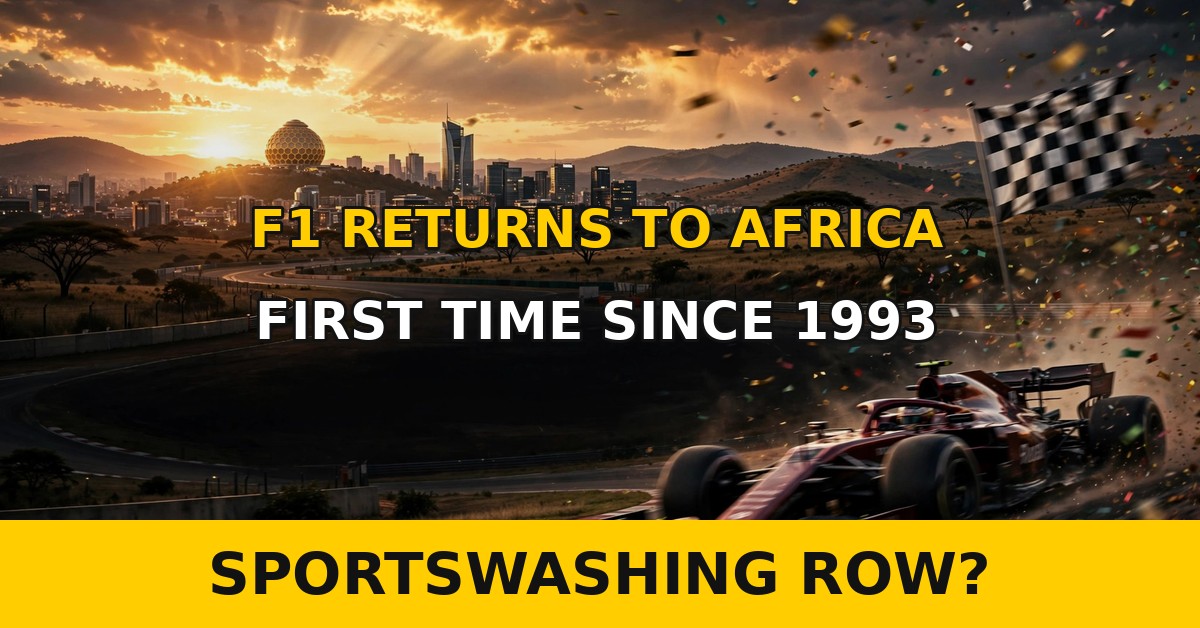
After more than three decades away, Formula 1 is coming back to Africa. The sport confirmed on Tuesday, October 13, 2026, that it has signed a 10-year agreement with Rwanda for the African Grand Prix — a race that will run under the title “presented by Visit Rwanda” on a brand-new circuit in Bugesera, roughly 25 miles from the capital, Kigali. The Formula 1 Rwanda race will be the first on the continent since the 1993 South African Grand Prix at Kyalami.
It’s a landmark moment for the sport, and the Formula 1 Rwanda race has been a long one in the making.
Formula 1 Rwanda race: what the 10-year deal actually covers
The agreement runs for a decade, which puts it among the longer race contracts on the modern calendar. The race will be called the African Grand Prix, presented by Visit Rwanda, and it will be held on a purpose-built circuit in Bugesera — an area sitting alongside a new international airport that is part of the same development push.
Here’s the catch: the track doesn’t exist yet.
The inaugural year hasn’t been pinned down either. All F1 has said is that the race will arrive in the early 2030s. Announcing a 10-year deal before a single corner has been drawn is unusual, and it tells you how confident both sides are that the Formula 1 Rwanda race circuit will get built. Rwanda gets a decade-long place on one of sport’s biggest global stages; F1 gets its long-promised return to a continent it left behind in 1993.
The end of a 33-year absence
That gap has always been a sore point. F1 races in the Americas, Asia, Europe and the Middle East — three Grands Prix in the United States alone — yet an entire continent hasn’t hosted a single race since Kyalami.
Drivers and fans have been calling for the Formula 1 Rwanda race for years. The sport’s leadership clearly agrees. F1 CEO Stefano Domenicali put the commercial and cultural case in one line: “Africa is home to more than 100 million Formula 1 fans.”
That’s a bigger audience than most countries on the calendar can claim. For a sport that has spent the last decade chasing new markets — from Miami’s street circuit to night races in the Gulf — Africa was the obvious missing piece. The Formula 1 Rwanda race is F1’s answer: a decade-long commitment to the continent’s fans rather than a one-off showcase. Now it’s back on the map.
Why Rwanda, and why now
This didn’t come out of nowhere. Rwanda’s president, Paul Kagame, has been pushing the bid since 2024, and Tuesday’s announcement was the payoff.
“Today belongs to Africa… that changes with this agreement,” Kagame said.
Kigali has spent years building a reputation as a host for big international events, and the Grand Prix is the biggest prize yet. The “presented by Visit Rwanda” branding fits a country that has invested heavily in selling itself to global audiences through sport. For Rwanda, a decade of F1 is a decade of the country’s name in front of hundreds of millions of viewers every season.
For the Formula 1 Rwanda race, Rwanda offered something concrete: a willing government partner, a site near the capital, and a development plan that ties the circuit to a new international airport. In a sport where new races increasingly depend on state backing, that combination won the day.
Amnesty calls it a “sportswashing prize”
Not everyone is celebrating the Formula 1 Rwanda race. Amnesty International accused Formula 1 of offering Rwanda a “sportswashing prize” with the race deal, with Felix Jakens, Amnesty UK’s head of campaigns, leading the criticism.
Amnesty pointed to arbitrary detention, torture, and the repression of free speech in Rwanda as the reason the sport should think twice. The rights group has long documented abuses in the country, and it framed the Grand Prix as an attempt to launder the country’s reputation through a glamorous global event.
The Rwandan government did not respond to the accusations.
The criticism puts F1 in a familiar spot. The sport has faced similar charges over races in other countries with poor human rights records, and it has always argued that engagement is better than isolation — that bringing the world’s cameras to a country opens it up rather than covering for it. How F1 navigates that debate will shape the legacy of the Formula 1 Rwanda race as much as the racing itself.
What this means for the F1 calendar
A new race in the early 2030s lands at a crowded time for F1’s schedule. The calendar already stretches past 20 races a season, and every addition means a tougher fight for dates, logistics, and attention.
But Africa is different. This isn’t another street circuit in a wealthy city-state — it’s a continent of 100 million fans finally getting a home race. The 10-year term gives the event room to grow into a fixture rather than a one-off experiment, and it gives Rwanda time to build the infrastructure the race needs.
Expect the first few years to be about more than racing. A new circuit, a new airport, a new Grand Prix — the Formula 1 Rwanda race will be judged on whether the grand plan survives contact with reality. If it does, Kigali could become one of the calendar’s most talked-about stops.
Sources and Resources
- Reuters — F1, Rwanda announce creation of African Grand Prix: F1, Rwanda announce creation of African Grand Prix
- Reuters — Amnesty accuses F1 of offering Rwanda “sportswashing prize” with race deal: Amnesty accuses F1 of offering Rwanda sportswashing prize
- World Reach Daily: more sports news and analysis
Frequently Asked Questions
When will the first Rwanda F1 race actually happen?
Nobody knows the exact year of the first Formula 1 Rwanda race yet. F1 and Rwanda have only said the early 2030s, and the inaugural season hasn’t been determined. The circuit in Bugesera still has to be built, so the date will depend on construction.
Where exactly will the track be?
In Bugesera, about 25 miles (40 kilometers) from Kigali, Rwanda’s capital. The site sits alongside a new international airport that is being developed in the same area.
When was the last F1 race in Africa?
The 1993 South African Grand Prix at Kyalami. The Formula 1 Rwanda race will be the continent’s first Grand Prix in more than three decades.
Why is Amnesty International criticizing the deal?
Amnesty accused F1 of handing Rwanda a “sportswashing prize,” with Felix Jakens of Amnesty UK leading the charge. The group cited arbitrary detention, torture, and the repression of free speech in Rwanda. The country’s government did not respond to the accusations.
What does “presented by Visit Rwanda” mean?
It’s the race’s title sponsorship. The African Grand Prix will carry the branding of Visit Rwanda, the country’s tourism board — putting Rwanda’s name front and center every time the event is mentioned or broadcast.
Conclusion
Thirty-three years after Kyalami, Formula 1 is going back to Africa — and it’s staying for a decade. The Formula 1 Rwanda race gives the sport what it has lacked since 1993: a home on the continent where more than 100 million of its fans live. The circuit isn’t built, the first year isn’t set, and the human rights questions aren’t going away. But the deal is signed, the ambition is real, and the countdown to the early 2030s has officially begun.