
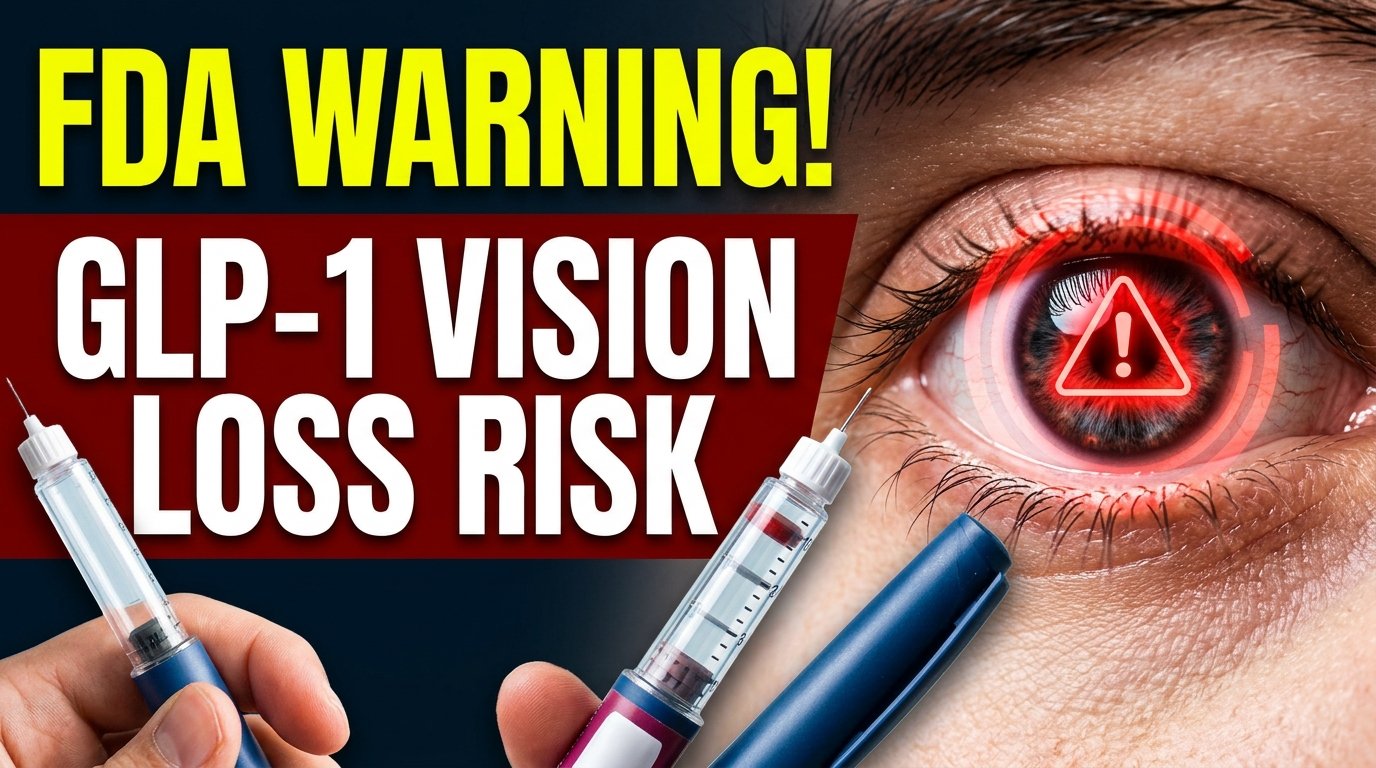
FDA Orders Vision-Loss Warnings on All GLP-1 Weight-Loss Drugs
In a sweeping regulatory action affecting millions of patients worldwide, the FDA orders vision-loss warnings on all GLP-1 weight-loss drugs and diabetes medications following post-marketing safety reviews linking the popular drug class to a rare, potentially irreversible eye condition.
Issued via a formal Drug Safety Communication on November 9, 2026, the U.S. Food and Drug Administration (FDA) mandate requires pharmaceutical manufacturers to update the prescribing information for every currently marketed glucagon-like peptide-1 receptor agonist (GLP-1 RA). The updated “Warnings and Precautions” section must explicitly highlight the potential increased risk of non-arteritic anterior ischemic optic neuropathy (NAION)—an acute optic nerve disorder that can cause sudden, painless, and permanent blindness.
Also Read:
FBI Probing Nvidia Chief Huang as Board Hires Top Law Firm for Review
Understanding the FDA Mandate and NAION
The announcement that the FDA orders vision-loss warnings on all GLP-1 weight-loss drugs marks one of the most significant safety label updates since semaglutide and tirzepatide surged in global popularity. According to World Health Organization (WHO) estimates, roughly 100 million people globally utilize GLP-1 receptor agonists to manage type 2 diabetes, obesity, and related metabolic conditions.
NAION occurs when blood flow to the front portion of the optic nerve—known as the optic disc—is abruptly reduced or blocked. Deprived of adequate oxygen and nutrients, the optic nerve fibers sustain rapid damage. Unlike diabetic retinopathy, which develops gradually through damage to retinal blood vessels, NAION strikes acutely. Clinical specialists note that vision loss resulting from NAION is frequently irreversible and can progressively worsen even after a patient discontinues the triggering medication. Furthermore, experiencing NAION in one eye elevates the risk of developing the condition in the second eye.
While federal regulators noted that evaluating post-marketing reports was complicated by overlapping patient risk factors—such as pre-existing type 2 diabetes, hypertension, obstructive sleep apnea, high cholesterol, anemia, kidney disease, and smoking—the volume and consistency of adverse event reports prompted decisive labeling action across the entire therapeutic class.
Complete List of GLP-1 Medications Affected by the FDA Warning
Because NAION cases have been documented across multiple formulations rather than a single brand, the FDA orders vision-loss warnings on all GLP-1 weight-loss drugs and diabetes therapies approved in the United States. The labeling mandate applies to both injectable and oral medications, as well as combination therapies and dual-agonist drugs:
Semaglutide: Ozempic (injection for type 2 diabetes), Wegovy (injection for chronic weight management), and Rybelsus (oral tablets).
Tirzepatide (Dual GIP/GLP-1 receptor agonist): Mounjaro (for type 2 diabetes) and Zepbound (for obesity and obstructive sleep apnea).
Liraglutide: Victoza (for type 2 diabetes) and Saxenda (for weight management).
Dulaglutide: Trulicity (once-weekly injection for type 2 diabetes).
Exenatide: Generic exenatide formulations (formerly marketed under the brand name Byetta).
Orforglipron: Foundayo (the oral small-molecule GLP-1 agonist approved in 2026).
Combination Insulin/GLP-1 Products: Xultophy (liraglutide and insulin degludec) and Soliqua (lixisenatide and insulin glargine).
Recognizing the Symptoms of NAION
A central goal of the FDA’s updated safety communication is educating both prescribers and patients on the early warning signs of optic nerve ischemia. Because NAION does not cause physical eye pain, individuals may initially mistake early visual disturbances for minor eye strain or routine prescription changes.
Patients taking GLP-1 medications are urged to monitor closely for the following symptoms:
Sudden, painless vision loss in one eye: Many patients first notice visual impairment immediately upon waking up in the morning.
Visual field defects: Missing portions of vision, new dark blind spots, or a narrowing of peripheral sight resembling tunnel vision.
Reduced central sharpness: Sudden blurriness, haziness, or difficulty recognizing faces and reading fine print.
Color distortion: Faded, washed-out, or altered perception of colors.
Guidance for Patients and Healthcare Providers
The news that the FDA orders vision-loss warnings on all GLP-1 weight-loss drugs does not constitute a drug recall, nor does it advise patients to abruptly stop taking their prescribed medications without medical supervision. For millions of individuals, GLP-1 therapies deliver substantial cardiometabolic benefits, including improved glycemic control, significant weight reduction, and lower rates of major adverse cardiovascular events.
Under the FDA’s clinical recommendations:
Immediate Ophthalmologic Evaluation: Any patient experiencing sudden visual changes should seek immediate medical care and undergo prompt evaluation by an ophthalmologist.
Benefit-Risk Reassessment: If NAION is confirmed or strongly suspected, clinicians should consider discontinuing the GLP-1 medication unless the therapeutic benefits of continued treatment clearly outweigh the ocular risks.
Baseline Risk Screening: Patients with pre-existing vascular risk factors—including diabetic retinopathy, uncontrolled hypertension, or a prior history of optic nerve disorders—should discuss baseline eye exams with their prescribing physician prior to starting or escalating GLP-1 doses.
Industry Response and Ongoing Litigation
Leading pharmaceutical manufacturers have responded cautiously to the FDA’s directive. Novo Nordisk, maker of Ozempic and Wegovy, stated that patient safety remains its top priority and reaffirmed confidence in the overall benefit-risk profile of semaglutide, while maintaining that existing clinical trial data have not established a definitive causal link between semaglutide and NAION. Eli Lilly, manufacturer of Mounjaro and Zepbound, stated it is evaluating the labeling update and continuing to monitor safety signals across its tirzepatide clinical programs.
Meanwhile, the regulatory action arrives amid mounting legal pressure. Both Novo Nordisk and Eli Lilly face expanding product liability lawsuits from plaintiffs alleging they suffered permanent vision loss after taking GLP-1 drugs without adequate warnings regarding optic nerve injury. As drug labels are updated nationwide, regulators and researchers continue investigating the exact biological mechanisms connecting rapid metabolic shifts, blood pressure fluctuations, and optic nerve blood flow.
Frequently Asked Questions (FAQs)
Why did the FDA order vision-loss warnings on all GLP-1 weight-loss drugs? The FDA ordered the labeling updates after reviewing post-marketing adverse event reports linking GLP-1 receptor agonists to an increased risk of non-arteritic anterior ischemic optic neuropathy (NAION), a rare condition caused by reduced blood flow to the optic nerve that can result in sudden, permanent vision loss.
Which GLP-1 medications are included in the new FDA warning? The warning applies to all currently marketed GLP-1 and dual GIP/GLP-1 medications in the United States, including Ozempic, Wegovy, Rybelsus, Mounjaro, Zepbound, Victoza, Saxenda, Trulicity, Foundayo, generic exenatide, Xultophy, and Soliqua.
What are the symptoms of NAION? Symptoms include sudden, painless vision loss in one eye (often noticed upon waking), blurry or hazy central vision, blind spots or missing areas in the visual field, tunnel vision, and distorted or faded colors.
Should I stop taking Ozempic, Wegovy, or Zepbound because of this warning? No, patients should not stop taking prescribed GLP-1 medications without consulting their healthcare provider. However, if you experience any sudden changes in vision, you should seek immediate medical and ophthalmologic care.
Is vision loss from NAION permanent? In most cases, vision loss caused by NAION is irreversible. While a small percentage of patients experience mild improvement, the damage to the optic nerve is typically permanent, making early detection and medical evaluation critical.
Disclaimer
This article is published for informational and educational purposes only and does not constitute professional medical advice, diagnosis, or treatment. Always consult a qualified physician, ophthalmologist, or healthcare provider before starting, stopping, or altering any prescription medication, and seek immediate emergency medical attention if you experience sudden changes in vision.