
EU fines Google 890 million — that is the headline from 23 July 2026, not a new announcement on 28 October 2026. On that July date, the European Commission fined Google €890 million under the Digital Markets Act, and this article explains that decision, what it ordered, and why it still matters months later.
The total was not a single penalty for a single act. It was €460 million for self-preferencing in Google Search, plus €430 million for anti-steering rules in Google Play. Together, they add up to €890 million.
That split is important. The two parts concern different markets, different users, and different kinds of power. One is about how people find things online. The other is about how app developers reach customers and get paid.
EU fines Google 890 million: how the search case worked
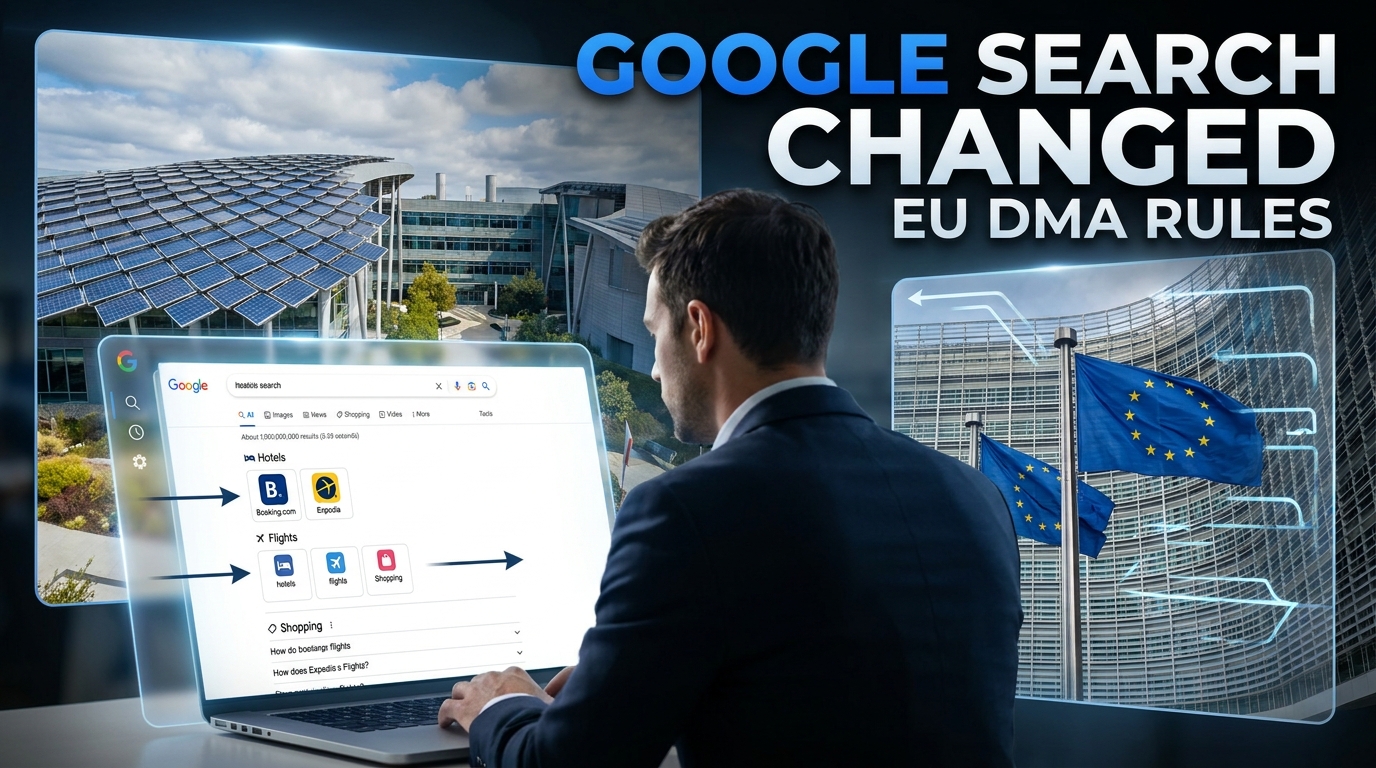
In search, the Commission found that Google gave its own services an unfair advantage. Its shopping, hotel, transport and sports services could appear more prominently than comparable services from other companies.
The advantage was not only about position. Google’s own services could also benefit from richer displays, clearer visuals and helpful filters at the top of results, while rivals did not receive the same treatment.
For an ordinary user, that difference can be hard to notice. A traveller comparing hotels, a shopper looking for a product, or a fan checking a sports result may simply click what is easiest to see.
That is why the Commission treated visibility as a competitive issue. When the company that runs the search page also competes on that page, the design of the page itself can decide who wins.
The Digital Markets Act was written for exactly this kind of conflict. It requires large platforms designated as gatekeepers to treat third-party services fairly, rather than using control of a gateway to favour their own products.
EU fines Google 890 million: what Google Play had to change
The Google Play case was about steering, a word that sounds technical but describes a simple freedom. Developers wanted to tell users about other ways to buy, including outside Google Play, and to complete transactions elsewhere.
According to the Commission, Google restricted that freedom. Developers could not freely communicate offers, promote alternatives, or conclude contracts with users outside the store on fair terms.
The Commission also objected to steering-related fees and to the conditions around the charging period. In its view, the costs and restrictions went beyond what was needed to run a safe and workable app store.
The point was not that Google Play should have no rules. App stores need security checks, payment safeguards and clear standards. The question was whether those rules were also being used to keep business inside Google’s own payment and distribution system.
For small developers, the difference can be decisive. A fee, a delay, or a ban on telling customers about a cheaper option can change whether an app survives, grows, or reaches new users at all.
The 60-day compliance clock and the orders behind the fine
Alongside the money, the Commission ordered Google to end the non-compliance within 60 days. That deadline turned a one-off fine into an ongoing obligation.
In search, the order meant treating third-party services without discrimination in ranking and presentation. Google’s own services should not receive a systematic advantage simply because they belong to Google.
In Google Play, the order meant letting developers steer users freely to alternatives outside the store. That includes communicating with users, promoting offers, and concluding contracts outside Google Play.
The Commission also warned of periodic penalty payments of up to 5 percent of average daily worldwide turnover if the underlying behaviour was not corrected. That threat matters because it grows with delay.
Compliance, in this context, is not a press statement. It is a change in ranking, display, fees, links and contracts that rivals and regulators can test in practice.
How the Digital Markets Act case was built
The Digital Markets Act has been in force since March 2024. It set clear, upfront obligations for the largest digital platforms, instead of relying only on long competition cases after harm had already occurred.
Google’s search and app-store practices were among the early tests of whether that law would work as intended. Investigations were opened in March 2024, and preliminary findings followed in March 2025.
That long build-up helps explain why the July 2026 fines did not come out of nowhere. They followed more than two years of investigation, discussion and changes by Google that, in the Commission’s account, had not gone far enough.
The case also attracted attention well beyond Brussels. Regulators in other countries were watching because the same questions arise everywhere: how should a dominant search engine present rivals, and how open should an app store be?
The European Commission’s Digital Markets Act pages set out the law’s aims and obligations for gatekeepers, and they are a useful starting point for readers who want the official framework: European Commission Digital Markets Act overview.
What Google argued, and how Brussels answered
Google pushed back strongly. Its president of global affairs, Kent Walker, argued that the Digital Markets Act’s implementation broke everyday products and removed helpful features for Europeans.
In Google’s framing, the disagreement was not about refusing to comply. It was about what compliance should look like when it changes products that millions of people use every day.
Google pointed to features such as instant pricing and direct availability for hotels, flights and restaurants. It said that changes required by the law risked making those features less useful, or dismantling protections in Google Play.
Google also said it was testing changes to shopping ads and sports content. That showed the company was adjusting its products, even as it disputed the Commission’s conclusions.
The Commission’s message was firm in substance, but deliberately balanced in tone. It said that changes already made represented substantial progress, while still finding that key obligations had not been met.
That balance is common in regulation. A regulator can recognise effort and still insist that the legal test is the outcome for users and rivals, not the effort alone.
Why the July 2026 decision still matters now
It is tempting to read a large fine as the end of a story. In this case, the fine was closer to a midpoint. The real test came after 23 July 2026, when Google had to show that search results and Play rules had actually changed.
Rivals have a strong incentive to check those changes closely. If a competing hotel site still appears below Google’s own hotel box, or if a developer still cannot tell users about a cheaper payment route, the complaint will return quickly.
Consumers may notice the effects more slowly. A fairer search page does not always look dramatic. It may simply show more choices, clearer labels, or a rival service in a place where it can compete.
Developers, by contrast, may feel the difference sooner. The ability to communicate directly with customers, offer a different price, or use an alternative payment method can affect revenue from the first month.
The case also shows how the Digital Markets Act differs from older competition law. Older cases often focused on past harm and a fine. This case combined a fine with a short deadline, a continuing duty, and the threat of daily penalties.
That combination is why other large platforms are likely to study the Google outcome closely. The lesson is not only that a breach can be expensive. It is that a breach can also require a redesign of a core product, under a timetable set by the regulator.
For readers following big tech in Europe, the key dates are therefore clear. The fine was imposed on 23 July 2026. The compliance clock ran for 60 days from that decision. And the question after that was not whether Google had paid, but whether its search and store behaved differently.
Technology regulation often moves in the background, through ranking rules, fee structures and contract terms that most users never read. This case is a reminder that those quiet details shape which businesses can reach us, and on what terms.
For a sense of how quickly the wider technology industry keeps moving, see World Reach Daily’s report on Apple M6 MacBook Pro and iMac launch with faster on-device AI. The contrast is useful: one story is about new hardware, the other about the rules that govern the platforms on which much of that hardware depends.
In short, the €890 million figure is only part of the story. The July 2026 decision matters because it tested whether Europe’s new digital rulebook could change the everyday experience of search and app distribution, not merely punish a company after the event.
EU fines Google 890 million: what to watch next
EU fines Google 890 million is a useful shorthand, but the next phase is about evidence. Readers should watch for rival services reporting better placement, and for developers reporting clearer routes to customers outside Google Play.
EU fines Google 890 million also raises a practical question for other platforms. If a search page or an app store is a gateway, how much of its design can favour its owner before the design itself becomes the problem?
That question will not be settled by one decision. It will be settled by repeated checks, by complaints from businesses that feel squeezed, and by whether ordinary users see more genuine choice.
EU fines Google 890 million, in the end, is best remembered with its date attached. It was a July 2026 decision, with a 60-day clock, and its importance lies in the changes it required after the fine was announced.
EU fines Google 890 million will likely be cited in future Digital Markets Act cases, because it paired a large penalty with a clear deadline and a testable change in product behaviour.
EU fines Google 890 million therefore deserves to be read with its July 2026 date in mind, rather than as breaking news. The date is the context that makes the compliance story make sense.
In this article
- How the search case worked
- What Google Play had to change
- The 60-day compliance clock and the orders behind the fine
- How the Digital Markets Act case was built
- What Google argued, and how Brussels answered
- Why the July 2026 decision still matters now
- What to watch next
Table of Contents
Contents
- How the search case worked
- What Google Play had to change
- The 60-day compliance clock
- How the Digital Markets Act case was built
- What Google argued, and how Brussels answered
- Why the July 2026 decision still matters now
- What to watch next
[ez-toc]
[toc]
EU fines Google 890 million is the decision to return to when the next Digital Markets Act dispute arises, because EU fines Google 890 million shows how a fine, a deadline and a product change can work together.
The search layout changes shown above are the kind of practical difference the July 2026 orders were designed to produce.