
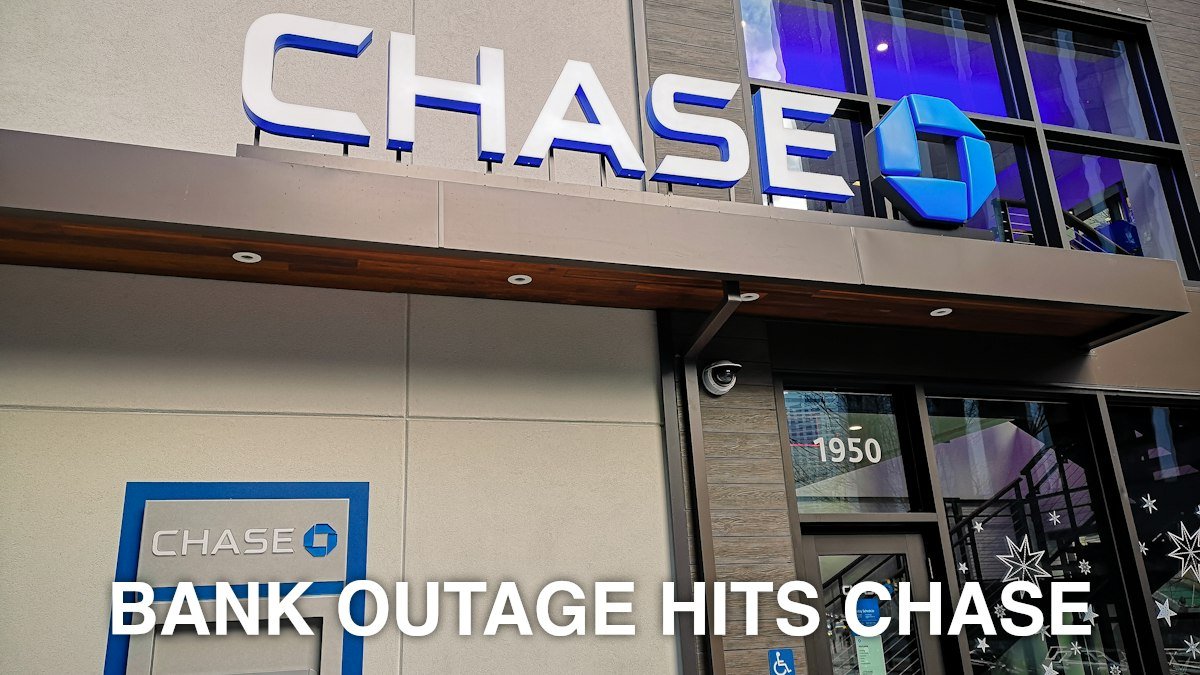
The bank outage Chase Wells Fargo Bank of America customers experienced on Monday, November 16, 2026, began as a technical fault inside JPMorgan Chase — and within hours it had spread far beyond a single bank. What started as a software problem at the country’s largest bank left customers at several of America’s biggest financial institutions unable to move money, check balances, or complete payments, turning an ordinary Monday afternoon into a nationwide reminder of how much of daily life now runs through a handful of giant financial systems.

By Monday evening, Chase said the problem was fixed and transactions were flowing normally again. But the disruption, which peaked in the middle of the afternoon and struck hardest at Zelle — the payment network millions of Americans use to send money to friends, family, landlords, and small businesses — raised uncomfortable questions. It arrived in the same week as a nationwide ground stop ordered by the Federal Aviation Administration and a global Microsoft 365 outage, a cluster of failures that has put the resilience of the systems Americans rely on under a harsh new spotlight.
Bank Outage Chase Wells Fargo Bank of America: What Happened on Monday
Reports of trouble began climbing on Monday afternoon. JPMorgan Chase confirmed to USA TODAY that technical issues originating at Chase were behind the problems customers were seeing at multiple banks across the country. The fault, Chase later said, was a software bug — not a hack, not an attack, and not a failure of the wider banking system. By about 7 p.m. Eastern time, the bank said the issue had been resolved and that transactions were being processed normally again, closing a disruption that had lasted much of the working day.
Which Banks and Services Were Affected?
Chase was at the center of the outage, but it was far from the only name on the list. Customers of Wells Fargo and Bank of America reported problems of their own, and Downdetector — the website that tracks user reports of service failures — also recorded surges for U.S. Bank, Capital One, and Zelle. That pattern is what made Monday unusual: a single bank’s internal problem showed up as trouble at several of its biggest competitors at the same time, because banks no longer operate as islands. They share payment rails, clearing systems, and networks like Zelle, so a fault in one large institution can quickly become a problem for customers of others — even when those other banks’ own systems are working exactly as they should.
The Zelle Problem: Payments Stuck Between Banks
The sharpest pain was felt on Zelle, the bank-owned network that lets Americans send money instantly to other people using just an email address or phone number. The failure hit Zelle payments between Chase customers and customers of other banks, leaving transfers stuck between institutions. U.S. Bank warned its customers that Zelle transactions involving another institution could be delayed, while Zelle itself said its network was operating as it should — a sign that the fault lay upstream, at Chase, rather than in Zelle’s own systems.
That distinction mattered little to people waiting on money. Zelle has become the plumbing for everyday payments: splitting rent with roommates, paying a babysitter, settling up with a contractor, or sending cash to a family member in a hurry. When those payments stall, the consequences are immediate and personal — a landlord waiting on rent, a small business waiting to be paid, a parent trying to get money to a child at college.
Downdetector Numbers: How Big Was the Outage?
The scale of the disruption is clearest in the Downdetector figures. Reports about Chase peaked at around 4,800 at about 2 p.m. Eastern time — the second-highest 15-minute total for the bank in at least a year. Downdetector counts user reports rather than confirmed failures, so the true number of affected customers was almost certainly far higher; most people who hit an error never file a report. Still, the spike, concentrated in a single afternoon, leaves little doubt that Monday’s outage was one of the most significant banking disruptions of the year.
What Chase, Bank of America, U.S. Bank and Zelle Said
Chase moved quickly to reassure customers once the fault was identified. The bank blamed a software bug, stressed that the incident was “not cyber related,” and said by the early evening that “transactions are being processed normally now.” The message was designed to draw a bright line between a technical failure and a security breach — a distinction that matters enormously to a bank whose customers entrust it with their savings.
Bank of America and U.S. Bank, meanwhile, said their own systems had not been directly affected. U.S. Bank added the caveat that Zelle transactions with another institution could be delayed, an acknowledgment that being unaffected at home did not mean its customers were unaffected. Zelle, for its part, said the network was operating “as it should,” pointing the explanation back toward Chase.
No Cyberattack, DHS Says — But Questions About AI Remain
The question everyone asks when banks go down is whether someone attacked them. On Monday night, Homeland Security Secretary Markwayne Mullin said the Department of Homeland Security had found no proof of a cyberattack behind the outage. Independent experts reached the same conclusion: there was no evidence that hackers were involved.
Mullin went further, suggesting that artificial intelligence being woven into existing infrastructure may itself be causing malfunctions — a striking claim from the official charged with protecting the country’s critical systems, and one that is likely to fuel a wider debate about how quickly AI is being bolted onto systems that were never designed for it.
A Week of Failures: The FAA Ground Stop and the Microsoft 365 Outage
Monday’s bank outage did not happen in isolation. It came in the same week as a nationwide ground stop ordered by the Federal Aviation Administration, which delayed flights across the country, and a global Microsoft 365 outage that knocked out Outlook and Teams for more than a day, generating more than 7.4 million reports on Downdetector. Our report on the Microsoft Outlook outage and how Teams came back online shows just how far that disruption reached, while the FAA ground stop grounded travellers nationwide.
Three different systems, three different causes — and the same underlying lesson. Each failure was traced to its own fault, not to a single coordinated attack. But each also showed how much of modern life now depends on a small number of very large, very complex systems, and how quickly a problem in one of them becomes a problem for everyone.
What Customers Should Do During a Banking Outage
The first step is to verify what is happening through official channels: your bank’s own app or website, its status page, or its verified social media accounts. Do not rely on screenshots circulating online, and be wary of accounts claiming to be your bank’s support team. Outages are prime hunting season for scammers, who send fake texts and emails urging customers to “verify” their accounts or click a link to restore access. Your bank will never ask you to hand over a password or a one-time code.
Next, try another way in. If the app will not load, try the website, another device, telephone banking, an ATM, or a branch. Keep a small amount of cash on hand for exactly these moments. And above all, do not send a payment twice. A transfer that looks stuck may still go through, and a duplicate Zelle payment is extremely hard to reverse. Wait, check your transaction history, and only resend once you are sure the first attempt failed.
Finally, keep a record. Save screenshots of error messages, note the times things failed, and keep any reference numbers. If money is still missing once the outage is over, contact your bank promptly with that evidence in hand. And keep an eye on your accounts for several days afterwards: delayed transactions can post late, and any charge you do not recognise should be reported straight away.
What the Outage Says About America’s Concentrated Financial System
The deeper question Monday raised is about concentration. A handful of banks now hold a huge share of American deposits, a single network carries most instant person-to-person payments, and a few cloud providers underpin much of the software the economy runs on. As Patrick Moorhead of Moor Insights & Strategy put it, concentration means that “when one piece fails, it fails at national scale.” The trade-off is familiar: centralisation brings speed, convenience, and lower costs — until the day it does not.
Regulators and bank executives will now face questions about testing, redundancy, and disclosure: how a software bug at one bank was able to disrupt payments at others, how quickly customers were told what was happening, and what will change so it does not happen again. Those answers matter, because the next failure may not be a bug — and the system that handled this one will be judged on how it handles the next.
What Happens Next
In the coming days, customers should check that pending transactions have posted correctly and that no payment went through twice. Chase will be pressed for more detail about the bug and about the fixes it has put in place, and the Department of Homeland Security will continue to monitor the situation. The wider debate — about artificial intelligence in critical infrastructure, and about how much of the country’s financial plumbing should run through a handful of giant institutions — is only just beginning.
Monday’s outage ended the way most such failures do: with services restored, a bug blamed, and customers told everything is back to normal. But the fact that a single software fault could ripple across Chase, Wells Fargo, Bank of America, and Zelle in a single afternoon is the part that will linger. The money moved again by the evening. The questions it raised will take much longer to answer.
Sources and Resources
This report is based on USA TODAY’s live coverage of the outage: Bank outage hits Chase, Wells Fargo and Bank of America (November 16, 2026). For more on this week’s wave of outages, read our coverage of the Microsoft Outlook outage and the FAA ground stop.