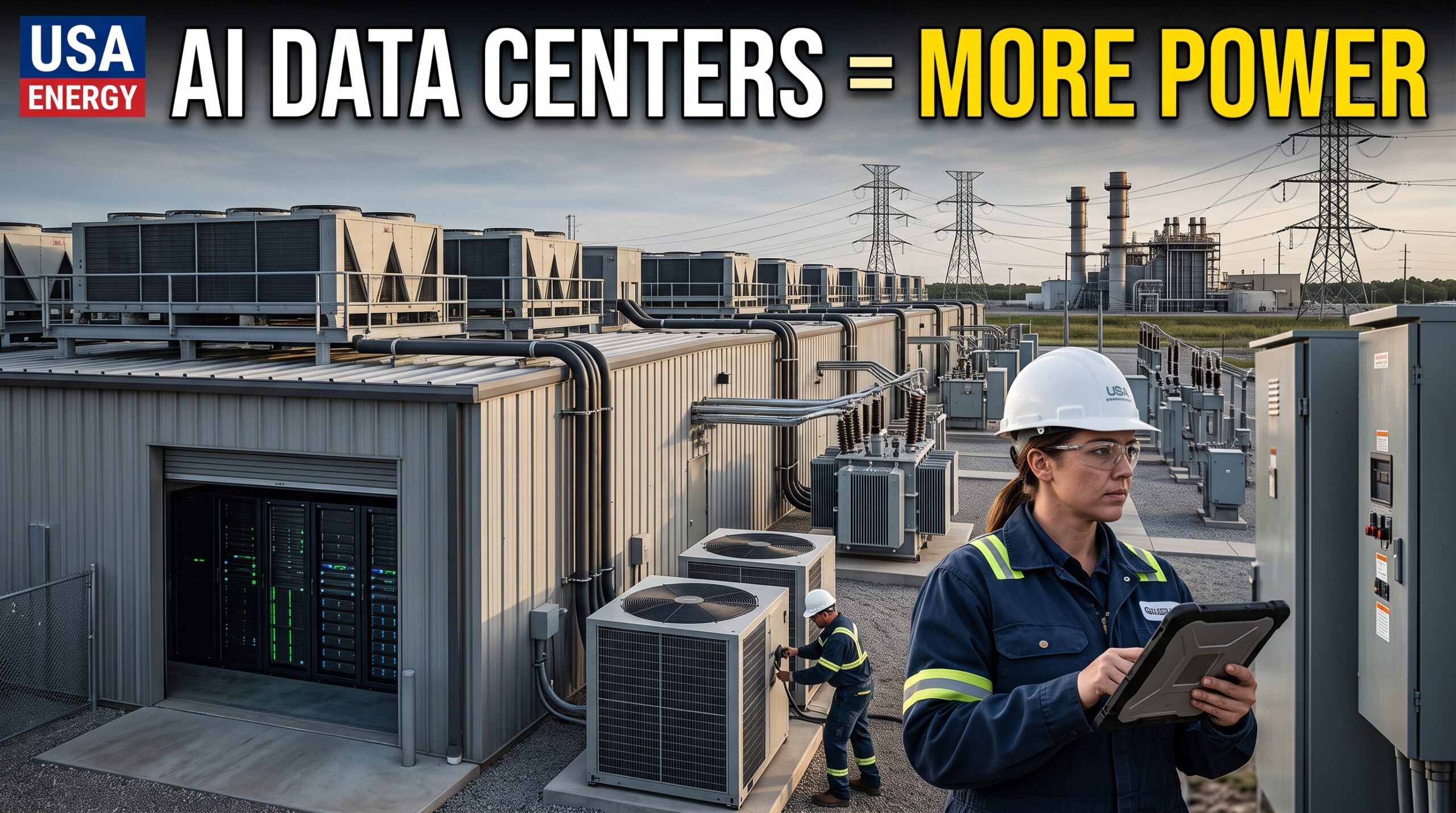
AI Data Centers Are Driving U.S. Energy Demand
AI data centers energy demand is becoming an increasingly important issue for the U.S. electricity market as artificial intelligence expands across the country. Large data centers require enormous amounts of electricity to operate high-performance computing equipment, cooling systems and other infrastructure around the clock.
Also read:
Oil Prices Rise as U.S.-Iran Tensions Raise Inflation and Fed Rate Concerns
The rapid growth of AI services is pushing technology companies and data-center developers to secure reliable power. At the same time, utilities and energy companies are evaluating new natural-gas plants, renewable projects, battery storage, nuclear power and other generation technologies to meet the expected increase in electricity consumption.
According to the U.S. Energy Information Administration, data centers are an important factor behind projected U.S. electricity-demand growth. This growing demand could have major implications for America’s power grid, energy infrastructure and electricity markets.
The U.S. Energy Information Administration (EIA) says electricity demand has been rising after years of relatively flat consumption, with data centers playing a major role in that growth. In 2025, U.S. electricity generation reached a record 4.43 trillion kilowatt-hours, up 2.8% from 2024.
Why AI Requires So Much Electricity
Traditional data centers already consume significant amounts of power, but AI infrastructure can require much more computing capacity. Training and operating advanced AI models depend on specialized processors that can operate continuously.
Data centers also require cooling equipment because high-performance servers generate substantial heat. This means electricity demand does not come only from computing equipment; cooling and other facility systems add to the overall load.
The Department of Energy says data-center deployment, partly driven by AI, is a significant factor in near-term U.S. electricity demand growth.
The International Energy Agency also expects global data-center electricity consumption to more than double by 2030, with the United States accounting for the largest share of the projected increase.
Natural Gas Could Play a Bigger Role
One major consequence of rising AI electricity demand is increased interest in reliable, dispatchable power generation.
Natural gas plants can provide electricity when demand is high and can operate independently of weather conditions. This makes gas generation attractive for regions where large data centers are being developed quickly.
EIA analysis shows that faster-than-expected electricity demand growth could significantly increase U.S. natural-gas generation. Under its higher-demand scenario, natural-gas generation would increase substantially between 2025 and 2027 compared with the baseline forecast.
This does not mean natural gas will be the only solution. Renewable energy, batteries, nuclear power and grid upgrades are also expected to contribute.
Private Power Generation Gains Attention
Large technology companies and data-center developers increasingly need dependable electricity close to their facilities. In some locations, connecting a massive new facility to the existing grid can take years because of transmission limitations, permitting requirements and the availability of generation capacity.
As a result, private or on-site power generation can become an attractive option.
Potential solutions include natural-gas generation, solar-plus-storage projects, fuel cells and other technologies. The exact combination will depend on local energy prices, grid conditions, regulations and reliability requirements.
The Department of Energy notes that data-center electricity demand can be geographically concentrated and that these facilities often require firm power to operate continuously.
Renewable Energy and Nuclear Power Remain Important
Although natural gas may help meet near-term demand, renewable energy is also expected to play a major role.
Solar and wind projects can provide large amounts of electricity, while battery storage can help shift renewable power to periods of higher demand. Nuclear energy can provide reliable, low-carbon electricity around the clock.
EIA’s 2026 Annual Energy Outlook projects that natural gas, solar and wind will account for much of the growth in U.S. generating capacity through 2050.
The energy mix therefore could become increasingly diverse as utilities and technology companies look for reliable and affordable electricity.
What This Means for the U.S. Energy Market
The AI boom could have consequences well beyond technology.
Higher electricity demand could encourage investment in power plants, natural-gas infrastructure, transmission lines, renewable projects, battery storage and nuclear facilities. It could also affect electricity prices in regions where data-center construction grows faster than available power supply.
EIA has identified Texas and the PJM region as areas where electricity demand growth could be particularly significant. Its analysis warns that faster demand growth could put pressure on wholesale electricity prices and grid reliability.
For investors, energy companies and policymakers, AI is therefore becoming an important part of the long-term electricity outlook.
FAQs
1. Why do AI data centers use so much electricity?
AI data centers use large numbers of high-performance processors that require continuous electricity. Cooling systems and other facility equipment add to total energy consumption.
2. Will AI increase U.S. electricity demand?
Yes. U.S. government energy forecasts identify data centers and AI as important drivers of electricity-demand growth.
3. Will natural gas power AI data centers?
Natural gas is likely to contribute to meeting demand because gas plants can provide reliable, dispatchable electricity. However, renewables, nuclear power and storage will also contribute.
4. Are renewable sources enough for AI data centers?
Renewables can provide a significant share of the required electricity, but continuous data-center operations may require a combination of renewable generation, storage, grid power and dispatchable resources.
5. How much U.S. electricity could data centers use?
The Department of Energy’s resources cite estimates that data centers could account for a significant share of U.S. electricity use by 2030, with estimates varying by study and scenario.
6. Why are private power plants attracting attention?
Private generation can potentially provide electricity directly to large facilities when grid connections are limited or delayed.
7. Could AI increase electricity prices?
It could in regions where electricity demand grows faster than generation and transmission capacity. EIA specifically highlights potential price pressures under higher-demand scenarios.
8. Is nuclear power part of the solution?
Yes. Nuclear power can provide continuous electricity and is included among the technologies being considered for meeting future data-center demand.
9. Which U.S. regions are seeing strong demand growth?
Texas and parts of the PJM region are among the areas highlighted by EIA for strong electricity-demand growth associated with large loads such as data centers.
10. Is AI changing the future of the U.S. energy industry?
Yes. The rapid expansion of AI is becoming an important factor in electricity forecasting, power-plant investment, grid planning and energy infrastructure development.
Conclusion
AI data centers are becoming one of the most important new drivers of U.S. electricity demand. The expansion of AI computing requires reliable power, advanced cooling and large amounts of electricity around the clock.
Meeting this demand will likely require a combination of natural gas, renewable energy, battery storage, nuclear power, transmission improvements and potentially private generation. The challenge for the United States will be expanding electricity supply quickly while maintaining reliability, affordability and environmental goals.
As AI adoption continues, the relationship between technology and energy is likely to become increasingly important for the U.S. economy.
Disclaimer
This article is for informational and educational purposes only. Energy forecasts, electricity prices, technology investments and generation plans can change as market conditions, regulations, fuel prices and AI demand evolve. Readers should consult official government sources and qualified financial or energy professionals before making investment or business decisions.