
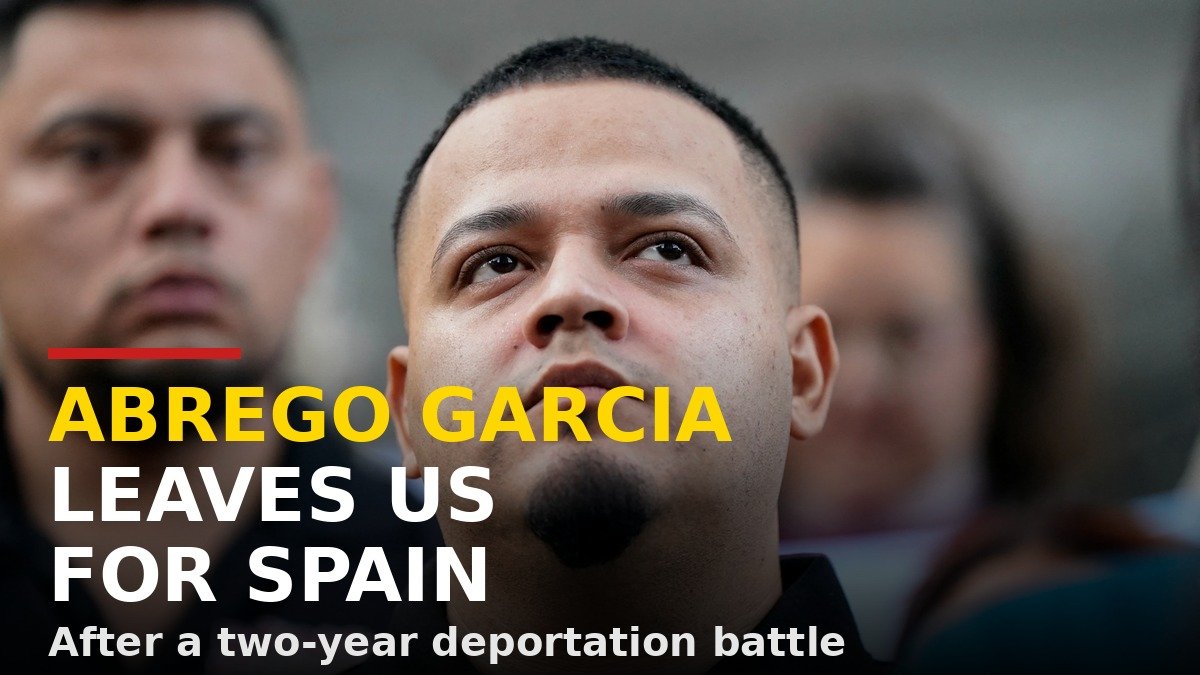
Kilmar Abrego Garcia leaves US for Spain on Tuesday, ending a deportation battle that stretched across nearly two years and turned the 31-year-old Maryland resident into one of the most recognisable faces of President Donald Trump’s immigration crackdown. Abrego Garcia boarded a commercial flight to Europe under a negotiated voluntary departure deal, according to his lawyers and US officials, and arrived in Madrid on Wednesday morning with his wife, who is an American citizen, and an attorney.
The departure closes — at least for now — a case that began with an admitted government error, ran through the Supreme Court, a Salvadoran mega-prison, criminal charges in Tennessee, and a last-minute fight over deportation to Africa. It ends not with a court ordering him out, but with Abrego Garcia choosing his own destination.
Abrego Garcia Leaves US for Spain — What Happened on Tuesday
According to Reuters, Abrego Garcia was set to fly to Europe on a commercial flight on Tuesday, with CBS News reporting the plan first and citing US officials familiar with the matter. The Washington Post reported that a negotiated agreement allowed the voluntary departure, while the New York Times, citing his lawyers, reported that Spain was the destination and that he ultimately planned to make his way to Mexico.
CNN reported on Wednesday that Abrego Garcia, his wife and an attorney had arrived in Madrid on a commercial flight that morning. His lawyer Chris Newman told CNN that Abrego Garcia had entered Spain on a tourist visa, allowing a stay of up to 90 days.
A federal judge told Abrego Garcia to self-deport on Tuesday, the Associated Press reported, citing a source familiar with the matter. The Department of Homeland Security said on Tuesday night that he had self-deported to Spain as part of a removal order, that he received no incentives, and that he would not be allowed back into the United States.
Homeland Security Secretary Markwayne Mullin welcomed the news on X, writing: “We are DELIGHTED to announce that Kilmar Abrego Garcia has self-deported from the United States to Spain.” In the same post he repeated the administration’s allegations that Abrego Garcia was a gang member and a human trafficker — accusations Abrego Garcia has repeatedly denied and which have not been proven in court.
A Case That Defined the Deportation Fight
Abrego Garcia, a Salvadoran national who had lived in Maryland for years with his wife and child — both US citizens — was arrested in 2025 and wrongfully deported to El Salvador in March of that year. The Trump administration later admitted the removal was an administrative error, but initially argued it could not bring him back after he was sent to the CECOT mega-prison.
The case became a national flashpoint. The Supreme Court ordered the government to “facilitate” his return, and Senator Chris Van Hollen of Maryland travelled to El Salvador to press for his release. Abrego Garcia was returned to the United States in June 2025, but instead of freedom he faced federal human smuggling charges in Tennessee, which he denies.
After his release from criminal custody, immigration officials moved to deport him again — this time to Uganda, and then to Liberia. His lawyers fought each destination in court, arguing that sending him to a country where he had no ties would put him at risk. The turning point came on 6 October 2026, when, five minutes before a hearing expected to decide whether Immigration and Customs Enforcement could detain and deport him to Liberia, attorneys for both sides left the courtroom with Abrego Garcia — the start of the negotiations that produced Tuesday’s voluntary departure.
For the administration, the case has always been about more than one man. Officials have presented Abrego Garcia as an example of the people they say should not be in the country. For his supporters and for immigrant advocates, he became the symbol of what they say is wrong with a mass deportation campaign: a man with a court order protecting him from removal to El Salvador, deported there anyway, and then kept in legal limbo for months after his return. Related reporting on the administration’s enforcement tactics: https://worldreachdaily.com/ice-seattle-airport-arrests-father-daughter/
What the Deal Means — and What Happens Next
The voluntary departure gives both sides something they can claim as a result. The administration gets Abrego Garcia out of the United States without another courtroom defeat, and Abrego Garcia avoids being sent in shackles to a country he did not choose. As his attorney Simon Sandoval-Moshenberg put it, he departed “on a commercial aircraft, to a country that he chose, and able to move freely around the world” — a sharp contrast with the deportation flight to El Salvador that started the saga.
His lawyers describe the move as temporary. Sandoval-Moshenberg said Abrego Garcia has “many options to return to the US”, and his wife and child, both American citizens, remain in Maryland. The Department of Homeland Security, however, says he will not be allowed back in, and his tourist visa in Spain lasts only 90 days. What happens after that — whether he stays in Europe, moves on to Mexico as his lawyers have suggested, or finds another legal route back to the United States — remains unclear.
Senator Van Hollen, who met Abrego Garcia during the fight for his release from CECOT, said he was “traveling to a country of his choice, a free man” — a framing his supporters have echoed as proof that the negotiated exit, not a forced removal, was the right end to the case.
Reaction From Both Sides
The two reactions capture how differently this case is seen. The administration celebrated the departure as a win for its deportation policy, with Secretary Mullin presenting it as proof that the system had worked. Abrego Garcia’s lawyers and supporters presented it as the least-bad ending to a case that should never have happened — a man who was wrongfully deported, brought back only after the highest court in the country intervened, and then forced to leave again to avoid being sent somewhere he had never lived.
The case also leaves unresolved questions for the courts. The criminal charges in Tennessee remain pending, and the legal arguments his team made about the limits of deportation to third countries are still being tested in other cases. Abrego Garcia’s departure may close his chapter, but the precedents set along the way will shape immigration fights for years. Source: https://www.reuters.com/world/americas/salvadoran-migrant-kilmar-abrego-garcia-leave-us-voluntarily-us-media-reports-2026-11-24/
For now, the man at the centre of one of the most closely watched immigration cases in recent American history is in Madrid — free to move, on a 90-day visa, with his family in Maryland and his future uncertain. Whether this is the end of the story or only a pause depends on what happens when that visa runs out, and on whether the legal doors his lawyers say remain open can ever bring him home.