
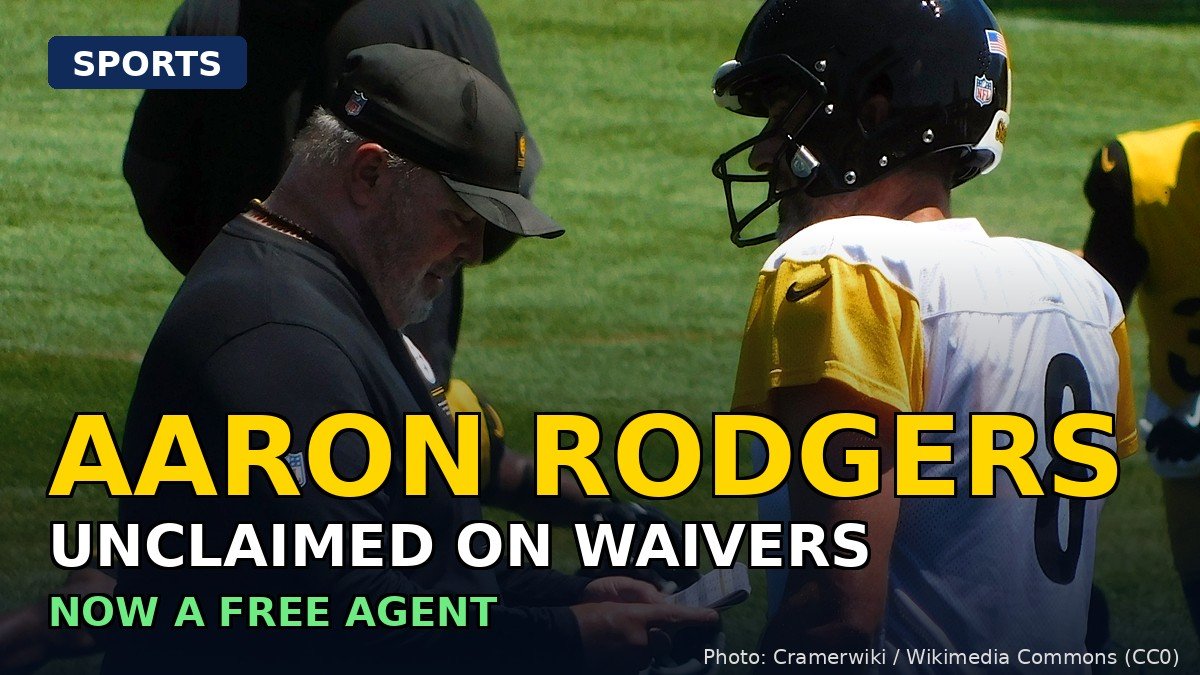
Aaron Rodgers unclaimed on waivers is now official: the four-time NFL MVP cleared waivers on Thursday, November 26, one day after the Pittsburgh Steelers released him, and is now a free agent — with no team willing to take on his contract or his baggage. It is a stunning fall for a quarterback who arrived in Pittsburgh as the answer and leaves it unemployed, unwanted by all 31 other teams, and facing the very real possibility that his career is over.
Rodgers was subjected to waivers because his release came after the November 10 trade deadline, which meant every other team in the league got a chance to claim him — and every one of them passed. For a player who has won four MVP awards and a Super Bowl, it is about as clear a verdict as the NFL can deliver.
Aaron Rodgers Unclaimed on Waivers: How It Unfolded
The end came fast. On Tuesday night, news broke that the Steelers would bench Rodgers for Friday’s game against the Denver Broncos, with Mason Rudolph taking over as the starter and Rodgers inactive for the contest. It was the first public sign that the relationship between the quarterback and the team had broken beyond repair.
The next day, Rodgers went on “The Pat McAfee Show” and detonated what was left of it. He alleged that head coach Mike McCarthy had fallen asleep during team meetings and missed others entirely. Then he told a story that has already become part of NFL lore: that McCarthy closed out a halftime speech during Sunday’s 19-16 loss to the Philadelphia Eagles by saying, “one, two, three, Packers.”
McCarthy did not deny it. In a news conference, the former Green Bay coach confirmed Rodgers’ account and called it an “embarrassing moment” — a remarkable admission from a head coach about his own quarterback’s public accusations.
The full story of the release — and the accusations that triggered it — is here: Steelers Release Aaron Rodgers After QB Accuses McCarthy of Sleeping in Meetings.
The Ultimatum That Ended It
According to McCarthy, things came to a head when Rodgers issued what the coach described as an “ultimatum” — one he considered “clearly outside of (Rodgers’) job description.” Rodgers revealed that he had told McCarthy to relinquish play-calling duties or release him.
Rodgers knew what he was doing. In making his explosive remarks, he acknowledged that his time with the Steelers was over, saying “that ship has sailed.” Shortly after, the team made his release official.
“I didn’t see this happening, and I didn’t want this to be the way that it ended,” Rodgers said on Wednesday — a line that sounds less like a man with a plan than a man who lit the fuse and then watched the building come down.
Why Nobody Claimed Him
The waiver wire does not lie. Thirty-one teams had the chance to add a four-time MVP for nothing more than his contract, and all thirty-one declined. The reasons are not hard to find.
Rodgers turns 43 on December 2. His passer rating this season sat at 86.6, his lowest since he became a starter. The Steelers started 6-2 and then lost 38-18 to Cincinnati and 19-16 to Philadelphia, and the quarterback’s play was part of the slide, not separate from it. And by the trade deadline, the overwhelming majority of teams had already settled their quarterback outlooks for the season.
Then there is the rest of it: the public war with his own head coach, the ultimatum, the willingness to air the locker room’s dirty laundry on national television. A team claiming Rodgers would not just be signing a quarterback. It would be signing the circus that now follows him everywhere — and in late November, with playoff races taking shape, nobody wanted the ticket.
What Happens Next
Rodgers is now a free agent and can sign with any team. But the market has already spoken once, loudly, and there is no obvious landing spot. A contender with a sudden injury at quarterback could change the picture overnight — that is how the NFL works — yet the same factors that kept all 31 teams from claiming him on waivers will still be there in any negotiation.
The more likely ending is the one Rodgers himself announced in the spring: that this season would be his last. He said in the spring that he planned to retire following the season, and the way it has ended — benched, released, unclaimed — may simply have brought the farewell forward by a few weeks.
Pittsburgh, for its part, has already moved on. The Steelers beat the Denver Broncos 27-5 on Friday behind Mason Rudolph, the quarterback Rodgers was benched for, and the team that could not wait to be rid of its star looked perfectly comfortable without him.
Rodgers is not the only veteran quarterback in the headlines this week — the NFLPA is demanding a full investigation into the Eagles’ handling of Jalen Hurts’ blood clots: Jalen Hurts Blood Clots: NFLPA Demands Full Investigation.
The End of an Era, However It Ends
Whatever comes next, the image of Rodgers’ final days in Pittsburgh will be hard to shake: a 42-year-old legend, a four-time MVP, telling the world his coach fell asleep in meetings and ended a halftime speech with a chant for the team he used to play for — and then discovering that no team in the league wanted him the day after.
If this is the end, it is not the ending anyone would have written for him. But it is the ending he chose, one interview at a time.
The story was first reported by USA Today. Read the full source report here: Aaron Rodgers goes unclaimed on waivers after explosive Steelers exit.