
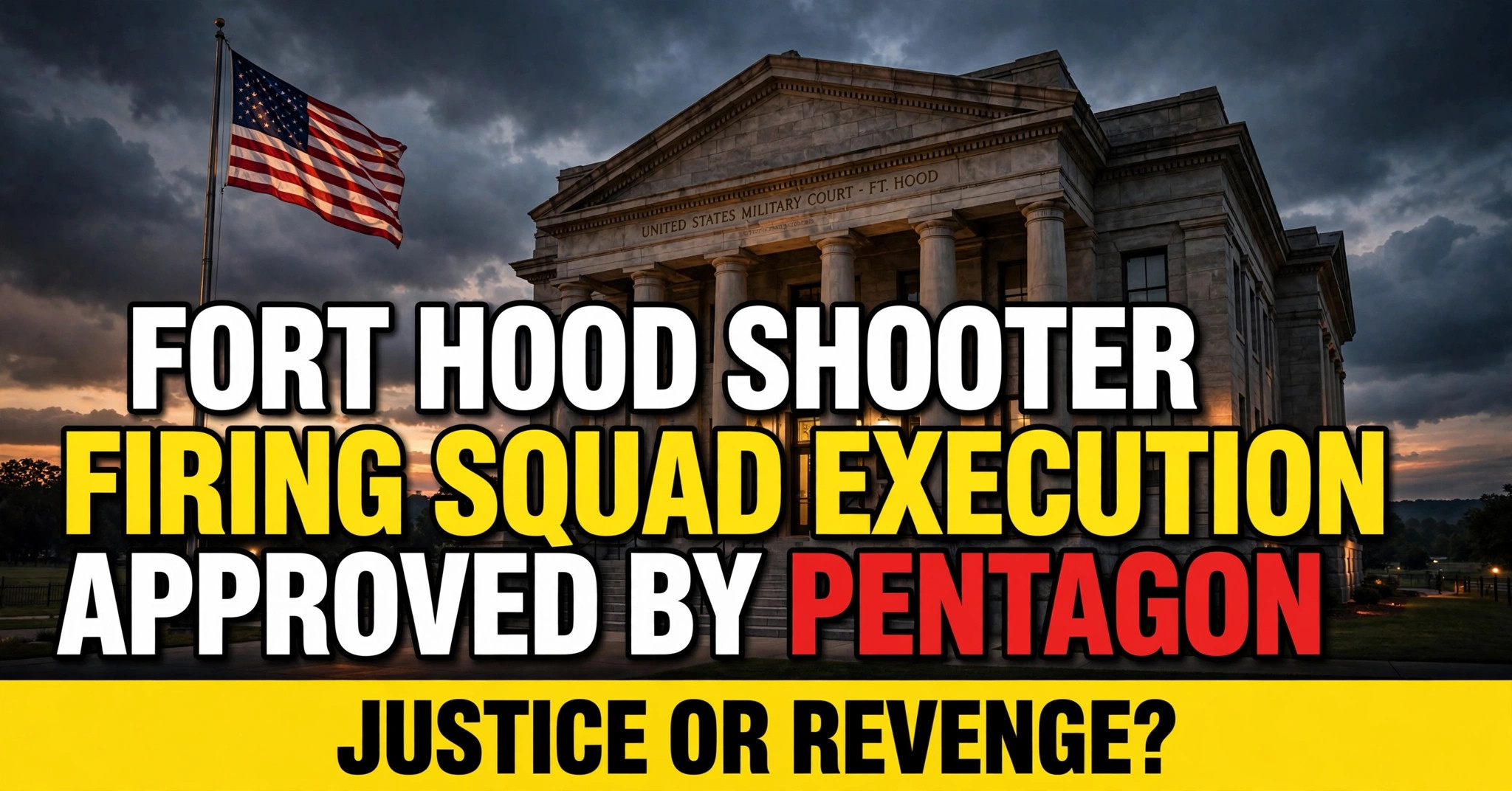
The Wait is Over: A Firing Squad for the Fort Hood Shooter
Fifteen years is a long time to wait for justice. For most of us, the 2009 Fort Hood shooting is a terrible memory from the past. But for the families who lost someone that day? It’s a nightmare they wake up to every single morning.
Now, the Pentagon has finally dropped a bombshell announcement that changes everything. Nidal Hasan, the former U.S. Army major who gunned down his own comrades, is going to face a firing squad.
Let that sink in for a second. A firing squad.
Also read:
US Withdraws Bombers From RAF Fairford: Security Threats & Impact
It’s not something you hear about every day. In fact, it feels like a punishment pulled straight out of a history book. But this decision isn’t random. It’s a massive, intentional shift in how the military handles its worst offenders. We need to unpack exactly why the Department of Defense is going this route, look back at the horrific events of that November afternoon, and figure out what this means for the survivors who have been stuck in limbo for a decade and a half.
A Normal Thursday Gone Wrong
If you want to grasp why the military is taking such a hardline approach, you have to remember what actually happened. November 5, 2009. It was just a regular Thursday in Killeen, Texas.
Fort Hood—which everyone now calls Fort Cavazos—was buzzing. Thousands of soldiers were stationed there, getting ready to ship out to Iraq and Afghanistan. Over at the Soldier Readiness Processing Center, the vibe was pure routine. Guys and girls in uniform were waiting in lines. They were getting their teeth checked, filling out medical forms, and doing all that tedious pre-deployment paperwork.
Nobody was carrying a weapon. Unless you’re military police, you don’t walk around a base back home with a loaded gun.
Then Nidal Hasan walked in. He was an Army Medical Corps psychiatrist. A guy whose literal job was to talk soldiers through their trauma. He was actually scheduled to deploy himself. But instead of grabbing his deployment files, he pulled out a semi-automatic FN Five-seven pistol he’d bought a few months earlier.
He yelled out, and then he just started pulling the trigger.
It was a slaughter. People couldn’t shoot back. They had to dive behind flimsy folding tables and medical screens. Some soldiers literally threw themselves on top of their friends to take the bullets.
It took civilian police officers Kim Munley and Mark Todd rushing into the building and exchanging heavy gunfire to finally drop him. Hasan took several bullets and ended up paralyzed from the waist down. But by the time he hit the floor, 13 innocent people were dead. One of them was a young woman who was pregnant. More than 30 other people were bleeding from gunshot wounds.
The Ultimate Betrayal
When the dust settled, investigators started digging. What they found was downright infuriating.
There was a whole trail of red flags that people just flat-out missed. During his medical residency at Walter Reed, people working alongside Hasan noticed he was saying some pretty extreme stuff. But nobody really did anything about it. Even worse? Intelligence agencies later figured out he had been trading emails with Anwar al-Awlaki. If you don’t know the name, he was a major radical cleric tied to Al-Qaeda.
Somehow, through a mix of bureaucratic blind spots and people not wanting to rock the boat, he slipped right through the cracks.
Believe it or not, some of the very first government reports actually called this “workplace violence.” You can guess how the victims’ families felt about that. It was a massive insult. They fought tooth and nail for years to get the military to call it what it was: an act of terrorism. They eventually won that battle, securing Purple Hearts for the victims and forcing the armed forces to completely rewrite the rulebook on base security.
The Trial Nobody Wanted to Sit Through
If you think civilian trials take forever, military courts are on a whole different level. The Uniform Code of Military Justice (UCMJ) is incredibly strict, especially when the death penalty is on the table.
When the court-martial finally kicked off in 2013, things got weird fast. Hasan actually decided to act as his own lawyer. A lot of folks thought he was going to turn the courtroom into a circus to preach his radical views. But the military judge shut that down immediately.
Because he was representing himself, the trial was agonizingly one-sided. He didn’t call any witnesses. He barely asked the survivors any questions when they got on the stand. He just sat there in his wheelchair while the people he shot looked him right in the eye and told the jury how he ruined their lives.
It didn’t take long for the jury to make a call. Late August 2013, they found him guilty on 13 counts of premeditated murder. The sentence? Death. Since then, he’s been sitting in a cell at Fort Leavenworth, Kansas, burning through all the automatic appeals the military gives you.
Why Bring Back the Firing Squad?
Okay, let’s talk about the firing squad. Why go there? We are so used to hearing about lethal injection in the U.S. that anything else sounds shocking.
Here’s the reality: lethal injection is a logistical mess right now. States and the federal government can’t get their hands on the drugs. Pharmaceutical companies refuse to sell them for executions. It leads to endless lawsuits and botched procedures.
The military looked at that mess and decided to take a different path. Under military law, the President and the Secretary of Defense can authorize a different method if they need to. And historically speaking, the firing squad is how the military deals with its absolute worst. We’re talking treason, mutiny, or turning your weapon on your own squad.
For a lot of military folks, what Hasan did is the textbook definition of those crimes. He broke his oath in the worst way possible. Plus, a firing squad doesn’t rely on back-alley drug deals with pharmacies. It’s handled by highly trained marksmen. It’s fast, it’s certain, and it bypasses the civilian legal drama entirely.
Closure for the Families
At the end of the day, this story isn’t just about military law. It’s about the families.
For 15 years, they’ve been stuck. They’ve gone through countless surgeries, therapy sessions, and painful anniversaries. And all the while, the guy who did it has been eating three square meals a day on the taxpayer’s dime.
Hearing that the Pentagon is moving forward with a firing squad brings up a lot of heavy stuff. It forces them to relive the worst day of their lives. But it also means the waiting is almost over. It shows that the military hasn’t forgotten the blood that was spilled in that processing center.
The U.S. military hasn’t executed anybody since 1961. When the final sign-off comes—and it has to come from the President’s desk—it’s going to be a massive moment in history.
Wrapping It Up
The Pentagon pulling the trigger on a firing squad for Nidal Hasan is a huge deal. It’s a stark reminder of a day that fundamentally changed how the American military operates on its own soil. While pulling a trigger won’t magically heal the survivors or bring back the 13 people who died, it closes a loophole. It proves that the military justice system, no matter how incredibly slow it might be, eventually catches up with you. Now, all eyes are on the final legal steps as a wounded community finally gets ready to close the book on this tragedy.
Frequently Asked Questions (FAQs)
What year did the Fort Hood shooting happen?
It all went down on the afternoon of November 5, 2009.
How many people lost their lives?
Thirteen people were killed, including a soldier who was pregnant. Over 30 others were badly wounded.
Why aren’t they using lethal injection?
It’s nearly impossible to get lethal injection drugs right now because pharmaceutical companies won’t sell them. A firing squad skips that whole headache and fits the historical military punishment for treason.
Where is Nidal Hasan right now?
He’s locked up on military death row at the United States Disciplinary Barracks. That’s over at Fort Leavenworth in Kansas.
Does the military execute people often?
Not at all. The last time the U.S. military actually executed someone was way back in 1961.
Trusted Sources & Official Links
If you want to track the official updates on this case or read up on military law, skip the rumors and check out these official portals:
Department of Defense Official Releases: defense.gov/News/Releases/
Military Justice Breakdown: justice.gov
Official Army News: army.mil/news
Defense & Veterans Updates: military.com
1 thought on “Fort Hood shooter firing squad execution Approved by Pentagon”